Cryptoparty @ ThoughtWorks

Cryptoparty: Possible Topics

  • mobile security
  • encrypt emails with PGP
  • encrypt your IMs with XMPP and OTR
  • anonymous surfing Tor
  • privacy enhancing browser plugins
  • file and hard-drive encryption with TrueCrypt hard-drive encryption with LUKS
  • password security and managers
  • Linux installation
  • Tails (safe and anonymous operating system… please bring a thumb drive if interested)
  • Pond (encrypted Tor based messaging system without meta data and spam)

Also worth a look: index of the handbook
Useful for non-journalists as well: Information Security for Journalists

Timetable

  • 7 p.m.: short intro and welcome speech, possibly followed by short lectures
  • 8 p.m. (at the latest) we’ll start the laptops, learn about the topics your interested in and install/configure the related software

Rules

  • Taking photos or filming will not be allowed. Please leave the cameras in your pockets.
  • Smoking is possible in the yard.

Contact

Please send questions to the Berlin mailinglist. Or through cryptoparty@enteig.net

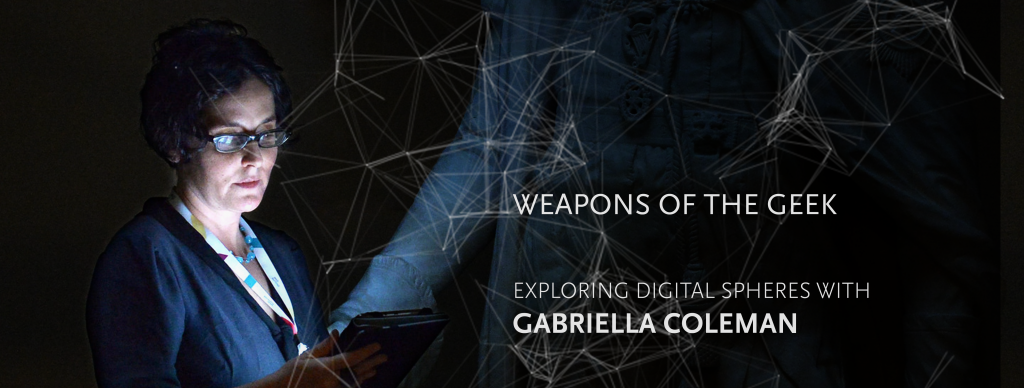
Weapons of the geek

Exploring digital spheres with Gabriella Coleman.

banner_coleman-1024x388
CC BY 2.0: Zak Milofsky on flickr

Gabriella Coleman is on of the most (if not the most) prominent anthropologist in the field of hacking culture and digital activism. During the last years, she became known as «the world’s foremost scholar on Anonymous». Her research intensively accompanied Anonymous through the developments of the last years, gaining deep insights on «what began as a network of trolls [and] has become a wellspring of online insurgency», as her new book Hacker, Hoaxer, Whistleblower, Spy: The Many Faces of Anonymous states. It recently has been named to Kirkus Reviews’Best Books of 2014.

En Necromasse: an optimistic, fungal perspective on death and production

Our friend Debra Solomon opened her show “En necromass: an optimistic, fungal perspective on death and production”

Debra’s practice has involved exploring the role of fungi as transformers of organic materials and as soil builders. Her residency placed particular emphasis on the soil rhizosphere; where plant roots, microbiota and soil fungi interact. During her residency she closely observed soil building in the diverse living locations of the gardens and woods at Schumacher and within the Dartington Estate. She was also able to engage with horticultural experts, including the Head Gardener at Schumacher (Jane Gleason), the Head Gardener at Dartington (Ian Gilbert) and the Forest Garden expert Martin Crawford, in a conversation about the value of soil compared to mainstream agricultural practice.

From this experience she developed a series of screen-prints, presented here, about soil from the perspective of fungi called En necromass: an optimistic, fungal perspective on death and production. The works reference the vast communication and exchange that takes place in around the root zone. Here there is the most life and nutrient production as well as the death and decay of organic matter, as nutritious necromass transforms into soil. The rootball of a recently storm-felled tree, mycelium feeding on a dead leaf, a leaf’s skeleton, and spore prints that appear as ghosts, tell a myco-centric story of materials becoming soil.  The silkscreen prints were produced with the well-known Amsterdam printmaker, Kees Maas.

Sealed with a Bit

Sealed with a Bit @ r15

Short thesis:
Random Darknet Shopping Bots, Mail Art and Surveillance Algorithms: Mediengruppe Bitnik on their latest works, Art and Technology

Description:
!Mediengruppe Bitnik are contemporary artists based in Zurich. In their talk they will give some insights into their latest works around bots. They will retrace their recent explorations into the Darknets – from Memes to Onionland – and talk about anonymity as anti-identity and applying loss of control to challenge established structures and mechanisms.

!Mediengruppe Bitnik has been known for sending a bot called «Random Darknet Shopper» on a three-month shopping spree in the Darknets where it randomly bought items like Ecstasy and had them sent directly to the exhibition space.

In early 2013 they sent a parcel to WikiLeaks founder Julian Assange at the Ecuadorian embassy. The parcel contained a camera which broadcast its journey through the postal system live on the internet. They describe «Delivery for Mr. Assange» as a SYSTEM_TEST and a Live Mail Art Piece.

Bots: Tracking Systems of Control

At Disruption Network Lab / Bots: Tracking Systems of Control !Mediengruppe Bitnik talks about Tracking Systems of Control


Disruption Network Lab is an ongoing platform of events and research focused on art, hacktivism and disruption. The Laboratory takes shape through a series of conference events at Studio 1, Kunstquartier Bethanien in Berlin. The goal is to present and generate new possible routes of social and political action within the framework of hacktivism, digital culture and information technology, focusing on the disruptive potential of artistic practices. The Disruption Network Lab is a conceptual and practical zone where artists, hackers, networkers, activists, whistle-blowers and critical thinkers enter into a dialogue.

after.video @ Besides the Screen

… this was the abstract for the ‘show & tell’
… which we adapted and updated a little with the actual presentation:

» Show & Tell: the ‘S.o.S’ piratebox & beyondthis ‘show & tell’, held together with Adnan Hadzi, presents the reflections of the journey of the ‘S.o.S’ piratebox, a research hosted and interlinked with work-and-research structures of the Brazil Besides the Screen conference, the Istanbul Video Vortex event, the reSync Athens workshop, and finally the Berlin Transmediale festival.
Materials were loaded onto a research-black-box (Pirate-Box) that could & can accumulate and ‘commonize’ critical material, travel and be presented at any place in any time.in particular we would like to discuss our ideas on new modes of collective and spectral research.
… and possibly give an outlook of the upcoming ‘after.video’ project that evolved partly out of this – basing theory exposition on video as carrying format.—in my part I show some attempts to develop formats of credible ‘theory’-production beyond the text-form – and show some collective and media-saturated examples, also arguing for blurry lines between ‘academic’ theory building and other forms when it comes to contemporary cultural and social phenomena – or media culture itself.I also touch upon the impact a social semiotics approach has to formats of theory (theoretical referencing) itself, and touch upon questions of ‘cultural referencing’ – and its inherent difficulties in times of new global copyright regimes that particularly enclose the ‘moving image’.while complex systems of para-textual reference, exposition and theory-building are getting more and more abundant (making it possible to turn events like a conference into a hyper-text), the options to extend cultural references to the most central cultural ‘para-texts’ and semiotic resources is getting more and more problematic.
… thus the current phenomena in research, theory building and other forms of systematic ‘cultural referencing’ are showing us, how every new medial formation – and indeed: every new research formation – implies new forms of ‘piracy’ in its entourage. «

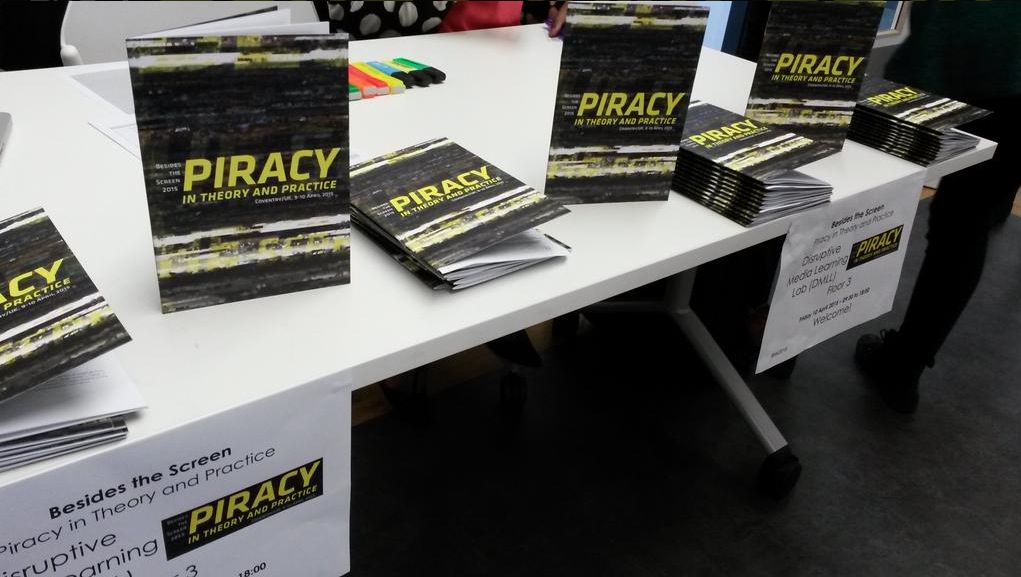
Departing from the relation of movie piracy with the economy and politics of content distribution, the symposium means to discuss the dynamics of authority embedded in contemporary systems of communication and explore how informal media practices might intervene with the development of new technologies, frame film curating, foster or inhibit particular scholarships, and even raise questions about the ontology of the moving image. BTS 2015 announcement

:: Besides the Screen
» seeks to make an intervention into film and screen studies by examining and considering the elements of cinematic experience, production and dissemination that exist beside the screen. New media technologies impact cinema well beyond the screen; they also promote the reorganization of its logic of distribution, modes of consumption and viewing regimes. This publication speculates about the changes in modes of accessing, distributing, storing and promoting moving images and how they might affect cinematographic experience, economy and historiography. In doing so, Besides the Screen examines three key themes: distribution, promotion and curation. The volume’s main argument is that we must examine those practices that exist besides the screen if we are to consider fully how filmic experience is mediated by various technological and societal changes in the early decades of the twenty-first century «

Programme

Thursday 9th April 2015 12.00 – 17.00 – DMLL Grass – Workshop [invited participants online]
17.00 – 19.30: Besides the Screen Book Launch

Friday 10th April 2015 DMLL Teaching Room

10.00 – 10.30: Welcome and Intro to Besides the Screen Network – Virginia Crisp

10.30 – 12.00: Panel 1
_ The Pirate Cinema – Nicolas Maigret The Pirate Cinema
_ Read Me – Maria Roszkowska
_ Tropa(s) de Elite: of the Forms Created within Informal Media – Gabriel Menotti

12.15 – 13.45: Panel 2

_ Torrentocracy: Archival Chivalry and Piratical Honourability – Jonas Andersson Schwarz
_ Show and Tell: the ‘S.o.S’ Piratebox and Beyond – Adnan Hadzi and Oliver Lerone Schultz
_ Gambiarra Culture in Brazil and its Impact on Piracy – h.d. Mabuse

14:30 – 16.00: Panel 3

_ Piracy and Access to Educational Materials in Rio de Janeiro: Shadow Libraries and Beyond – Pedro Mizukami
_ Reimagining Film History Through Piracy: Reflections on the Case of Budget Films, 1975 – Paul McDonald
_ Pirate Capitalism: The Theory and Practice of Monstrosity – Gary Hall

16.15 – 17.45: Plenary Lecture
_ Piracy and Economic Plurality Ramon Lobato

17.45 – 18.00 Closing remarks – Virginia Crisp


Adnan Hadzi – Spectrals of the Spectacular from Besides the Screen on Vimeo.

Show and Tell: the ‘S.o.S’ Piratebox and Beyond

Oliver and Adnan presented the ‘S.o.S’ Piratebox and beyond @ the Besides the Screen conference Piracy.

Show & Tell: the ‘S.o.S’ piratebox & beyond” presents the reflections of the journey of the ‘S.o.S’ piratebox, a research hosted and interlinked with work-and-research structures of the Brazil Besides the Screen conference, the Istanbul Video Vortex event, the reSync Athens workshop, and finally the Berlin Transmediale festival. Materials were loaded onto a research-black-box (Pirate-Box) that could & can accumulate and ‘commonize’ critical material, travel and be presented at any place in any time.

In perspective we aimed at two ways to make these ‘pre-syncs’ valuable for future common use:
1: restreet, AWMN and local knowledge commons production: we were collectively thinking about ways to network and share the material in ways useful to pre-existing local structures
2: The ‘Glossary of Subsumption : collective edition’ will be a longer-term project creating critical collective characterizations of new forms of ‘integrative power’ and ‘value extraction’ in the post-media age.

Oliver Lerone Schultz and Adnan Hadzi from Besides the Screen on Vimeo.

Our friend Jonas Andersson Schwarz presented a paper on Torrentocracy: Archival chivalry and piratical honourability:

Using my own empirical research on file sharing communities and everyday file sharer justification, I explore a range of sociological observations, reflecting the human tendency to form social clusters and draw up normative boundaries. Taking the phenomenon of private BitTorrent trackers and their auxiliary online communities into consideration, I explore how boundaries of membership, status, taste, and individual norm are policed.

There is more to file sharing than The Pirate Bay. Private tracker communities are covert archives that often excel in quality and depth, yet—due to their clandestine nature, enforced due to the rigidity of presently surrounding copyright regimes—they remain far from utopian, far from public even, since far from everyone would have the social capital and technical skill to access them.

In my presentation, I will delve on issues of charismatic authority, the formation of sociotechnical fields, and the emergence of de facto hierarchical structures in an allegedly heterarchical environment. One of my key arguments is the necessity to treat file sharer motivation with appropriate levels of critical concern; here, the academic field of critical media studies should serve as a guiding light. If media consumers are increasingly becoming (co)producers and (co)distributors as well, these latter roles entail a power dimension; the power to influence, and the power to build and maintain infrastructure. At what point does these forms of power become significant enough to be worthy of adequate critical investment among sociologists of digital life?

Jonas Schwarz from Besides the Screen on Vimeo.
The Yes Men are revolting @ Human Rights Filmfestival

Our friends the Yes Men opened with ‘The Yes Men are revolting‘ the Human Rights Watch film festival in London.

For the last 20 years, notorious activists the Yes Men have staged outrageous and hilarious hoaxes to draw international attention to corporate crimes against humanity and the environment. Armed with nothing but quick wits and thrift-store suits, these iconoclastic revolutionaries lie their way into business events and government functions to expose the dangers of letting greed run our world. In their third cinematic outing (after The Yes Men and The Yes Men Fix The World), they are now well into their 40s, and their mid-life crises are threatening to drive them out of activism forever—even as they prepare to take on the biggest challenge they’ve ever faced: climate change.
Opens theatrically at IFC Center following the festival screening.

Off Networks @ FLOSS4P2P

James, Jaromil and Adnan joined a 2-day London FLOSSP2P workshop, gathering FLOSS projects that are building software for peer production and organization, with a focus on distributed platforms. *Scholarships* to attend are offered to grassroots communities. We met with participants of the Off Networks mailinglist.

** Context ** see p2pfoundation blog:

We know that the Internet was originally decentralized, with protocols and services built by hackers. However, with the arrival of the celebrated Web 2.0, centralization and corporations proprietary platforms seem to have taken over. Moreover, this centralized structure is used by governments to increase surveillance (following Snowden’s revelations), to blackout internet whenever it is needed (e.g. Egypt, Syria, or San Francisco’s BART) or to choke annoying activist organizations (such as Wikileaks).

On the other hand, in the last few years we have seen the emergence of Internet-enabled collaborative communities building shared libre/open resources. Commons-based Peer to Peer Production (CBPP) is rapidly growing: not just for software and encyclopedias, but also for information (OpenStreetMap, Wikihow), hardware (FabLabs, Open Source Ecology), accommodation (Couchsurfing) and currency (Bitcoin, Altcoins).

In the last few years, it has become clear to many that it is not enough to develop free/libre/open source (FLOSS) alternatives, but we also need to re-decentralize the Internet. Many initiatives are being undertaken under this premise (e.g. Ethereum, Diaspora, OwnCloud, MediaGoblin, Sandstorm). These new software tools may also be useful to boost CBPP communities further. In this workshop, we will gather those working around the decentralized FLOSS that could help CBPP/P2P communities. Hackers, academics, activists and interested stakeholders are welcome.

D-Cent & Snowden @ FutureFest

Today our friend Jaromil chaired a panel discussion on “Blockchain: How Encryption Will Shape The Economics and Politics of the future” @ FutureFest.
Denis “Jaromil” Roio (chair), Brett Scott, Jorge Timón, Stacy Herbert

FutureFest is a multi format event which gives visitors ample opportunity to take self-guided journeys. This year’s speakers include the visionary musician George Clinton, NSA whistle-blower Edward Snowden, fashion designer and activist Vivienne Westwood, and journalist/best-selling author Jon Ronson, among others.

D-CENT hosts two panels:

  • Networks, Movements and Parties: D-Cent and the challenges of net-era politics
    Francesca Bria (chair), Birgitta Jonsdottir, Davide Barillari, Fabrizio Sestini, Miguel Arana Catania
  • Blockchain: How Encryption Will Shape The Economics and Politics of the future
    Denis “Jaromil” Roio (chair), Brett Scott, Jorge Timón, Stacy Herber

Vivienne Westwood at FutureFest 2015: End Vulture Capitalism from Nesta UK on Vimeo.

Edward Snowden at FutureFest: full interview from Nesta UK on Vimeo.

Worth mentioning is Vivienne Westwood’s engagement in the protest against TTIP in the campaign Artists against TTIP.

What is Artists Against TTIP?

Artists Against TTIP is a growing group of performers, musicians, designers, visual artists, directors and thinkers who have come together to raise awareness of the threats posed by TTIP.

BUT WHAT IS TTIP?

The Transatlantic Trade and Investment Partnership (TTIP, pronounced tee-tip) is a comprehensive free trade and investment treaty currently being negotiated – largely in secret – between the European Union and the USA.

The scope of the negotiations is very broad. The stated goal is to reduce “barriers to trade” between the EU and US. In practice TTIP would lead to a huge transfer of power from democratically elected governments to large corporations. The implications for public health, the environment, public service provision, financial regulation, labour standards and social protections are profound. On top of this, research produced for the European Commission estimates that TTIP will lead to the loss of 1 million jobs.