
D.TV

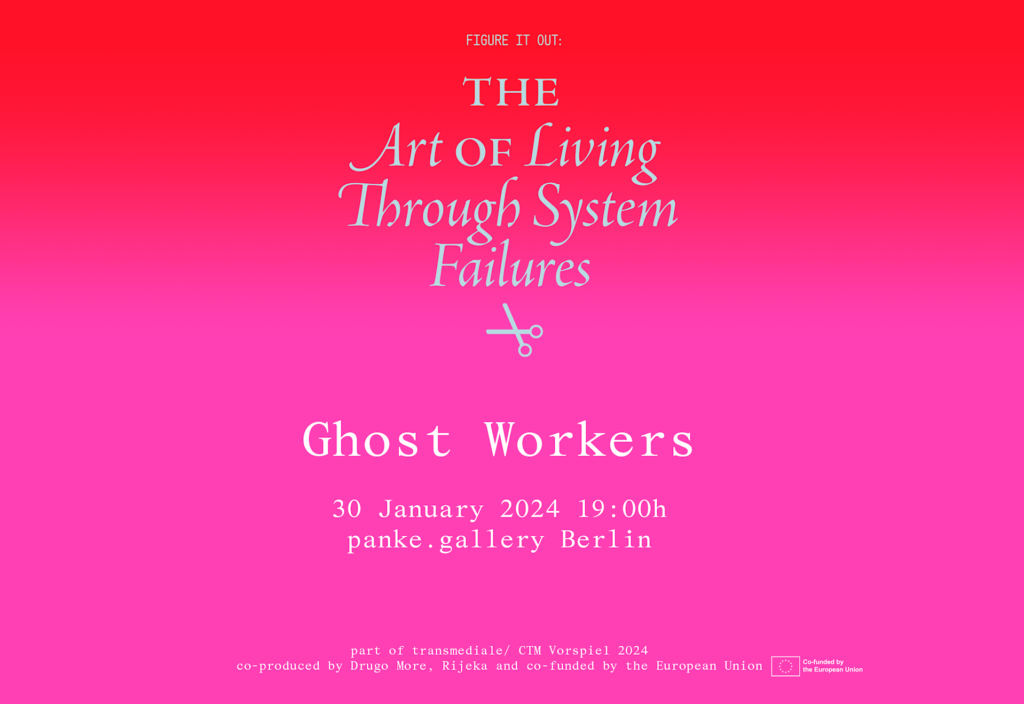
Ghost workers

“Snađi se, druže!” – “figure it out, comrade” – is a common phrase
used in former Yugoslavia. It originated during the WWII indicating that
partisans in action had to come up with solutions under extremely
unfavourable conditions. The question, when given instructions for an
impossible mission, would often be “but how do I do that?”, and the
answer would often be “figure it out, comrade”. Later during the
socialist period, this expression would be used for practices that
people were devising when encountering bureaucratic or material
constraints in everyday life. All periods and societies have such
practices of common lying, cheating and stealing and common phrases to
name them.FIO is a collective exploration of stories of ingenuity that people
with little or no power devise when systems fail them. The evening at
panke.gallery is focused on the inginuity of workers in the global gig
factory. Particularly on tactics the workers on platforms such as
Microwork, Amazon Turk or Upwork based in the Eastern Europe and the
Global South contrive to fake their location or presence to cirumvent
scant pay, surveillance and control that is frequently not expected from
the gig workers in the Western Europe and the Global North.The upcoming event features a talk by Aleksandra Lakić, introducing
her and Saša Savanović’s research on the socio-economic situation and
labor conditions in platform economy in South Eastern Europe. The talk
will also assess the impact of algorithmic management and surveillance
as factors contributing to declining quality of work on digital labour
platforms. A second presentation will be held by the researcher Max
Haiven, who has recently collaborated with rank-and-file Amazon workers
to write and publish short, speculative fiction stories about ‘the world
after Amazon.’The bonfire is an invitation to participate in a collective reading
of stories of such practices we have gathered and to contribute your own
first-hand or second-hand stories and thoughts. We intend the reading
to be convivial, spilling over into a shared meal.Event produced by Drugo More in collaboration with !Mediengruppe Bitnik.

Figure It Out – The Art of Living Through System Failure

Figure It Out The Art of Living Through System Failure is collaborative project that has been granted support under the Creative Europe program, sub-program Culture, of the European Education and Culture Executive Agency. Collaborators are Drugo More (HR) (Project Lead), Kiosk (RS), La Labomedia Association (FR), Vektor (EL) and Unfinished Art Space (MT). The project explores a range of practices that enable disenfranchised groups to overcome barriers established by administrative, institutional, and algorithmic regimes.

The project’s Closing Symposium will be held at the Malta Society of Arts,  Valletta, Malta between 18 – 20 September 2024, alongside an exhibition.

We are happy to announce the call for presentations for the upcoming symposium titled “Figure it Out: The Art of Living Through System Failures”. This multidisciplinary gathering welcomes proposals from the fields of humanities, social sciences and artistic practice. Alongside academic papers and panel discussions, we welcome non-traditional and experimental formats.

Programme curated by: Margerita Pulè and Adnan Hadziselimovic

Gendered, racialized, bordered and exploited, marginalised, underserved, discriminated and vulnerable communities are often forced to develop tools and strategies that are considered unacceptable to the institutions of the system; thus developing practices and phenomena of coping, tinkering, making-do and circumventing exclusions. Sometimes these tools and strategies are forged out of necessity, of survival, sometimes to exercise rights or to secure access to basic services available only to ‘deserving’ citizens. Such tools and strategies are always aimed at a certain system (state, welfare institutions, corporations, workplace, credit, housing, utilities etc.) that has its own rules and conditions of access that these communities or individuals cannot meet, producing and reproducing systemic exclusion.

Finding ‘holes in the system’ and developing strategies to take advantage of system weaknesses, people use their ingenuity to avoid detrimental effects on their lives and lives of their communities.

Moreover, such practices have now expanded into the digital sphere, where they are facing new kinds of power structures and also getting recombined in interesting ways. As dataveillance, algorithmic governance and digital profiling seep into mechanisms of exclusion and dispossession, from border controls to public transport, education, health and housing, new workarounds, tinkering and hacking emerges. As they do with the growing impacts of climate change, forcing underserved communities across the globe to be resourceful and devise their own forms of adaptation.

We are particularly seeking contributions that critically examine the ethical dimensions of practices deemed illicit and illegal in mainstream contexts, considering their political implications and necessity in the face of exclusion. We encourage analyses of practices of ingenuity, of figuring it out, that people devise facing systemic exclusions perpetuated by state, corporate, or social institutions. Topics might include, but are not limited to;

System Failures and Social Exclusion: Exploration of strategies used by disenfranchised groups to navigate and subvert constraints imposed by administrative and algorithmic regimes;

Innovative Practices of Resistance: Discussions on frugal innovation and counter-innovation as responses to the rise of neo-fascisms and the rise of emergencies connected to ecological collapse;

Ambivalent Figures of Resilient Subjectivation: Critical analysis of many figures that figure it out practitioners are typically stigmatised as: “welfare queens”, scroungers, cheaters, free riders, scamleteers, tricksters… ;

Ethics of Research with Marginalized Constituencies:  Critical and reflexive methodologies for research practices into illegal and unlawful, particularly the concept of ‘ethnographic refusal’;

Cultural and Historical Perspectives of ‘Figuring It Out’: Historical and cross-cultural comparisons of ‘figuring it out’ practices, stories and characterizations, as presented in artistic praxis, as well as folk and popular cultures.

Submission Guidelines:

Please submit a short bio and abstract using the form here.

Time-line
Call opens: January 15 2024
Submission deadline: 28 February 2024
Response date: by 30 April 2024
Symposium program announcement: by 30 July 2024
Registration deadline: 31 August 2024
Exhibition opening: 18 September 2024
Symposium dates: 19 & 20 September 2024

BeeBuzz.farm design ecologies

BeeBuzz.farm

The BeeBuzz.Farm, launching this year, is an exciting project focused on organic bee farming and ecological sustainability. Situated in Gozo, Malta, this family-owned business emphasizes the production of natural honey, with bees freely roaming and feeding on nectar. Not just a farm, BeeBuzz.Farm is an educational hub, offering insights into organic farming, beekeeping, and the crucial role of bees in our ecosystem.
The project, serving as an Erasmus+ Green Educational Media case study, aims for organic certification. Its mission extends beyond honey production to educating the public about the significance of bees in agriculture and biodiversity. Bees are vital for pollinating a vast array of crops, contributing immensely to global food security and ecological balance. The BeeBuzz.Farm initiative is more than just a business; it’s a commitment to protecting bee populations, ensuring environmental health, and fostering a sustainable future.