DATAFIELD2

Henry Warwick DATAFIELD2
A Temporary Autonomous Field Off the Internet

DATAFIELD is an ongoing artwork based in common computer technology operating as a Temporary Autonomous Field off the Internet. While DATAFIELD(1) was based on a mounted WIFI router, DATAFIELD2 and DATAFIELD3 – hosted at the foyer of transmediale 2015 – are units that can be moved and can be hidden.

DATAFIELD2 is a Network Attached Storage Unit that takes the theme of common ordinary household information appliances to the next level. Its low cost consumer unit is a significant part of the aesthetic and political choices surrounding the project – anyone can buy one of these devices, fill it with data and leave it in a public place. It is easy to programme and to access files, a common browser can be used. DATAFIELD2 of course has some limitations, in terms of bandwidth but at the same time it offers some freedoms. As it is battery-operated, it has the advantage that it can be moved constantly; it is nearly impossible to find or stop. DATAFIELD was and is *not* connected to the Internet – this is a strictly offline operation, a voluntary *post-Internet community*.

DATAFIELD
Henry Warwick (School of Media, Ryerson University)

DATAFIELD is a work in technology. It is similar to the PirateBox concept by David Darts, but differs in important ways, as this is not a box of piracy. This is a field of sharing. This installation, as an electromagnetic field, operates as a field of possibilities. It invites, indeed, requires participation to exist – otherwise, it’s just another electromagnetic field. To participate, the user must have a device that can access a WIFI router and mount a drive. How to locate the open WIFI connection DATAFIELD and access to the DATAFIELD drive will be provided with explicit instructions in the Conference space. If for some reason the WIFI stops working, Ethernet cables will be provided, as DATAFIELD is *not* connected to the internet. Within DATAFIELD, you can share files with others. The more people share, the more they gain from involving themselves with this piece and with others. While DATAFIELD responds to enthusiasm, as greater involvement creates a richer dataset, the WIFI router has a limit of ten users at a time. Operating as a Temporary Autonomous Field, this window will only be open the duration of this exhibit. Again, the DATAFIELD router has *no* access to the internet — this is a strictly offline operation, a voluntary *post-internet community*. This is for you, here, now. Remember, sharing is caring.
reSync All

During Transmediale 2015, reSync will promote collaborative synchronisation services and introduce a growing P2P exchange network of free media resources, synchronised between those in London [own], Athens [awmn] and Berlin [freifunk], that sidestep the rising sense of network surveillance and preserve privacy whilst continuing to enjoy free media exchange in public and over free information infrastructures wherever they flourish.

IMG_20141107_152203lunatic03Join us in the lobby area of Haus der Kulturen der Welt on Friday 30th January to make sync code badges and configure your media files, messages and phone things to reSync @ Capture All.

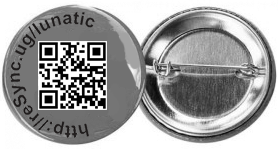
reSync-badgepressPick up a flyer sheet and claim a reSync ‘key’, print posters and press your own badges. Each badge features the unique QRcode to promote media from your smart phones, tablets and pc’s using Bit Torrent Sync app. Anyone then scanning the code or exchanging the key will be able to receive new images texts and sounds as you add them during Transmediale and therafter.
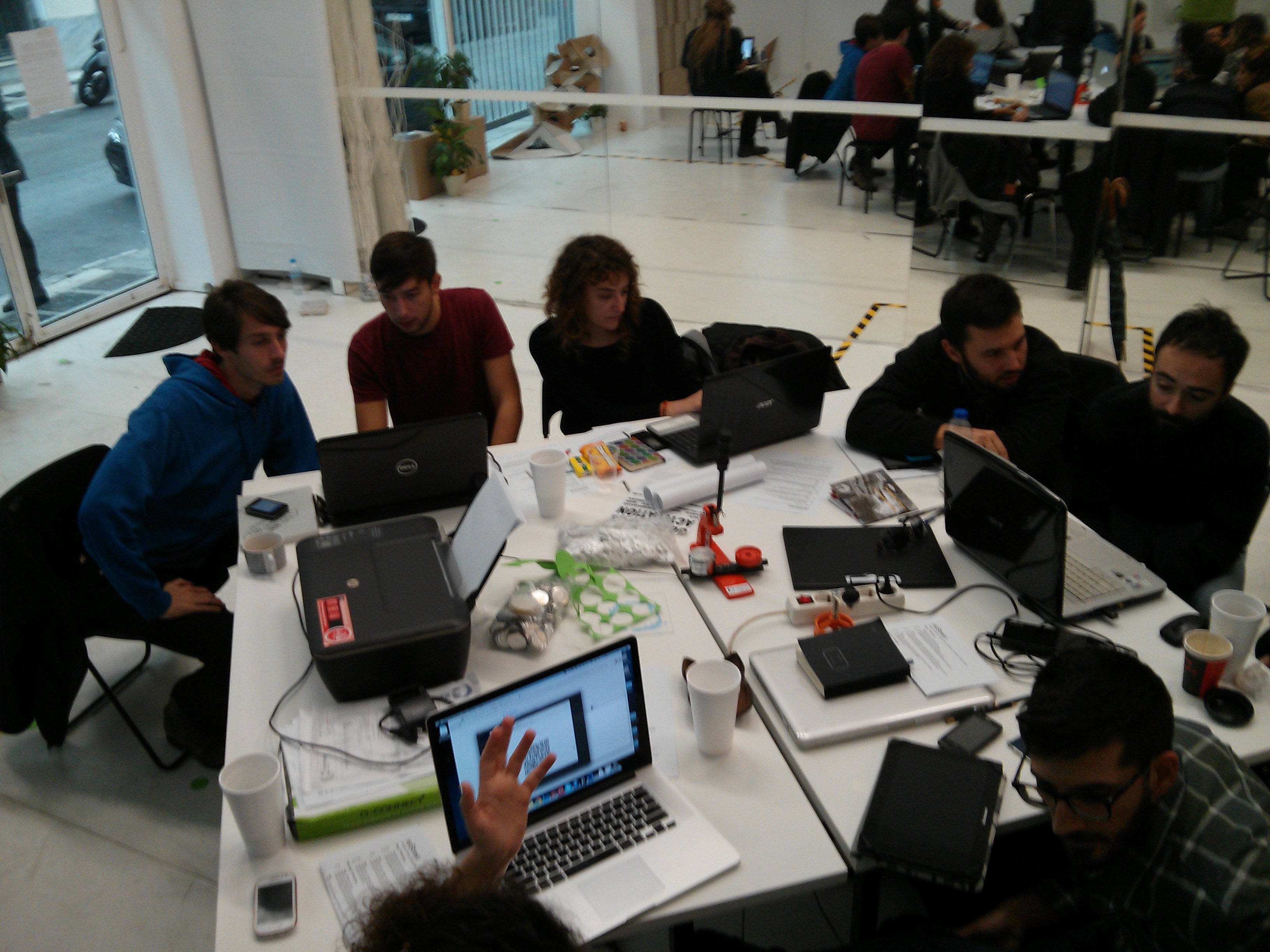
 

See the howto for more details.

Each reSync is then automatically relayed across our international network nodes using Syncthing (floss) then available on open wireless networks in Athens, London, Lueneburg and Berlin (so far!)

see this reSync All video for some instructions on the process…(ish)

This follows on from ‘reStreet’ workshops in Athens 2014 and will run parallel to the “Enclosed Athens Disclosed”/”Glossary  of Subsumption – Projecting a Collective Collation” sessions.

It is no secret that ‘pirate’ sites are amongst the most popular in the world. There are already huge numbers (hundred of millions) of P2P users, and the number continues to grow despite technical and legislative attempts to slow or censor P2P technologies. Media industries are quite unwilling to accept the inevitability of filesharing as a significant, if not the most significant, global media distribution system. The continued belief that intellectual property protection, Digital Rights Management, regulation of ISPs etc. will solve the ‘filesharing problem’ prevents tinkering in this area is being overturned.

Many thanks Rob Canning for the Imagemagic qrcode compositing!

reStreet

ReSync are pleased to be joining the Goethe Institut Athen for a cluster of 4 workshops around the topic of the city and autonomous networks this November, 6th – 9th called “New Babylon Revisited

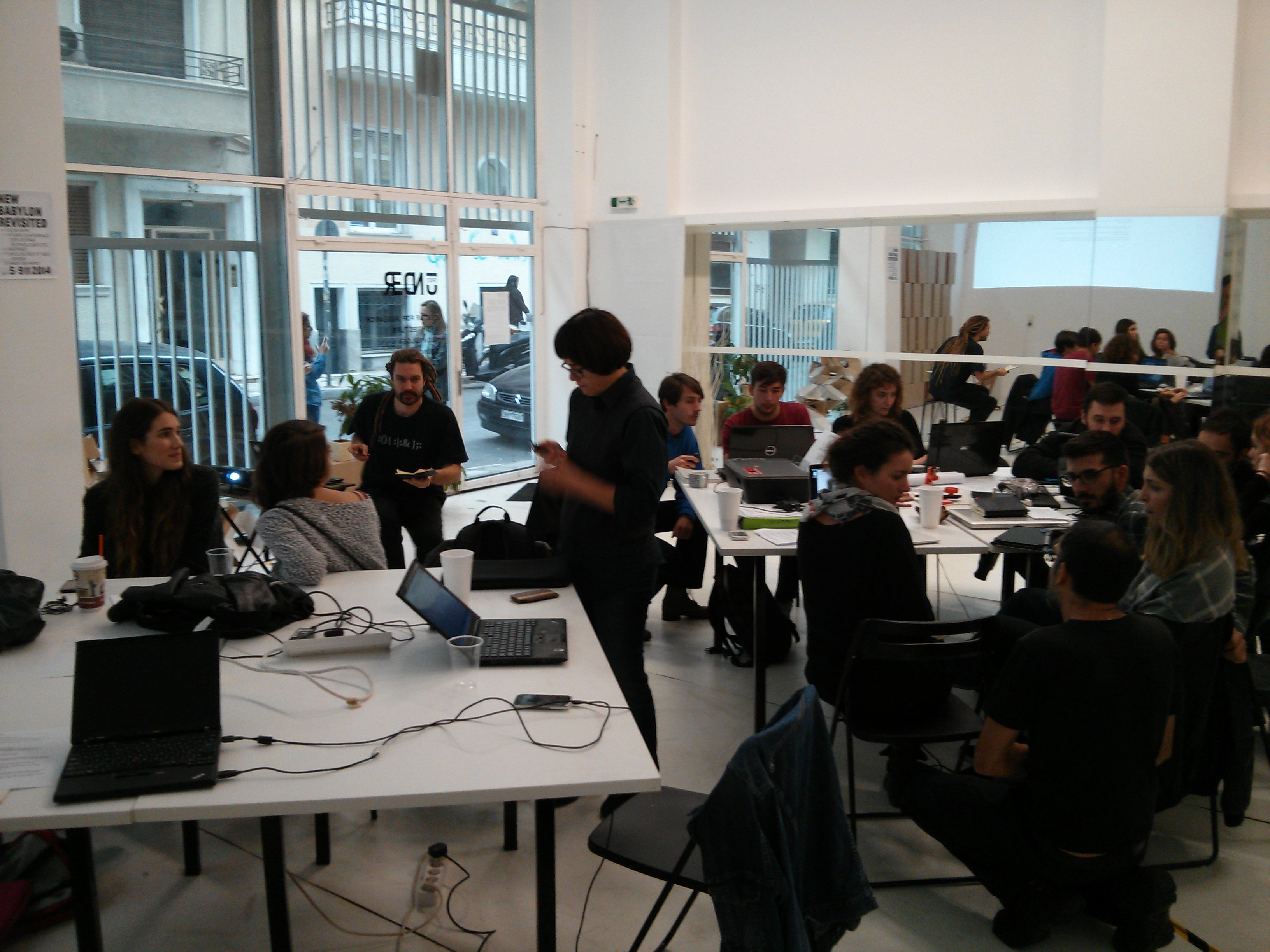
Friday 7th and Saturday 8th November; The reStreet workshop @ Space Under will focus on AWMN and it’s leading role as infrastructure pioneer, techniques to help advance use of the network and promoting the access and synchronisation points we discover around the city – with maps, printed material and social mediation.

We will touch on aspects of open infrastructure and software philosophy as well as explore secure methods for file sharing and data exchange which promote the wireless network and acknowledge the the scope for services as well as introduce some of our own.

IMG_20141107_152156 IMG_20141107_152151

Sunday 9th November is the the final event during which we will walk/drift from place to place and re-discover our street-sync signalling and signage, play with the network and discuss the experience of New Babylon.

reSync-reStreet01

Lunatics

Welcome to the reSync workshop at the Lunatic annual arts and music festival in Lüneburg Germany 6th and 7th June 2014. from 12:00 till 20:00 each day.

Please register to make your custom reSync badges to promote your media shares over the Freifunk open wireless network and contribute to a festival mashup of image sound and video.

lunaticbadgemock

  • Install BTsync to your Smart phone, Tablet or PC
  • Create a reSync folder for your favorite texts, images or movies
  • Scan your dedicated reSync code and add media to your reSync folder.
  • select automatic sync
  • make and wear your badges.

Visit us and find out more in the Spielwiese area on (artist fair on campus). see the map

reSync UG

Following on from a short research fellowship at Post media Lab in Leuphana University, Luneburg, co-workers on deckspace.tv have formed reSync UG to move ahead with some of the ideas arising and apply some outcomes to this new business.

The next reSync activity takes place in Berlin during Transmediale early in 2015 where we will use workshops to continue investigating a range of experimental synchronisation techniques to explore the extra value of media exchange via open wireless networks.

Please see the ‘New Babylon reVisited‘ session ‘reStreet‘ report.

(UG a small private company with limited liability based in Germany).

RTEmagicC_logos_inkubator_sw_w210_01

reSync

In October and November 2013 Deckspace.tv will host a series of reSync workshops as part of a research project with Post Media Lab in Luneburg Germany.

IMG_0446During this period we will  meet with originators of the numerous projects that SPC subscribers have made in Deckspace over a decade of operation.

At each themed workshop you will review the projects and materials then package a report to Deckspace.tv containing text, sound and image to be republished at Deckspace.tv. Each reSync will be encoded to RFID / NFC tags and added to posters and flyers for distribution.

reSync – Wilderness | Transmissions | Rights | Objectives | Origins | Screens | Futures

reSync-Lunburg

Interview with Adnan Hadzi, Deptford.TV, by Hanna Harris

As part of the Finnish Institute‘s new publications series, Hanna Harris edited a book about urban/community TV. It is largely based on experiences emerging from an exchange and mini seminar/workshop Harris organised with Tenantspin at FACT/Liverpool and m2hz in Helsinki. The book will be published in early 2012. Harris interviewed Adnan Hadzi for this edition:

Adnan is finalising a practice-based PhD entitled ‘FLOSSTV – Free, Libra, Open Source Software (FLOSS) within participatory ‘TV hacking’ Media and Arts Practices’ at Goldsmiths College, London. His research focuses on the influence of digitalisation and the new forms of media and arts production, as well as the author’s rights in relation to collective authorship. The practical outcome of his research is Deptford.TV, an online database drawing on and documenting the current process of urban change in Deptford, South East London. Adnan is also part of the artist group !Mediengruppe Bitnik. The group’s artistic practice focuses on media systems, mediatized realities and live media feeds which they manipulate and reproduce to give the viewer a novel and refined understanding of their mechanisms. Adnan and his collaborators ask:

How can broadcasting systems be reconfigured into participative media?
How can media systems be used to provide access to closed circuits?

Here we talk to Adnan about communities, power and experimenting with TV.

1. What do you understand by community media? How and by whom is it produced?

I like to refer to the Critical Art Ensemble’s notion of “electronic civil disobedience” (1996). Community is a discriminatory term, a label, used for minority communities; it is too loaded. This leaves out the power you can assert with media. I don’t see the power in community. There is a political dilemma with “community media”: it becomes about power vs. community media, about empowering vs. taking the power away. That’s why I prefer to use the term “participatory media”, although, recently, this term has become loaded too, espcially with the recent discussions around ‘social networks’. You can allow mainstream media to be there too.

2. You have been hacking contemporary TV cultures with Deptford.TV. What kind of media and TV is being created with Deptford.TV?

Deptford TV is research into media and communication. It is practice-based experimentation, not a community media project. It’s about getting lost into collectives. Deptford TV started in 2005 with the notion of urban change. The community media angle was strong in the beginning. We started with a group of MA documentary students at Goldsmiths and began documenting urban change. We did this by creating and developing database filmmaking. Soon, there was a shift to art practice and participatory media through methods such as video sniffing. Deptford.TV serves as an open and collaborative platform for artists and filmmakers to store, share and re-edit the documentation of the urban change of South East London. Deptford TV is hosted by Deckspace – which is like a hack space with subscription fees for members. Deckspace has an open wireless network, hosts servers and experiments with network activities. As it is very difficult to host these activities within the institutional context of universities, one often needs to step out in order to undertake this research. The open and collaborative aspect of the project is of particular importance as it manifests in two ways: a) audiences can become producers by submitting their own footage and b) audiences interact with each other through the database. Deptford TV makes use of licenses such as the Free Art License, the Creative Commons SA-BY license, and the GNU General Public license to allow and enhance this politics of sharing. Deptford.TV is accessible publically but you need to come to the workshops to be allowed into the database and to get to play around with the database and clips. Deptford TV is research into arts production that engages with those who are interested. It aims to develop methods to enable this. The process is similar to the development of free and open source software. It is about thinking around collectives and collaboration. Up until now the focus has been on postproduction methods. There is potential to focus on distribution: immediate file sharing and live TV. Recently we produced Ali Kebab Live on Air. We experimented by broadcasting live CCTV footage from a local kebab shop. The same material, shown in Linz at the 2011 Linux Wochen Linz, was also shown on monitors 200 metres away from the shop in a gallery.

3. Why is what you refer to as participatory media needed?

It’s about reclaiming TV. It’s about decentralising TV in order to offer the next generation of media a less centralised notion of politics. The Internet is becoming more centralised. If TV becomes less centralised, one could argue that, it will be more difficult for those parties interested in centralising the Internet to do so. First, there is the political aim. Reclaiming TV is about the redistribution of wealth. I’m a big fan of sharing wealth – for me, knowledge production signifies wealth. We should have a big redistribution system going on. The digital networks are good starting point for this. In the light of the digital divide, TV can mean access for all. Second, there is a cultural aim. I talk about post-mortem. We are locking culture away. Where is the benefit for society, for future generations? For us being able to philosophise about life and what is important? Marshall McLuhan predicted this, and it hardly materialised, but maybe the time for bottom up TV is now, the time for reclaiming your TV. Nevertheless when looking into McLuhan one should not forget Raymond Williams’ criticism of McLuhan’s techno-deterministic approach to media systems.

4. What are the future platforms and practices of participatory media?

Open wireless networks might have a future. Operating on ‘many to many’ principles, they are more powerful than having a community TV station. We should focus more on use and on small entities that can network each other. Currently however, the community aspect cannot go further because it is not allowed; we are still under a centrally controlled service system. Under the British Digital Economy Act, open networks can potentially become heavily censored. We are witnessing a similar moment everywhere in Europe.

5. What actions should be taken now?

For Deptford TV, it has become more and more a reflection about culture. The open wireless network needs to be defended. If we are banned from intellectual properties of the past, future generations will not have our culture. This is also why I am interested in database filmmaking. We need to move back to thinking about distribution. Using the model of Deptford TV, I could imagine to set up something like Stratford TV based on a wireless network around Stratford and Hackney in East London and have the tenants “ranting” about the Olympics. Wouldn’t that be cool!

Deptford.TV @ PIKSEL11, 19th November 2011

“The 9th edition of the Piksel Festival took place on November 17th-20th 2011 in Bergen, Norway. The festival was subtitled this year as “re:public” for rethinking and redefining public space, both as a concrete physical space, and in a larger social and political context. As previously, through the nine-year history of the festival, Piksel is firmly grounded on free/libre and open source.” (Tuomo Tammenpää)

Deptford.TV was invited to PIKSEL11 to hold a FLOSSTV workshop. Our main tool for this workshop were video receivers that could intercept the data collected by small CCTV video cameras (often placed covertly in shops, offices and other public/private spaces). The workshop introduced participants to Surveillance and CCTV filmmaking where material and images from the Deptford.TV archive were edited to submissions from the Deptford.TV database. Footage taken from Deptford.TV was filmed during a previous TV hacking workshop where participants equipped with CCTV surveillance signal receivers were lead through the city by incoming surveillance camera signals.

Free Culture Forum 2011

From 27th to 30th October 2011 the third edition of the Free Culture Forum took place in Barcelona. Version 2.01 of the Charter for Innovation, Creativity and Access to Knowledge was released n line with the declaration of the UN Committe on Economic, Social and Cultural Rights: General Comment Nº17 (2005), the introduction of the charter states:

We are in the midst of a revolution in the way that knowledge and culture are created, accessed and transformed. Citizens, artists and consumers are no longer powerless and isolated in the face of the content production and distribution industries: now individuals across many different spheres collaborate, participate and decide in a direct and democratic way.

Digital technology has bridged the gap, allowing ideas and knowledge to flow. It has done away with many of the geographic and technological barriers to sharing. It has provided new educational tools and stimulated new possibilities for social, economic and political organisation. This revolution is comparable to the far-reaching changes brought about by the invention of the printing press.

In spite of these transformations, the entertainment industry, most communications service providers, governments and international bodies still base the sources of their profits and power on controlling content, tools and distribution channels, and on managing scarcity. This leads to restrictions on citizens’ rights to education, access to information, culture, science and technology, freedom of expression, the inviolability of communications and privacy, and the freedom to share. In deciding copyright policy, the general interest shall take priority over the specific private interests.

Today’s institutions, industries, structures and conventions will not survive into the future unless they adapt to the changes that result from digital era. Some, however, will alter and refine their methods in response to the new realities. And we need to take account of this.

Political and Economic Implications of Free Culture

Free culture (“free” as in “freedom”, not as “for free”) opens up the possibility of new models for citizen engagement in the provision of public goods and services, based on a ‘commons’ approach. ‘Governance of the commons’ refers to negotiated rules and boundaries for managing the collective production and stewardship of, and access to, shared resources. Governance of the commons honours participation, inclusion, transparency, equal access, and long-term sustainability. We recognise the commons as a distinctive and desirable form of governance that is not necessarily linked to the state or other conventional political institutions, and demonstrates that civil society today is a potent force.

We recognize that this social economy is an important source of value, alongside the private market. The new commons, revitalised through digital technology (among other factors), enlarges the sphere of what constitutes “the economy”. Governments currently give considerable support to the private market economy; we urge them to extend to the commons the same comprehensive support that they give to the private market. A level playing field is all that the commons needs in order to prosper.

The current financial crisis has highlighted the severe limits of some of the existing models. On the other hand, the philosophy of Free Culture, a legacy of the Free/Libre Software movement, is empirical proof that a new kind of ethics and a new way of doing business are possible. It has already created a new, workable form of production based on crafts or trades, in which the author-producer does not lose control of the production process and can be free of the need for production and distribution intermediaries. This form of production is based on collaborative entrepreneurial initiatives, on exchange according to each person’s abilities and opportunities, on the democratisation of knowledge, education and the means of production and on a fair distribution of earnings according to the work carried out.

We declare our concern for the well-being of artists, researchers, authors and other creative producers. Projects and initiatives based on free culture principles use a variety of approaches to achieve sustainability. Some of these forms are well established, others are still experimental. The combination of these different options is increasingly viable for both independent creators and industry. There must be clear rules that promote public, sharable knowledge, protecting it from any form of exclusive appropriation by individuals or companies and thus preventing the possibility of restrictive monopolies or oligopolies emerging from this appropriation.

The digital era holds the historic promise of strengthening justice and being rewarding for everybody.

The charter can be found here.