4 for four

Creeknet, is one of four project pilots being operated as part of the MAZI initiative which will bring together components for a neighborhood network toolkit. This will feature a guide for those establishing or improving on open wireless and offline collaborative systems, advising on cost effective hardware and open source software solutions, whilst refining tactics and tutorials.
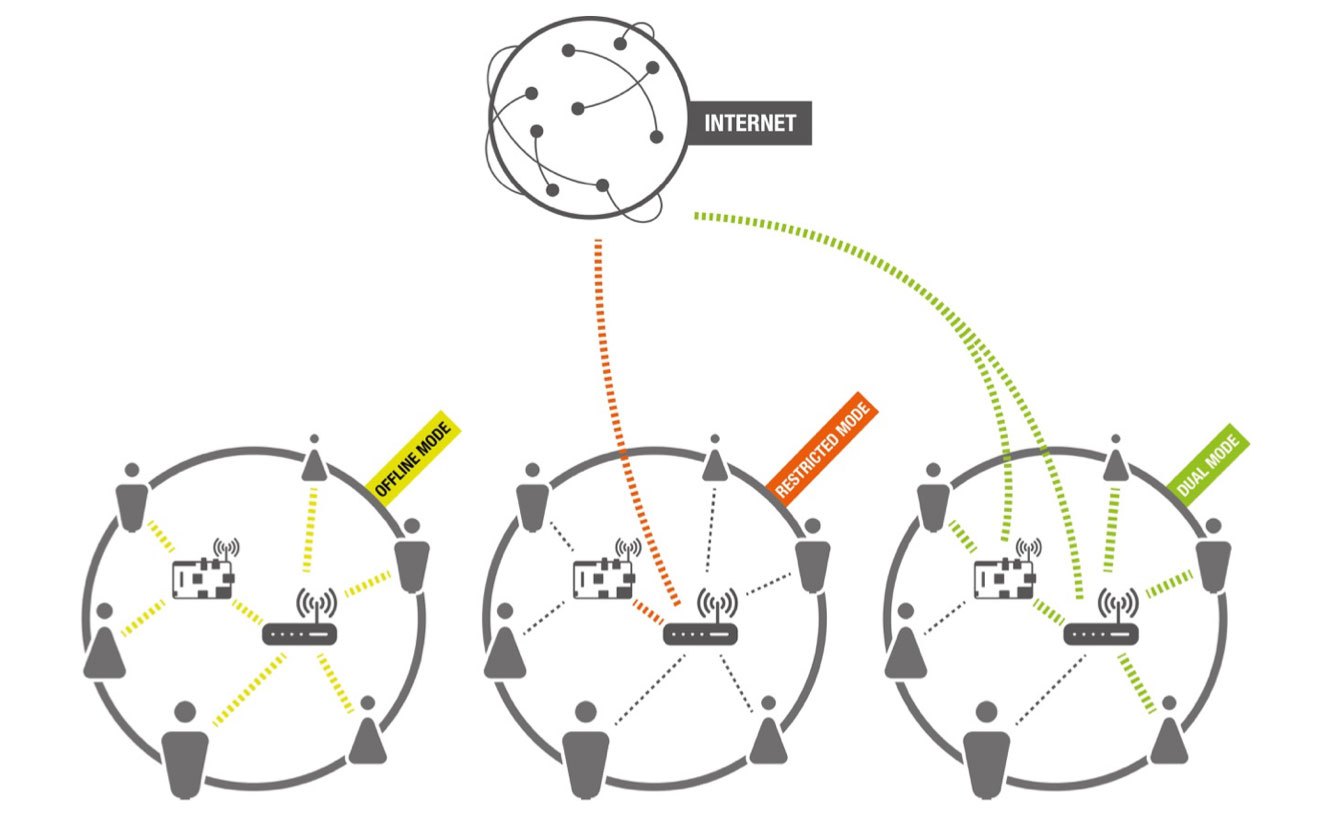
To help co-ordinate and explore the many options, we worked with MAZI partner University of Thessaly, Greece, to establish a suite of software to test and use in our local networks. Etherpad is a collaborative writing tool and OwnCloud is a document and media management system. UTH role is to co-ordinate and consolidate toolkit components and the first prototype, on a RaspberryPi disk image is available for testing featuring these and small selection of complimentary applications. In the simplest mode, presents a ‘stand alone’ wireless access point running webserver and other local services to promote working together. Without internet connection, any requests for webpages are redirected to local webpages listing services and describing options.

During recent workshop at the Prinzessinnengarten in Berlin, we heard about progress of MAZI pilot ‘Common Ground‘ during launch of Neighborhood Academy building in the garden. Their prototype ‘interview station’ enables one 2 one interview recording and publishing process. Completed interviews are published directly to their offline server prototype  for review and comment by those visiting the garden academy. The same combination of powerful software options and offline network server was in use during the recent Unmonastery at Kokkinopolis, a two week meeting in the Olympus mountains in Greece where it was first tested by them for communal exchange and interaction.
Kraftwerk1 housing cooperative in Zurich is working with Nethood to identify suitable evolutionary path away from their proprietary cloud information system. Their inspirational living model has been a great success and with growth of cooperative housing across Switzerland there is increasing interest in mapping of methods and monitoring of progress not least at Inura.

The ‘Creeknet’ pilot began in April 2016 describing first impressions and identified groups from the local area whom SPC have worked with in the past, to propose key issues and ideas to explore.There are many aspects to consider, changes to the built environment here are continuing at a rapid rate, some groups are being sidelined with conditions for living and working in the area facing disruptive challenges as well as opportunities.

Our role as advocate for user owned and operated information infrastructures is well known in the area. SPC worked with individuals, neighborhoods and local businesses from 2001 on a series of DIY low tech network projects, last represented by OWN, the open wireless network established 2008. Today the effects of population churn, rise of portable computing, concerns for personal security as well as long term exposure to the elements have reduced the operational status of OWN to a shadow of it’s former self.

The afterglow of positive experiences gained over eight years is now being rekindled with the prospect of renewed offline network development, expressing a passion for the ‘local’, celebrating neighborhood news and wider collaboration. The access to broadband provided by OWN in the area, needs re-doubling if it is to serve the co-ordination demands of MAZI ‘offline’ network development and monitoring of process. This process is now underway with new connections being upgraded between Deckspace in Greenwich and Minesweeper on the creek. From there we will continue to redistribute access to locations of activity nearby.

Monumental civil engineering and relentless apartment block building is underway throughout the area, bringing changes to the environment for everyone. For some it will mean the end of affordable rents for both domestic and workspaces. For others, this area of London is where overheads are still comparatively low. It will certainly result in increased traffic, noise and pressure on services, a transformation in the mix of people and expectations.

Pollution concerns over quality of water, air and electrosmog, processing of rubbish and recycling urgently seek answers. The Creekside Centre and other Deptford Creek groups are already working on the creeknet MAZI pilot to build on existing relationships and operate more effective information sharing and neighborhood network solutions. With these issues in mind early installations will include a range of passive environmental sensing of sound, light and radio.

The opportunity for social interaction in the area is limited to the few publicly accessible parks, pathways and the remaining pubs alongside west and eastern banks of the creek. A few new public areas have being created which have yet to be understood and adopted. For example the new footbridge at the mouth of the Deptford Creek, completes the Thames path between Deptford and Greenwich, a perfect place to focus attention and present a MAZI zone.
Knitted out

The quest for suitable, sustainable network equipment is an ongoing and fascinating one.  New products with great capabilities, low cost and power, compactness and accessibility, hold much promise.

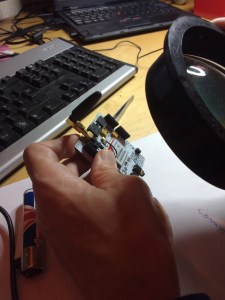
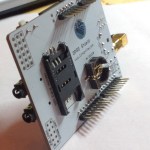
The first to catch my eye during a recent visit to Raylab is this GPRS shield v1.0. It’s a compact and versatile board featuring audio I/O, generic GSM module and 12 GPIOs. It is also fully compatible with Arduino modules so that existing controllers, radios and sensor packs fit right in!

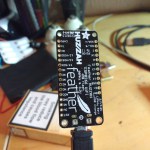
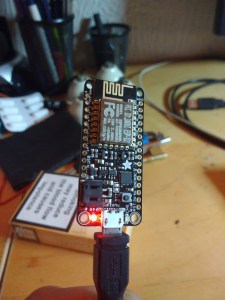
Next on the desk was long awaited Huzzah! IoT ‘feather‘ which Alexei ordered some weeks ago and so popular it’s rarely in stock. Preliminary test returns simple but reassuring responses.. This tiny board boasts memory, processor very low power consumption and frilled with many connection options, amazing value at £12.

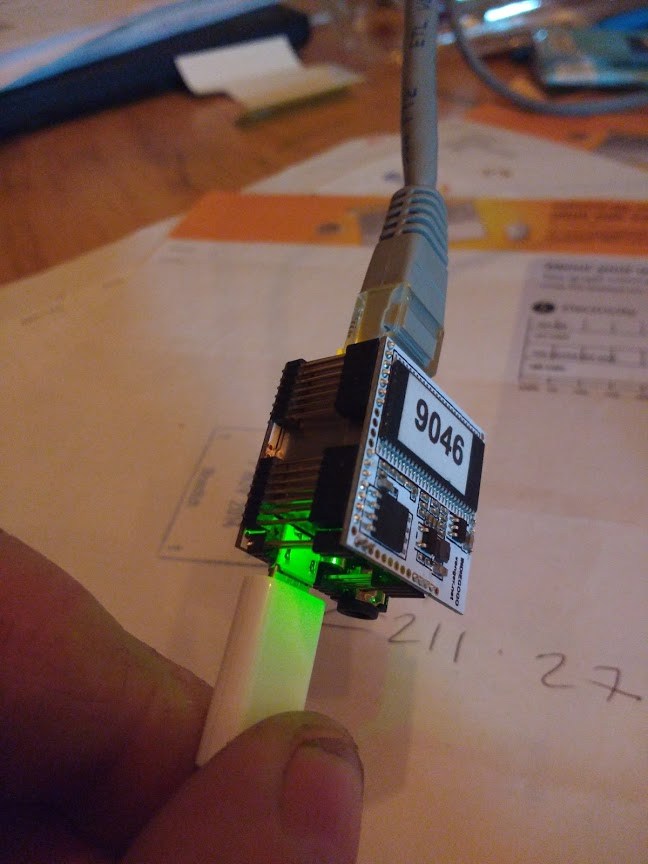
A third product blinking innocently away across the desk,  had been delivered just that afternoon. Vocore.io is a fully featured mini OpenWRT SoC (system on chip) module with ethernet and USB dock, wireless and RAM enough to make itself indispensable. £40 ish.

Our MAZIzone assignment to identify and utilise the best of options for neighborhood activities and network development have already drawn us close to a series of interesting options for environment sensing , information storage and energy management. It’s a fragmented story so far, but one that we are bringing into focus, piece by piece.

When we next link up with guys at University of Thessaloniki research department in Volos there will be much to discuss. They have been working with a selection of off the shelf and custom pico pc boards and adapters to interface a wide range of environment sensors to track temperature to radiation and drive Bluetooth, Zigbee, Wifi and LTE radios.

after.video @ AMRO

Art Meets Radical Openness
Festival dedicated to Art, Hacktivism and Open Culture

“Art Meets Radical Openness” is a community festival, an open lab, and a meeting point for artists, developers, hactivists, and idealists involved with the culture of sharing and communal production. They are catalysts that spark new discourses and open up new directions of thinking. Free Open Source Software, open tools in general and the use of free licenses are the precondition and basis for the digital practice of a community like this, which impels social transformation. This tangible transformation goes beyond a digital practice and also changes our real life.

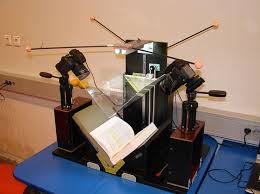
This exhibit and/or paper presents the after.video video book, discussing the topic of “Online and offline platforms for the exhibition and circulation of audiovisual media”. The after.video book represents a fusion of the modes of the digital/networked publication and the traditional form of the physical (wasted?) book. There have been first thoughts about the links and exchanges of the old traditional format of the book and the possible accordances of the digital book on a more practical level. The theoretical framing is given by thinkers of the book like Bob Stein: “the computer screen became a place for synchronous and asynchronous conversation. As web technology improved people started putting essays and books in a browser with a dynamic margin where readers could make comments visible to everyone. Over the past ten years the experience of dozens of ‘social reading’ platforms suggests that books will become places where people congregate to hash out thoughts and ideas.” (1). Practically this fusion of the possibilities and formats of new digital media (like video) and traditional academic text-form is also making headways – like exemplified in the ‘Frames of Mind’-project (2). Open Humanities Press has taken these beginnings and fused different pre-existing trajectories of development as instantiated by above projects and conceptions, and fused them with the idea of rendering the digital book after.video as a physical device, much along the lines already taken in the landmark project “The Weise7 in/compatible Laboratorium Archive” (3). This conceptual leap represented by the dual-mode video-book enables the Centre for Digital Cultures (4) and Open Humanities Press (5) to not only go beyond the format offered by the first two volumes of Video Vortex (as put out by the Institute for Network Cultures (6), but also beyond the current state of digital publishing in media-rich, video-centric contexts, thus presenting a unique publication which reflects upon video theoretically, but attempts to fuse form and content in its own dual format.

We also participated in the Liquid Democracy workshop, a report (in German) can be found here.

reMem.or/ized

Earlier this week Maydayrooms hosted ‘Militant Technics‘ a fascinating string of critical interactions and introspection over three days at the cafeteria on the top floor in their Fleet Street den. The aim was to develop tuition modules, extend understanding of respective library projects and explore opportunities to improve on in house archive ‘activation’ practices. We started with beer and a great mushroom risotto, thanks to Rosemary !

Sean Dockray of (Aaaaarg/Public School); Marcell Mars and Tomislav Medak (Mama/Memory of the World); Sebastian Luetgert and Jan Gerber (Pan.do/ra /Pirate Cinema) joined friends and members of MayDay Rooms collective on Monday for ‘Back to the future‘ a public discussion on the legal challenges to open access distribution in an age of ‘takedown notices’ and other proprietorial threats posed to online information sharing. (audio recording was made)

Your local library is also under threat, but this has ever been so! Act now, to protect you collections, share books and be the media, challenge hegemonic assumptions protecting commercial control over access to information, your quality of public life and freedom rights.

Open Science Conference Sao Paolo

We presented the after.video book project during the Besides the Screen / Open Science Conference in Sao Paolo. Adnan Hadzi & Pablo De Soto discussed the Drone Hackademy & Algorythmic Noir, a dystopian “future-opolis.” It became the location for their experimental film noir. Pushing the envelope of cinematic form, the film is edited live in real time by a custom programmed computer they call the “serendipity machine.” It delivers a changing narrative, culled from 3,000 clips, 80 voice-overs and 150 pieces of music, that could run forever and never plays the same way twice. The unexpected juxtapositions create a sense of suspense alluding to a story that the viewer composes. Driven by key words, the work seamlessly comes together as a movie that is not a movie. The film draws on the abstractions and reflections on transcendence of the artist Kasimir Malevich, and the fate of Russian astronaut Yuri Gagarin, seen through the lens of science fiction and film noir.

The film follows the observations and surveillance of a geophysicist named Holz (Jeff Wood), stuck in a 1970s-looking metropolis operated by the New Method Oil Well Cementing Company. Voiceovers and dialogues forge the implied narrative—wire-tapped telephone conversations, reel-to-reel tapes, snippets of a job interview between Mr. Holz and his employer and a mysterious woman referred to simply as “Dispatch.” According to the Musée d’art contemporain de Montréal, whiteonwhite is a fascinating investigation into space and time, utopia and dystopia, fractured narration, train travel and landscapes marked by economic and ecological upheaval.

Cyphersongs @ Piksel15

Our friends Rob, Barbara & Anton performed Cyphersongs @ Piksel15:

CipherSongs WEB

CipherSongs: Trustless is the second in a series of performance and installation works reflecting on issues surrounding encrypted network communication technologies. It is a data driven, audio visual installation/performance which responds to real-time data from the Bitmessage service. Bitmessage is a decentralised, peer-to-peer, trustless communications protocol. The service became particularly popular after the 2013 Snowden revelations exposing the widespread collection and analysis of communications metadata. These works respond to the threat to our “right to a private life” posed by the planned amendments in the UK to the Data Retention and Investigatory Powers Bill (aka The Snoopers Charter). This amendment seeks to criminalise the use of encrypted communications in the UK. In this context, CipherSongs functions as the ‘canary in the coal mine’, an early warning system where the disappearance of song indicates a dangerous problem within the system.

This performance is a dialogue between the on-stage performers and the streams of encrypted network data. The data is picked up by performers and improvised into the physical performance space as well as streamed via the TOR hidden service. Alongside the data driven sonic improvisations are woven textual interpretations of both factual and fictional encrypted content.

Rob Canning (Laptop), Antonios Galanopoulos (Laptop), Barbara Kukovec (Voice/Electronics).

MoneyLab#2: Economies of Dissent

The Institute of Network Cultures presents MONEYLAB#2: ECONOMIES OF DISSENT on Thursday 3 & Friday 4 December 2015 at Pakhuis de Zwijger in Amsterdam– an international symposium hosting artists, activists, programmers and academics that probe, challenge and hack today’s global economy.

What political imperatives shape the economy of dissent? What different views on the redistribution of wealth and the exchange of value are out there? How can we re-design our financial infrastructures?

The important first steps are being taken beyond moral outrage and towards systemic interventions in the global austerity economy. We witness an impressive amount of financial counter-concepts, works of art, digital currencies, tools and hacks giving shape to an emerging economy of dissent. This economy operates across borders, on different scales, from sole acts of defiance to a sovereign ‘oxi’, and is expressed variously as: strategy, circumvention, innovation, visualization, and making-do.

Data Traces: Big Data in the Context of Culture and Society

IXDM will host a conference on data traces.

Big Data describes a passage into a new era in which the power of data induces a radical transformation of a society whose actions and productdata_traces01ion of knowledge rely increasingly on the accumulation and evaluation of data. The conference ‘Data Traces. Big Data in the Context of Culture & Society’ draws upon this prospect and delves into critical questions of Big Data in dialogue with international experts, academics and artists. It addresses the paradigm of a data-driven society and reflects life in an increasingly datified world. The conference is organized by the Institute of Experimental Design and Media Cultures at the Academy of Art and Design FHNW and HeK (House of Electronic Arts Basel). The conference is part of the exhibition ‘Poetics and Politics of Data’ at HeK. Further infos can be found on the IXDM website & the HEK website.

Sealed with a Bit

Sealed with a Bit @ r15

Short thesis:
Random Darknet Shopping Bots, Mail Art and Surveillance Algorithms: Mediengruppe Bitnik on their latest works, Art and Technology

Description:
!Mediengruppe Bitnik are contemporary artists based in Zurich. In their talk they will give some insights into their latest works around bots. They will retrace their recent explorations into the Darknets – from Memes to Onionland – and talk about anonymity as anti-identity and applying loss of control to challenge established structures and mechanisms.

!Mediengruppe Bitnik has been known for sending a bot called «Random Darknet Shopper» on a three-month shopping spree in the Darknets where it randomly bought items like Ecstasy and had them sent directly to the exhibition space.

In early 2013 they sent a parcel to WikiLeaks founder Julian Assange at the Ecuadorian embassy. The parcel contained a camera which broadcast its journey through the postal system live on the internet. They describe «Delivery for Mr. Assange» as a SYSTEM_TEST and a Live Mail Art Piece.

Off Networks @ FLOSS4P2P

James, Jaromil and Adnan joined a 2-day London FLOSSP2P workshop, gathering FLOSS projects that are building software for peer production and organization, with a focus on distributed platforms. *Scholarships* to attend are offered to grassroots communities. We met with participants of the Off Networks mailinglist.

** Context ** see p2pfoundation blog:

We know that the Internet was originally decentralized, with protocols and services built by hackers. However, with the arrival of the celebrated Web 2.0, centralization and corporations proprietary platforms seem to have taken over. Moreover, this centralized structure is used by governments to increase surveillance (following Snowden’s revelations), to blackout internet whenever it is needed (e.g. Egypt, Syria, or San Francisco’s BART) or to choke annoying activist organizations (such as Wikileaks).

On the other hand, in the last few years we have seen the emergence of Internet-enabled collaborative communities building shared libre/open resources. Commons-based Peer to Peer Production (CBPP) is rapidly growing: not just for software and encyclopedias, but also for information (OpenStreetMap, Wikihow), hardware (FabLabs, Open Source Ecology), accommodation (Couchsurfing) and currency (Bitcoin, Altcoins).

In the last few years, it has become clear to many that it is not enough to develop free/libre/open source (FLOSS) alternatives, but we also need to re-decentralize the Internet. Many initiatives are being undertaken under this premise (e.g. Ethereum, Diaspora, OwnCloud, MediaGoblin, Sandstorm). These new software tools may also be useful to boost CBPP communities further. In this workshop, we will gather those working around the decentralized FLOSS that could help CBPP/P2P communities. Hackers, academics, activists and interested stakeholders are welcome.