D.TV

Poetry on Film

Poetry on Film is an initiative that beautifully merges the visual art of film with Malta’s rich literature. Each year, Maltese poems are selected to be adapted into a short film which then premieres at the Malta Mediterranean Literature Film Festival.

This year’s edition of the Festival will be happening between the 24th and the 26th of August at Fort Saint Elmo, starting at 8.00PM, with the two selected poetry films being premiered on Thursday 24th August and on Friday 25th August.

The first poetry film is an adaptation of Maria Grech Ganado’s poem Relazzjoni, by Nicky Aquilina and Lyanne Mifsud, which will be premiered on Thursday 24th.

The second is a poetry film of Victor Fenech’s work Fuq Għoljiet Dingli, by artist and academic Trevor Borg, which will be premiered on Friday 25th.

Both films will include an introduction by film director and lecturer Kenneth Scicluna.

Poetry on Film 2018 is a Valletta 2018 project in collaboration with Inizjamed which aims to develop the poetry film sector in Malta through training, the commissioning of short poetry films to be screened at the annual Malta Mediterranean Literature Festival, and the export of the commissioned films. The project is central to the Valletta 2018 Foundation and Inizjamed strategy to make poetry more accessible and alive through collaboration and co-creation across different artistic disciplines and media. To stimulate wider interest and activity in the sector and with a view to supporting the high-quality production of poetry films in Malta, the Valletta 2018 Foundation and Inizjamed will commission two more poetry films via a selective process.

**

This year’s edition of Poetry on Film sees Abigail Mallia and Carlos Debattista are producing a poetry film of Oliver Friggieri’s work “Il-Lejl f’Dan l-Istazzjon”.

The finished works will be screened during the annual Malta Mediterranean Literature Festival, which will take place between the 23rd and 25th of August 2018 at Fort Manoel, Manoel Island, Gżira.

Abigail Mallia Carlos Debattista Valletta 2018 – European Capital of Culture Inizjamed Malta Mediterranean Literature Festival 2018


Cabinet of Futures

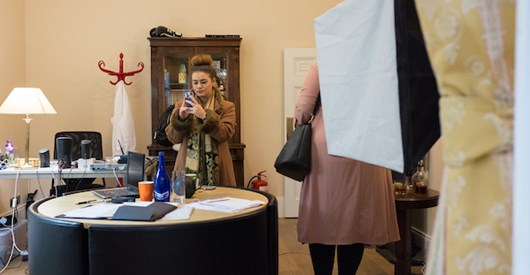
We took our students to see the Cabinet of Futures exhibition and to take part in a workshop organised by our friends the Time’s Up collective. Photos.

The Austrian art and culture group Time’s Up engages the public in playful experiences designed to explore alternative, preferable futures.

Over the course of their stay on the Maltese Islands, this radical team have brought internationally renowned futurists, local experts and everyday citizens together through communal workshops; during these creative meetings, participants have shared imaginative scenarios, dreams and concerns that explore diverse visions of the local future.The year 2018 sees people’s ideas come to life through the resulting site-specific exhibition, Cabinet of Futures. This immersive, walk-through exhibition creates a ‘proto-scientific’ laboratory atmosphere, inviting local individuals and communities to add their own touch to the scenario. With constant creative exchange from all walks of life, the hypothetical futures presented become sites that are continuously evolving into richer and ever-more tangible worlds.

Art Meets Radical Openness (#AMRO18)

The current issue “Unmapping Infrastructures” deals with the idea of “mapping” as a process of becoming aware and then acquiring a critical position about the current landscape of technological infrastructures.

This conglomerate of machines, human and non-human actors, nation-states and borderless companies is increasingly complex to observe and describe. Nevertheless, we believe that there is more to be seen than a hyper-commercialized structure of interlaced technological layers. Cartographic mapping consists of a series of practices of observing, analyzing and representing a territory to be able to move through it. How can art and activism appropriate the methods of cartographic mapping to produce new, critical and alternative views of the current landscape shaped by different players?

The festival aims at deepening the thematic areas of digital geopolitics, alternative design methods, activist practices and autonomous infrastructures, themes that offer directions for localizing areas of intervention. Throughout the festival, these topics will be further explored through discussion panels, workshops, and performances.

Contributors:
Abelardo Gil-Fournier, Adnan Hadzi, Alina Krobok / Sea-Watch e.V. – Zivile Seenotrettung von Flüchtenden, Alison Killing, Antti Pussinen, beepblip, BridA/Tom Kerševan, Sendi Mango, Jurij Pavlica, César Escudero Andaluz, Christina Gruber, Christo Petkov, Cristina Cochior, Davide Bevilacqua, Emily Buzzo, Felipe Castelblanco, Fieke Jansen, Florian Voggeneder, Franc González, Franz Xaver, Giulia de Giovanelli, Hansi Raber, IOhannes m zmölnig, Jakub Pišek, Jens Vetter, Joana Chicau, Joana Moll, Julia del Río, Julia Nüßlein, Katalin Hausel, Marloes de Valk, Martín Nadal, Martina Schönbauer, Martina_K, Martino Morandi, Nicolas Maigret / DISNOVATION.ORG, Nicolas Zemke / Sea-Watch e.V. – Zivile Seenotrettung von Flüchtenden, Pablo DeSoto, Patrice Riemens, Roelof Roscam Abbing, Sabina Hyoju Ahn, Sam Bunn, States of Clay, Stefan Tiefengraber, Taro Knopp, The AMROgraphers / Art Education Department – University of Art and Design, Linz, TinTin Patrone, Us(c)hi Reiter, Varvara & Mar, Vuk Ćosić, Waiwai (Hiuwai Chan), Wolfgang Spahn, Yoshinari Nishiki.

⚡️⚡️⚡️ HACK YOUR WAY INTO THE CRYPTO RAVE BLOCKCHAIN ⚡️⚡️⚡️

“Hack Child” LARP RGP Berlin.
👢 Live Action Role Play
⚠️ Real Game Play
Over the last few years we have seen an increased drive within the autonomous dance scene, collectively organising sub-raves via the blockchain, and using mining as an entry point via friend2friend networks. This ultimate shadow play tactic has created a tight knit community but we wish to expand the social novel, beyond our own cliques and networks.
So for one-night-only, this underground subculture will be opened up to those who wish to PLAY CRYPTO RAVE. On this occasion, we will launch the very first EP «Alexiety» specifically for _smart_ devices, electronically produced by Low Jack [1] & !Mediengruppe Bitnik.

🕳 The game will be held at an undisclosed location
📡 in Berlin on 21:00h, 9th May 2018.
Points of contact Omsk Social Club [2] and !Mediengruppe Bitnik
Zen, Speed, Organic
3 lifestyle choices
<3 Mediengruppe Bitnik
https://wwwwwwwwwwwwwwwwwwwwww.bitnik.org/
[1] Low Jack https://soundcloud.com/low-jack
[2] OMSK SOCIAL CLUB http://www.punkisdada.com/

Circuits 2018

This annual conference is led by the voluntary organisation, Electronic Music Malta, with the 2016 and 2017 editions held in collaboration with Fondazzjoni Kreattività. In 2018, Circuits will also host an interactive music installation at Saint James Cavalier, a series of talks by two international electronic music artists, and a performance on modular synthesisers. University and MCAST students are invited to participate in the organisation of the upcoming conference, which offers great networking in the sphere of electronic and world music and visual arts. This event is supported by Valletta 2018 – European Capital of Culture and is part of the Spazju Kreattiv programme. Over the course of a day, the conference showcases a mix of arts, music and technology related to electronic music performance and production: installations, talks, workshops, challenges, equipment, expositions and a final performance.

Circuits 2018 huwa avveniment fejn fih ilaqqa’ diskussjonijiet, performances, preżentazzjonijiet, workshops interattivi bl-għan li jaqsmu l-ideat varji fejn tidħol mużika, teknoloġija u kreattivita’. Ltqajna ma’ Mike Desira, li huwa dilettant Malti ta’ l-elettronika, fejn bena modeller synthesizer li joħloq ħsejjes differenti. Nhar is-Sibt li ġej l-pubbliku, ser jingħata’ l-opportunita’ li tużgħu dan is-synthesizer u japplika Din hija organizzata mill-organizazzjoni volontarja Electronic Music Malta, din hija t-tielet edizzjoni ta’ Circuits music conference. Dan l-avveniment huwa appoġġjat minn Valletta 2018 – European Capital of Culture u jifforma part mill-programm ta’ Spazju Kreattiv.

Circuits 2018 huwa avveniment fejn fih ilaqqa’ diskussjonijiet, performances, preżentazzjonijiet, workshops interattivi bl-għan li jaqsmu l-ideat varji fejn tidħol mużika, teknoloġija u kreattivita’. Ltqajna ma’ Darren Borg, li huwa mużiċist li ħoloq strument electro mekkaniku. Nhar is-Sibt li ġej l-pubbliku, ser jingħata’ l-opportunita’ li tużgħu dan l-istrument.

Kif jistgħu l-artisti jittraduċu idea, tema jew forma oħra ta’ ispirazzjoni bħal din bl-aħjar mod fi proġett bħal installazzjoni? Liema forma ta’ assistenza hija disponibbli biex l-artisti jkunu jistgħu jirrealizzaw tali proġetti? Electronic Music Malta tippreżenta EMM Talks #2 – A Means to an End – diskussjoni pubblika li se ġġib flimkien lil Mario Sammut (Cygna), Andrew Schembri, Toni Gialanze (Late Interactive) u Toni Attard (Direttur, Culture Venture) biex jiddiskutu dan is-suġġett interessanti.

Virtualities and Realities

Adnan presented the after.video project at the Open Fields conference. After video culture rose during the 1960s and 70s with portable devices like the Sony Portapak and other consumer grade video recorders it has subsequently undergone the digital shift. With this evolution the moving image inserted itself into broader, everyday use, but also extended it ́s patterns of effect and its aesthetical language. Movie and television alike have transformed into what is now understood as media culture. Video has become pervasive, importing the principles of “tele-” and “cine-” into the human and social realm, thereby also propelling “image culture” to new heights and intensities. YouTube, emblematic of network-and online-video, marks a second transformational step in this medium’s short evolutionary history. The question remains: what comes after YouTube?

This paper discusses the use of video as theory in the after.video project, reflecting the structural and qualitative re-evaluation it aims at discussing design and organisational level. In accordance with the qualitatively new situation video is set in, the paper discusses a multi-dimensional matrix which constitutes the virtual logical grid of the after.video project: a matrix of nine conceptual atoms is rendered into a multi-referential video-book that breaks with the idea of linear text. read from left to right, top to bottom, diagonal and in ‘steps’. Unlike previous experiments with hypertext and interactive databases, after.video attempts to translate online modes into physical matter (micro computer), thereby reflecting logics of new formats otherwise unnoticed. These nine conceptual atoms are then re-combined differently throughout the video-book – by rendering a dynamic, open structure, allowing for access to the after.video book over an ‘after_video’ WiFi SSID.

Comments: Dr. Adnan Hadzi has been a regular at Deckspace Media Lab, for the last decade, a period over which he has developed his Goldsmiths PhD, based on his work with Deptford.TV. It is a collaborative video editing service hosted in Deckspace’s racks, based on free and open source software, compiled into a unique suite of blog, cvs, film database and compositing tools. Through Deptford TV and Deckspace TV he maintains a strong profile as practice-led researcher. Directing the Deptford TV project requires an advanced knowledge of current developments in new media art practices and the moving image across different platforms. Adnan runs regular workshops at Deckspace. Deptford.TV / Deckspace.TV is less TV more film production but has tracked the evolution of media toolkits and editing systems such as those included on the excellent PureDyne linux project.

Adnan is co-editing and producing the after.video video book, exploring video as theory, reflecting upon networked video, as it profoundly re-shapes medial patterns (Youtube, citizen journalism, video surveillance etc.). This volume more particularly revolves around a society whose re-assembled image sphere evokes new patterns and politics of visibility, in which networked and digital video produces novel forms of perception, publicity – and even (co-)presence. A thorough multi-faceted critique of media images that takes up perspectives from practitioners, theoreticians, sociologists, programmers, artists and political activists seems essential, presenting a unique publication which reflects upon video theoretically, but attempts to fuse form and content.

How much of this is fiction?

We took our students to FACT Liverpool to see the How much of this is fiction exhibition, where !Mediengruppe Bitnik has been exhibiting Delivery for Mr. Assange (2013).

Julian Assange has been living at the Ecuadorian embassy in London since June 2012. In early 2013, !Mediengruppe Bitnik sent a parcel to the WikiLeaks founder, in a work entitled Delivery for Mr. Assange. The parcel contained a camera which broadcast its entire journey through the postal system live on the
Internet. Delivery for Mr Assange is presented here in three parts, including an X-Ray of the original package sent to the Embassy during the mail-art performance, and a text written by Daniel Ryser in 2014, which captures the extraordinary delivery and the uproar that followed on the Internet.
The largest element is Assange’s Room: a striking, sculptural 1:1 reproduction of Assange’s office at the embassy. The room is meticulously constructed entirely from memory (photography is not allowed in embassy rooms) after several visits made by the artists to the office. The disparity between Assange’s
lack of freedom is emphasised by the visitors freedom to walk in and out of the uncannily normal space. The physical restrictions placed on a seeker of political asylum stand in stark contrast to the reach offered by Wikileaks, and the Internet, as a platform designed for free speech.

Accompanying the installation is digital work Skylift (VO.2) by Adam Harvey, a geolocation spoofing device that virtually relocates visitors to Assange’s residence at the Ecuadorian Embassy.

How much of this is fiction.is a touring exhibition, programme of events, and media campaign exploring the art and activist movement, Tactical Media, which emerged in the late 90s. Specifically, the project investigates the ways in which one of the key legacies of Tactical Media (namely, the politically inspired
media hoax) exploits the boundary between fiction and reality. How much of this is fiction. examines the role, and social purpose, of the artist as Trickster.

This exhibition looks at the legacy of the initial projects, moments and acts within Tactical Media’s ‘history’, as well as how these approaches have altered in today’s era of mass self-mediation through the widespread availability of social media and other decentralised communication platforms. It also presents new works by contemporary artists who are working within the areas of politically engaged (media disseminated) art, using approaches which resonate with the ethos of Tactical Media, shifting public perception and awareness of issues through artistic experimentation and a call to the imagination.

visiting IRA in JPN

Following our friend Pablo de Soto’s advise we visited IRA on our JPN tour. Irregular Rhythm Asylum is an infoshop that opened in 2004. Keeping anarchism, art, and activism as its main themes, it carries publications, zines and goods related to social movements, culture of resistance and the DIY scene as well as serves as a space for people directly involved in these both in Japan and abroad to gather. IRA also sometimes hosts events like exhibitions, film screenings, workshops, and parties. In addition, a sewing circle called NU☆MAN meets here every Tuesday evening and the A3BC woodblock print collective meets every Thursday evening.

Pablo researched into Anthropocene, Capitalocene, Chthulucene, staying with the trouble at Fukushima when he visited JPN. Pablo writes: In the space-time of environmental devastation announced by the Anthropocene, nuclear catastrophe is a type of “fuzzy boundaries trouble” that challenges our capacity for understanding. We know from Günther Anders that it operates in the supraliminary sphere, so large that it cannot be seen or imagined, which causes cognitive paralysis. By Ulrich Beck that produces an anthropological shock, the transformation of the consciousness of the subjects in relation to the experience of insecurity and uncertainty in the face of an invisible threat. By Svetlana Alexeivich that is characterized by vagueness and indefinition, which produces a war without enemies. And by Olga Kuchinskaya that generates a politics of invisibility regarding public knowledge of its consequences for life.

As Chernobyl before, the Fukushima disaster has reached the maximum level in the scale of accidents, when several nuclear reactors melted down 200 kilometers from the most populous metropolitan area of the planet. The dangerous radionuclides, once enclosed between concrete and steel walls, began to blend intimately with the biosphere. Before this mutant ecology, the artists have responded from the first moments. Through photography, guerrilla art, dance, video art or fiction narrative, this artistic response to the nuclear crisis has faced a double invisibility: the one of ionizing radiation and the institutional invisibility – the affirmation of the authorities that the problem “is under control”.

Taking as a theoretical framework the interdisciplinary discussion of the Anthropocene and its critical epistemologies, such Jason Moore’s Capitalocene and Donna Haraway’s Chthulucene, we investigate how artists are staying with the trouble in Fukushima. Recalibrating our sensory systems to adjust them to the contradiction and volatility of industrial advances, we explore the ability of art to construct an ontology complementary to hegemonic technoscience, one that allows us a more in-depth understanding of what nature and we humans has become in the Anthropocene.

VideoVortex XI conference report

Video technology has radically altered the ways in which we produce, consume and circulate images, influencing the aesthetics and possibilities of moving image cultures, as well as yielding a rich body of scholarship across various disciplines. Given its ease of access and use, video has historically been aligned with media activism and collaborative work, further enabled by digital platforms, that facilitate transnational networks even as they exist within heightened systems of surveillance. Having emerged as the driving force behind the web, social media, and the internet of things, video, as Ina Blom (2016) suggests, is endowed with life-like memory and agency. As witnessed in the recent network crash in America as a result of the hacking of web cameras, video overload can even become a cause for infrastructural vulnerability. While the infrastructures of video in Europe and America may almost be taken for granted, in many parts of the global South, video exists across uneven conditions, and this invites engagements with video history and theory that are attentive to these varied lives and forms of video. Video Vortex XI proposed to place emphasis on these ‘other’ video cultures, which have largely evaded scrutiny under the fiction of video’s universalism.

Download the conference report here.

Sweeping for power

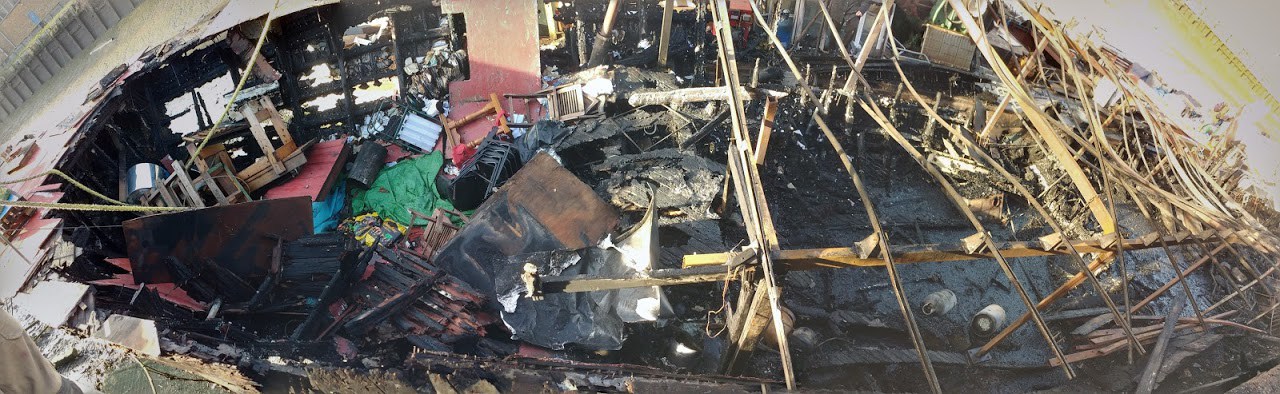
Since first writing this report the Minesweeper has been destroyed by a terrible fire on 5th Jan 11pm. Despite quick response from the London Fire Service and attendance of a dozen fire engines, it was all over by 5am – toast. Adjacent boats were also effected as was the mechanics workshop in the Brookmash estate. YT visited on Friday and stood on the river wall there with some Minesweeper Collective members looking over the side into the abyss of charred timbers and blackened soup of belongings, chairs, books, some vinyl records and somewhat strangely, bags of charcoal untouched by the fire.

For those living and working aboard the Minesweeper, keeping warm during winter months presents the greatest hardship. Wood burners are kept alight 24/7 that require continual feeding. A store of suitable timber has to be collected throughout autumn and kept dry for use. Neighbours in in Brookmash yard supply the off-cuts from their furniture production. (as well as supply power the broadband wireless uplink)

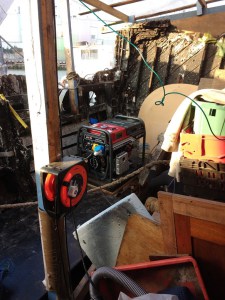
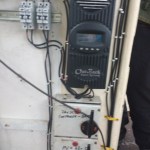
The collective recently purchased a new AC generator after many months fundraising and having experienced breakdown of previous secondhand units, however bad luck has again struck, an oil leak forces it’s return for repair, leaving them without power again. A new wind turbine is ready for installation, to provide the top up charge their battery array needs if it to remain in good condition to supply 12v for lighting and laptop charging. The print working areas of the minesweeper already have bright LED worklights fitted, with more needed throughout, as well as external motion triggered perimeter and safety lighting.

An energy audit was carried out on the boat late summer as part of the Creeknet pilot, which revealed just how much energy the print curing and screen cleaning processes demand, too much of a shortfall for any solar or wind turbine system to close. Gaining a better understanding about how off-grid power systems need to be configured and managed has been difficult, though progress is being made. We recently visited other boats on the creek and noted how their installed systems reliably store and distribute available power as needed, so will return for their support if the need arises.

Over a year ago, YT attended Transmediale media arts festival in Berlin to meet up with old friends living in the city and introduce them to members of the Mazi project attending for the first time. One of the first panels Global Ports still resonates as we edge forward with Creeknet pilot in Deptford. Much like in Port of Hamburg, the PLA (Port of London Authority) conforms a hydrachy of power, governing access to the waterways of the city, monitoring shipping and controlling all but the the weather and tides.

For those who are dependent on the Thames and it’s tributaries for transport,  trade and residence, there are very few resources available to guide use and track changing conditions.  It’s the knowledge of the boating community and their interpretation of PLA bylaws that hold sway here. Resistance, skulks the waters edge, using forgotten inlets, overgrown steps and derelict locks, to retain river access and uphold liberties. Mooring rights and tidal rituals, ebb and flow along the river wall, entangled in mooring chains, revealed as the river bed is drained by tides.

The Thames river wall all the way into Deptford Creek is part of the UK coastline, it’s beaches are monitored and rubbish cleared. Material on the shore clusters much where it was dropped into the water so great collections of red brick, clay pipes, animal bones, oyster shells and drift wood colour the shorelines in alignment to forgotten industry. Warehouses and wharves are fast being replaced by multi-story condos, only a very few remain out of the grasp of developers such as the abandoned squatted restaurant on Odessa Street up river in Rotherhithe, where recent Minesweeper fundraiser was such a success.

The burning of the Minsweeper and subsequent loss of mooring access at Brookmarsh Yard in Greenwich, point to an inevitability that will end occupation of these reaches by  the many barges and boats currently resident. Lengthy negotiations and legal actions by boaters to retain land access and not often ended well. Current proposals for redevelopment at 2 Creekside could well be followed by overturning of long established moorings at No4. Meanwhile, redevelopment of No3 and No1 form breaking wave of transformation that may well consume all undeveloped land and property up to Deptford Church Street.