Contact workshop during Hybrid City III conference

SPC took part in the CONTACT workshop during the Hybrid City III conference, meeting collaborators of the MAZI project.

diversity

An indoors/outdoors workshop which explores citizen engagement in the smart city toward more conviviality and human interactions, shifting the perspective from sensors to senses, from Internet-based locative media to offline DIY networks, from algorithmic matching to genuine serendipity, from powerful mediators to local actors.

CONTACT wishes to explore the advantages of offline networks and smart city concepts for the design of technology that can serve face-to-face meetings and local communities. We will first provide a short introduction to certain important concepts that help us guide the workshop participants through a collaborative process of hybrid space design: Do-It-Yourself networking, urban interaction design, field research methodologies, and the role of the stranger. Then we will go out to the streets of Athens to explore the surroundings of the conference’s venue, to analyze the spatial and social aspects of different places, and to identify locations that are candidates for hybrid urban interventions toward our objectives of conviviality and human interactions. After our collective walk, we will gather in a public space to think together about possible applications and possible processes to design them, including software, hardware, surrounding artifacts and performance. We will focus on ways to take advantage of the special characteristics of DIY networking — ownership, de facto physical proximity, anonymity, and inclusive access — to facilitate contact between strangers, in t,his specific part of the city. The next day, building on the number and competencies of the participants, we will develop a few prototypes of selected applications and organize an urban intervention in some of the selected locations.

Dyne @ CCC Camp

This year Dyne presented Devuan @ the CCC camp. Also see how to take care of skeletons in your closet with tomb.

quoted from the ccc devuan page:

Believe it or not, there are many users and ICT professionals needing to opt-out from systemd, for various reasons for instance to keep compatibility with old scripts or to keep supporting embedded setups, or simply because they don’t believe systemd is going to work. As a matter of fact, from its first announcement in November 2014 until today the Devuan project received enormous media attention and a steady stream of donations up to approximately 10.000€.

This lightning talk will illustrate the state of things in Devuan development, which is quickly approaching its 1.0 Beta release.

For the 1.0 release Devuan will derives its own installer and package repositories from Debian Jessie, applying the necessary modifications to remove systemd. Our objective for 2015 is to make anyone using Debian Wheezy or Jessie able to update or switch to Devuan 1.0 – and we are very close to enter Beta stage.

As of today we have a continuous integration system in place and fully functional based on gitlab, jenkins and a custom repository software called Amprolla. We are also supporting the development of a new, minimal susbstitute for udev which written from scratch and is called vdev.

Action timed, envisioned..

James Stevens shared the great news of MAZI getting the Horizon2020 grant, on the SPC blog:

Despite the numerous claims raised by UK councils and GLA to establish public wireless service for all, few examples have made it out of the boardroom and even then, fall to commercial pressure or operational chaos before long.

mazi_logoWe are hopeful that the very recently awarded fund for MAZI project starting early in 2016, will re-energize interest and activity along Deptfords Creekside, with a program supporting development of local innovation over the next 3 years that will galvanize existing networks and promote fresh collaborations.

DagePano2015

This image is taken from the roof above the DAGE shop on Deptford High Street, one of the dozen surviving OWN nodes which continues to offer public access and mesh with the other points in the area. It retains a unique status in London, an operational model of ‘collectively owned and operated broadband infrastructure’, but by just a thread!

lateralaniBuilding and co-coordinating public access networks is very tricky and time consuming operation but increasingly affordable and relevant. As we wake up to the realities of state surveillance and data mining of our interactions, we may well find the recent interest in off-line networking adds a layer of obscurity that’s preferable.

En Necromasse: an optimistic, fungal perspective on death and production

Our friend Debra Solomon opened her show “En necromass: an optimistic, fungal perspective on death and production”

Debra’s practice has involved exploring the role of fungi as transformers of organic materials and as soil builders. Her residency placed particular emphasis on the soil rhizosphere; where plant roots, microbiota and soil fungi interact. During her residency she closely observed soil building in the diverse living locations of the gardens and woods at Schumacher and within the Dartington Estate. She was also able to engage with horticultural experts, including the Head Gardener at Schumacher (Jane Gleason), the Head Gardener at Dartington (Ian Gilbert) and the Forest Garden expert Martin Crawford, in a conversation about the value of soil compared to mainstream agricultural practice.

From this experience she developed a series of screen-prints, presented here, about soil from the perspective of fungi called En necromass: an optimistic, fungal perspective on death and production. The works reference the vast communication and exchange that takes place in around the root zone. Here there is the most life and nutrient production as well as the death and decay of organic matter, as nutritious necromass transforms into soil. The rootball of a recently storm-felled tree, mycelium feeding on a dead leaf, a leaf’s skeleton, and spore prints that appear as ghosts, tell a myco-centric story of materials becoming soil.  The silkscreen prints were produced with the well-known Amsterdam printmaker, Kees Maas.

after.video @ Besides the Screen

… this was the abstract for the ‘show & tell’
… which we adapted and updated a little with the actual presentation:

» Show & Tell: the ‘S.o.S’ piratebox & beyondthis ‘show & tell’, held together with Adnan Hadzi, presents the reflections of the journey of the ‘S.o.S’ piratebox, a research hosted and interlinked with work-and-research structures of the Brazil Besides the Screen conference, the Istanbul Video Vortex event, the reSync Athens workshop, and finally the Berlin Transmediale festival.
Materials were loaded onto a research-black-box (Pirate-Box) that could & can accumulate and ‘commonize’ critical material, travel and be presented at any place in any time.in particular we would like to discuss our ideas on new modes of collective and spectral research.
… and possibly give an outlook of the upcoming ‘after.video’ project that evolved partly out of this – basing theory exposition on video as carrying format.—in my part I show some attempts to develop formats of credible ‘theory’-production beyond the text-form – and show some collective and media-saturated examples, also arguing for blurry lines between ‘academic’ theory building and other forms when it comes to contemporary cultural and social phenomena – or media culture itself.I also touch upon the impact a social semiotics approach has to formats of theory (theoretical referencing) itself, and touch upon questions of ‘cultural referencing’ – and its inherent difficulties in times of new global copyright regimes that particularly enclose the ‘moving image’.while complex systems of para-textual reference, exposition and theory-building are getting more and more abundant (making it possible to turn events like a conference into a hyper-text), the options to extend cultural references to the most central cultural ‘para-texts’ and semiotic resources is getting more and more problematic.
… thus the current phenomena in research, theory building and other forms of systematic ‘cultural referencing’ are showing us, how every new medial formation – and indeed: every new research formation – implies new forms of ‘piracy’ in its entourage. «

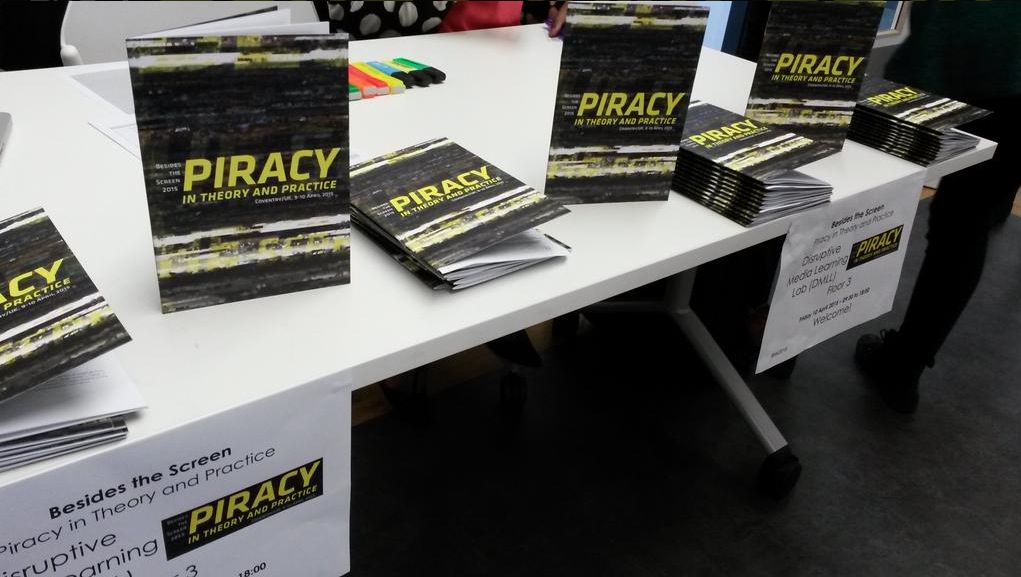
Departing from the relation of movie piracy with the economy and politics of content distribution, the symposium means to discuss the dynamics of authority embedded in contemporary systems of communication and explore how informal media practices might intervene with the development of new technologies, frame film curating, foster or inhibit particular scholarships, and even raise questions about the ontology of the moving image. BTS 2015 announcement

:: Besides the Screen
» seeks to make an intervention into film and screen studies by examining and considering the elements of cinematic experience, production and dissemination that exist beside the screen. New media technologies impact cinema well beyond the screen; they also promote the reorganization of its logic of distribution, modes of consumption and viewing regimes. This publication speculates about the changes in modes of accessing, distributing, storing and promoting moving images and how they might affect cinematographic experience, economy and historiography. In doing so, Besides the Screen examines three key themes: distribution, promotion and curation. The volume’s main argument is that we must examine those practices that exist besides the screen if we are to consider fully how filmic experience is mediated by various technological and societal changes in the early decades of the twenty-first century «

Programme

Thursday 9th April 2015 12.00 – 17.00 – DMLL Grass – Workshop [invited participants online]
17.00 – 19.30: Besides the Screen Book Launch

Friday 10th April 2015 DMLL Teaching Room

10.00 – 10.30: Welcome and Intro to Besides the Screen Network – Virginia Crisp

10.30 – 12.00: Panel 1
_ The Pirate Cinema – Nicolas Maigret The Pirate Cinema
_ Read Me – Maria Roszkowska
_ Tropa(s) de Elite: of the Forms Created within Informal Media – Gabriel Menotti

12.15 – 13.45: Panel 2

_ Torrentocracy: Archival Chivalry and Piratical Honourability – Jonas Andersson Schwarz
_ Show and Tell: the ‘S.o.S’ Piratebox and Beyond – Adnan Hadzi and Oliver Lerone Schultz
_ Gambiarra Culture in Brazil and its Impact on Piracy – h.d. Mabuse

14:30 – 16.00: Panel 3

_ Piracy and Access to Educational Materials in Rio de Janeiro: Shadow Libraries and Beyond – Pedro Mizukami
_ Reimagining Film History Through Piracy: Reflections on the Case of Budget Films, 1975 – Paul McDonald
_ Pirate Capitalism: The Theory and Practice of Monstrosity – Gary Hall

16.15 – 17.45: Plenary Lecture
_ Piracy and Economic Plurality Ramon Lobato

17.45 – 18.00 Closing remarks – Virginia Crisp


Adnan Hadzi – Spectrals of the Spectacular from Besides the Screen on Vimeo.

Documenting Random Darknet Shopper: «Here, but Invisible»

Today we documented Aram Bartholl’s workshop «Here, but Invisible» and the «The Darknet – From Memes to Onionland. An Exploration» exhibition, featuring !Mediengruppe Bitnik’s Random Darknet Shopper.
«The Darknet – From Memes to Onionland. An Exploration»

There is a parallel world beneath the surface of the Internet: the Darknet is an encrypted, invisible network that cannot be accessed by conventional browsers or search engines but is nevertheless used by millions. This digital territory is the impulse for cooperation between the artist collective !Mediengruppe Bitnik (Carmen Weisskopf and Domagoj Smoljo), the project :digital brainstorming from Migros-Kulturprozent and Kunst Halle Sankt Gallen. Forms of organisation, structures and communications systems which penetrate everyday life but which are largely unknown to the public will be examined with the help of other artists, theoreticians and hackers. The exhibition «The Darknet – From Memes to Onionland. An Exploration» will open Kunst Halle Sankt Gallen for interdisciplinary expeditions and encompass themes such as copyright, privacy, illegality and resistance.
Public awareness of the Darknet, also called Deep Web or Onionland, has increased as a result of recent events. It has a bad reputation: drugs, weapons, pornography, stolen data and forged documents can be bought there. However, Edward Snowden’s revelations seem to have shifted this one-sided perception. The Darknet is an apparently power-free space with potential that is still little-known and even less used. The participants want to take this factor seriously as critical individuals and articulate its non-transparent mechanisms and systems. Some artistic contributions directly access data and visual worlds from the Deep Web. For example, !Mediengruppe Bitnik transports goods and games from this Internet subculture into the art space while Eva and Franco Mattes present reactions to a video from Onionland. Cory Arcangel’s work remains concealed from exhibition visitors. He is concerned with the
visibility of the Kunst Halle on the World Wide Web. Other artists deal with Internet phenomena that also exist on the Surface Web and which are located in the tension-filled area between anonymity and commerce: Robert Sakrowski is curating YouTube films on the history of Anonymous, Valentina Tanni is making available her archive of memes and Simon Denny will provoke questions about business models, income and property in times of global data interchange. In contrast, Heath Bunting examines
data storage in relation to identities. These are constructed by means of shopping cards, credit cards or mobile phones. The artist thus also broaches the subject of class systems. Conversely, an identity can also be deleted – as Seth Price demonstrates with How to disappear in America.
With this show the Kunst Halle Sankt Gallen links the visible and the invisible which are interlocked – From Memes to Onionland. Aware of the uncertainties in this regard an approach from multiple perspectives is intended. It is an attempt to grasp this extremely controversial phenomenon of our times with artistic contributions, archive material, workshops and discussions. The format of the exhibition gives visitors access to the digital underground and questions familiar notions – Kunst Halle Sankt
Gallen can now also be found in Onionland at http://vtw7g7wcdsgxq4ru.onion/

In cooperation with !Mediengruppe Bitnik and :digital brainstorming
With contributions from: Anonymous, Cory Arcangel,!Mediengruppe Bitnik, Aram Bartholl, Heath Bunting, Simon Denny, Eva and Franco Mattes, Seth Price, Robert Sakrowski, Hito Steyerl, Valentina Tanni

The Random Darknet Shopper

The Random Darknet Shopper is an automated online shopping bot which we provide with a budget of $100 in Bitcoins per week. It goes on a weekly shopping spree in the deep web where it randomly choses and purchases one item and has it mailed to us. The items are exhibited in «The Darknet» at Kunsthalle St. Gallen, each new object adding to a landscape of traded goods from the Darknet.
The Random Darknet Shopper is a live Mail Art piece, an exploration of the deep web via the goods traded there. It directly connects the Darknet with the art space. The items bought in the Darknet by the Random Shopper are commonly contraband and range from drugs to counterfeits, ebooks, software, electronics and services including security and hacking services.

All these items share as a common characteristic the most interesting aspects of hidden online markets: They exemplify how the internet in general and the darknets most notably are helping to increasingly blur the lines of national legal dictates: What is legally produced and sold in one country is not necessarily legal in another [1]. Being global, these markets connect diverse jurisdictions, questioning the notions of legality and producing a vast greyzone of goods available virtually everywhere.

Furthermore, the goods traded in the darkweb show the manner in which trust is successfully established in anonymous networks. Although the hidden market is based on the anonymity of its participants, rating systems and anonymous message boards ensure a certain level of trust. The ability to rate your dealer is radically changing the way people are buying drugs and other controlled items. Buying contaband online means having access to a reliable rating system, while at the same time staying anonymous, all from the comforts of your home.

By randomizing our consumerism, we are guaranteed a wide selection of goods from the over 16’000 articles listed on Agora market place. We want to see what goods come out of the deepweb, where they are sent from, how (and whether) they arrive. We want to find out how the goods are packaged to be concealed from the postal services.

Agora
The random darknet shopper shops at Agora, a marketplace in a part of the Darknet called Onionland. The Darknet and Onionland are hidden niches of the Internet which are not discoverable by search engines and which are accessible only for visitors who cloak themselves by using the anonymous Tor Browser. In the Darknet, people meet, chat, trade. Activists and dissidents use the cloaking mechanisms of the Tor Browser to cover their tracks.

Agora launched in 2013 and has become the largest and most popular online hidden marketplace since the take-down of Silkroad in October 2013. Its customers are able to buy or sell virtually anything, including illicit goods like drugs, contraband or weapons.

The Agora Market uses the anonymous cryptocurrency bitcoin to pay for transactions. To protect customer privacy, Agora uses anonymous courier services and camouflage for shipping regulated and prohibited items. Site transactions, despite anonymity, are surprisingly reliable. Like in similar surfaceweb market places, all transactions can be rated, allowing customers an assessment of the seller and his or her goods.

There are already more than 16,100 listings on Agora, according to a new report from Digital Citizens Alliance, a U.S. crime research group [2]. That popularity is enough to make Agora more popular than Silk Road 2.0, the black market that sprouted when the FBI closed down the original incarnation in October 2013.

The Random Darknet Shopper is a temporary exploration of the Darknet through the greyzones of hidden online markets. We regard it as crucial that art must inevitabily expand to include new formats and subject matters if it is to stay relevant. That is why we consider the Darknet to be a valid subject matter for art because not only the Internet but also the Darknets are changing the fundamentals in which societies work. How does building trust relationships work in a global market that is based on the anonymity of its participants? How do we maintain notions of legality and illegality when these markets
connect diverse jurisdictions with differing concepts of what is lawful. How do we as societies deal with anonymity online while offline identifiability, trackability and surveillability become the norm?

Viewed under Swiss art laws

The Swiss art law expert, Bruno Glaus, also considers the work to be legitimate and legal under criminal law. In his book “Kunst- und Kulturrecht” (Art and Culture Law) to be published in 2015, he outlines the preconditions that justify a violation of law in an art work.
In the Swiss constitution freedom of art is explicitly referenced. This requires judges to carefully balance interests between the interests of free art production and an exceptional breach of law [3]. According to Bruno Glaus, the preconditions that justify a violation of law in an art work are a plausible interest of scientific, artistic or informational nature. Also the infringement should be comprehensible and described in a written statement or concept. The breach of law should be temporary and the means used should be
appropriate [4]. Additionally, in accordance with Swiss law, the prosecuting authorities can refrain from prosecuting due to minor fault [5].

[1] See for example how eBay und Paypal, two US-american companies, restrict certain items on European eBay/Paypal sites because of trade restrictions in US law. They do this for example for Cuban goods where by doing this, they override European laws. See German Wikipedia: “Beim Handel mit Waren aus Kuba gilt nach US­Recht, dass eBay Deutschland – ebenso wie z.B. eBay Österreich und eBay Schweiz – als Tochterunternehmen eines US amerikanischen Konzerns „denselben Handelsbeschränkungen unterliegt wie die Muttergesellschaft“. Folgerung von eBay: „Daher dürfen  grundsätzlich nur solche kubanischen Artikel bei eBay angeboten werden, die ‚informativ‘ oder ‚lizenziert‘ sind oder die vor dem Inkrafttreten des US­Handelsembargos gegen Kuba am 8. Juli 1963 auf den Markt gekommen sind.“ Daher ist es zum Beispiel nicht möglich, kubanische Zigarren auf eBay anzubieten.
Nach Expertenansicht verstösst diese Handhabung, die auch für die eBay-Tochter Paypal angewendet wird, jedoch gegen die Verordnung (EG) Nr. 2271/96, die sogenannte EU Blocking Regulation. Diese verbietet es europäischen Unternehmen, also auch europäischen Tochterunternehmen außereuropäischer Muttergesellschaften ausdrücklich, die US-Sanktionsbestimmungen gegen Kuba und verschiedene andere Länder zu befolgen. “ Wikipedia (in German): http://de.wikipedia.org/wiki/EBay#Handelsbeschr.C3.A4nkungen_nach_US-Recht
Also (in German): http://www.welt.de/print/die_welt/wirtschaft/article13516280/Die-Bank-gewinnt.html
[2] Report by Digital Citizens Alliance, published 22.08.2014: http://www.digitalcitizensalliance.org/cac/alliance/content.aspx?page=Darknet
[3] “Die ausdrückliche Erwähnung der Kunstfreiheit in der Verfassung führt dazu, dass Richter im Einzelfall vermehrt eine Güterabwägung vornehmen und entscheiden müssen, ob das Interesse an künstlerischer freier Produktion ausnahmsweise die Rechtsverletzung zu rechtfertigen vermag .” From the manuscript of “Kunst- und Kulturrecht”, Bruno Glaus et. al., 2015

[4] “Grundvoraussetzung für die Rechtfertigung einer Rechtsverletzung im künstlerischen Kontext ist ein nachvollziehbares Informations, Kunst- oder Wissenschaftsinteresse. Der Eingriff sollte so weit als möglich erkennbar sein oder jedenfalls im Konzept nachvollziehbar erläutert und als begrenzter „Laborversuch“ deklariert werden. Zweck kann ja beispielsweise eine Untersuchung der durch ein Projekt ausgelösten Proteste sein (vergleichbar den Blind- und Doppelblindversuchen bei Medikamenten). Meist wird ein – gewöhnlicherweise widerrechtlicher – Eingriff, nur für eine beschränkte Zeit durch ein überwiegendes Kunstinteresse gerechtfertigt werden können (z.B. Aktionskunst, Einsperren eines Tieres, Belästigung von Personen auf der Strasse durch Theatermacher, Ausstellen von illegalen Gegenständen usw.). Die zum Zweck eingesetzten Mittel müssen notwendig, verhältnismässig und zumutbar sein (dies in Analogie zu den Datenschutzgrundsätzen).” From the manuscript of “Kunst-und Kulturrecht”, Bruno Glaus et. al., 2015 [5] “Unter strafrechtlichen Aspekten ist folgendes zu berücksichtigen: Die Strafbehörden haben gestützt auf Art.52 StGB die Möglichkeit (und die Pflicht) von einer Strafverfolgung oder einer Bestrafung abzusehen, „wenn Schuld und Tatfolgen“ gering sind (beschränktes Opportunitätsprinzip). Insbesondere bei der Schuldfrage muss das Interesse an freier künstlerischer Entfaltung berücksichtigt werden.” From the manuscript of “Kunst- und Kulturrecht”, Bruno Glaus et. al., 2015

Near Field Communication

We are experimenting with near field communications (NFC) to stimulate distribution of homegrown media over the open wireless network (OWN in London, and Freifunk in Lueneburg).

NFC is a set of standards for smart-phones and similar devices to establish radio communication with each other by touching them together or bringing them into close proximity, usually no more than a few inches. Present and anticipated applications include contactless transactions, data exchange, and simplified setup of more complex communications such as Wi-Fi.  Communication is also possible between an NFC device and an unpowered NFC chip, called a “tag”. More on NFC.

An idea is to design stickers with embedded tags which we then distribute during our workshop in Lueneburg and thus mediating Deckspace.TV and any local media sources in Lueneburg (eg. Freifunk/Graswurzel.TV).

We ordered this RFC reader/writer (see also advance card reader ltd.)

Radio-frequency identification (RFID) is the wireless non-contact use of radio-frequency electromagnetic fields to transfer data, for the purposes of automatically identifying and tracking tags attached to objects. The tags contain electronically stored information. Some tags are powered by and read at short ranges (a few meters) via magnetic fields (electromagnetic induction). Others use a local power source such as a battery, or else have no battery but collect energy from the interrogating EM field, and then act as a passive transponder to emit microwaves or UHF radio waves (i.e., electromagnetic radiation at high frequencies). Battery powered tags may operate at hundreds of meters. Unlike a bar code, the tag does not necessarily need to be within line of sight of the reader, and may be embedded in the tracked object. More on RFID.

File:Bugged-great-seal-open.jpg

The Thing on display in NSA‘s national cryptologic museum.

Interestingly Leon Theremin, the inventor of the theremin, is often referred to as the inventor of RFID. Leon created a bug (the Thing)  in order to spy on the US ambassador, operating on an RFID principle.

Leon Theremin playing his own instrument

start of fellowship

We started the PML fellowship with meeting sessions during the Transmediale resource006 event: Overflow.

Talked about theories, praxis, & administration (media utopianism of the 90s being trashed by web 2.0 / political, collective, social).

Jonathan Kempp and Martin Howse discussed christal worlds, drill corez, segmentation of the mind, stack/frame/heap, bio leaching…

Fabian Giraud presented several projects, burning the chip of a camera in the focus point of a particle accelerator underneath the louvre.

We also discussed the January 2014 event titled ‘Taking care of Things’

some more notes:
Howard Slater on Post Media
Claus Pias on Cybernetics
Mark B Hensen on human agency & social life
Forian Cramer on Anti-Media
Graswurzel.TV  Susa Neubronner
Conrad Atkinson on Dreams of Permanence: Dreams of Transience
Fassbinder’s film Welt am Draht
Kate Rich on bureau of inverse technology
Friedrich Kittler on time based media
Wolfgang Welsch on Ästhetisches Denken
Robin Mackay editor collapse journal

Research Questions

  • How might radical social perspectives interpret these convolutions of thought and action which re conceive human and object relations?
  • How do current models of politics contend with the question ‘do artefacts have politics?
  • ’ How do we relate digital aesthetics – in which abstract computational actors like algorithms give rise to new forms and morphologies – to the social and sensual conditions in which they arise and take effect?
  • What happens to our understanding of politics and culture when the satisfaction of ‘human needs’, however problematic these are to define, ceases to be a key aim of knowledge systems?
  • What, indeed, is ‘thought’ when the notion of the human, let alone the cogito, is recursively destabilised by the same man-made tools developed to defend our ontological centrality and certainty?
  • What can we make of ‘cognition in the wild’, when ‘the wild’ is seen not as threatening or dystopian, but as a social utopia?

FLOSSTV @ ISEA – 17th September 2011

Adnan Hadzi will be talking about FLOSSTV and Data Spheres at the ISEA conference.

Founded in the Netherlands in 1990, ISEA International (formerly Inter-Society for the Electronic Arts) is an international nonprofit organization fostering interdisciplinary academic discourse and exchange among culturally diverse organizations and individuals working with art, science and technology.

The main activity of ISEA International is the annual International Symposium on Electronic Art.

Founded in the Netherlands in 1990, ISEA International (formerly Inter-Society for the Electronic Arts) is an international nonprofit organization fostering interdisciplinary academic discourse and exchange among culturally diverse organizations and individuals working with art, science and technology.

The main activity of ISEA International is the annual International Symposium on Electronic Art.