ILUM @ELIA Biennial

Immersive Lab

Adnan Hadzi presented the Immersive Lab University of Malta (ILUM) project at the ELIA Biennial. In the Immersive Laboratory University of Malta (ILUM), as well as in the Visual Narratives Laboratory (VNLAB) of Lodz Film School, researchers, artists, and filmmakers investigate and create different kinds of immersion. Researchers from Malta will focus on the insights with state-of-the-art immersive experience (IX). After the presentation, participants will be invited to join the walk-through of Lost in a garden of clouds, virtual show of works that are engaging with aspects of the climate emergency and its negationism, with the places where natural or urban ecosystems connect with the digital ones and with the exploitation of natural resources and chemical pollution.

Expanding the Arts

An online extravaganza that will energise, inspire and kindle connections throughout the entire arts education community. In partnership with Zurich University of the Arts, thought leaders from the arts and academia, producers and practitioners, will explore the brightest, boldest transdisciplinary ideas, question the art of the possible and where boundaries lie. Be part of a rich tapestry of provocation, interrogation and co-creation crossing over 40 presentations, walk-shops, workshops and a myriad of opportunities to connect with collaborators. Together let’s re-imagine Arts Education as a catalyst for change in the post-COVID world.

Imagine you wake up and there is no Internet

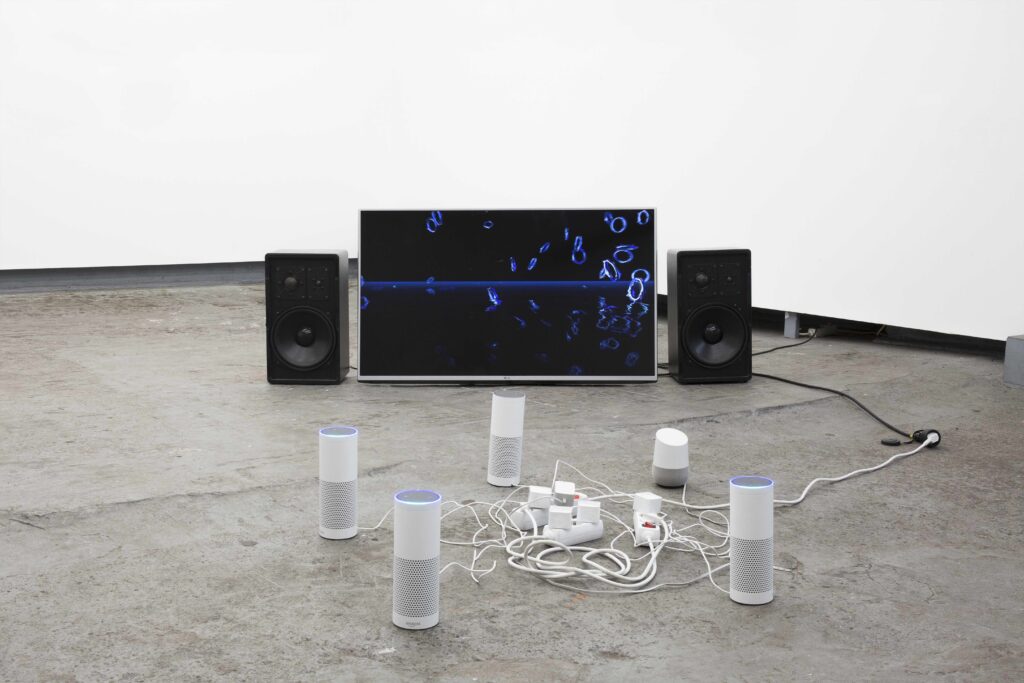
!Mediengruppe Bitnik & Low Jack – Alexiety (2018)

!Mediengruppe Bitnik & Low Jack (DE/FR)

Alexiety (2018)

Single channel video installation with sound, Full HD, 16:9, 08:28; Amazon Echo and Google home devices, screen, loud speakers and cables; printed 12” EP sleeve, print on acrylic glass, download code.


Intelligent Personal Assistants like Amazon’s Alexa, Google Home and Siri are the brains of the smart home ecosystem. They operate, monitor and control smart home appliances while keeping the algorithms and rule-sets that determine their workings secret. Intelligent Personal Devices are voice controlled, thus dissolving the machinic presence of the computer while placing its functionalities at the users disposal. It’s like living inside the machine, while at the same time having no agency over the composition and structure of one’s environment. What are the relationships that we are forming with these IPA devices? What happens when IoT devices are hacked to form rogue bot-networks? Is my capacity to act expanded or diminished when relying on these semi-autonomous devices?

Together with French musician Low Jack, !Mediengruppe Bitnik have been looking at ways to engage with Alexa and similar ‘Intelligent’ Personal Assistants through music. A set of three songs attempt to capture the feelings we develop toward Intelligent Personal Assistants: The carefree love that embraces Alexa before the data privacy and surveillance issues outweigh the benefits. The alienation and decoupling/uncoupling from the allure of remote control and instant gratification. The anxiety and discomfort around Alexa and other Intelligent Personal Assistants that is Alexiety. The EP is best streamed on the radio for the enjoyment of smart homes everywhere. Play it loud, so your neighbours devices can hear.

About the Exhibition

What will happen if one day you wake up and there is no Internet?
The exhibition Imagine you wake up and there is no Internet explores the effects of ubiquitous connectivity and technology in everyday life. Starting from our obsession with digital technologies, the exhibition seeks to enhance the debate about the coexistence of human and machine in the 21st century.   13 artists and 5 art collectives showcase scenarios from the present time and the near future, strategies of disconnection and disorientation, evacuation and escape plans from the city, studies on the information society, snapshots from digital life and the infrastructures that allows us to be connected to the network, and new readings for the political period we are going through. Any sense of certainty for the present and the future seems to have been destabilised.   31 years after the creation of the world wide web, concepts such as space, time, value and labor have acquired new meaning. And these concepts will continue to take on new meaning as the technology that we use the most, changes at great speed leaving us -often- in the position of the observer with little space for manoeuvring. The levels of control and surveillance in the networks we navigate, whether resulting from political decisions or market trends, are often obscure. At the same time, everyday life and personal data have acquired a particular economic value within networks and our obsession with constant connectivity, can only accelerate a technological future where human behaviour becomes predictable or can be predicted to meet political or/and economic trends.   The works in the exhibition highlight moments and fragments of our digital life surfacing issues related to the human-machine relationship and its impact on the public sphere. The exhibition aims at contributing to the discussion on the constantly accelerating dynamics of the Network, our position within it, and finally, the boundaries between a human-driven versus a machine-driven technological world.   The exhibition presents new commissions and works from: Marina Gioti, Vaggelis Deligiorgis, Antonis Kalagkatsis, George Moraitis, Manos Saklas, Alexandros Tzannis, Jono Boyle and the new version of the work “Tracing Information Society – A Timeline” by Technopolitics group.   Participating Artists:
!Mediengruppe Bitnik & Low Jack (DE/FR), Aram Bartholl (DE), Jono Boyle (UK), Heath Bunting & Kayle Brandon (UK), Vaggelis Deligiorgis (GR), Exonemo (JP), Marina Gioti (GR), Antonis Kalagkatsis (GR), George Moraitis (GR), No Más / No More (GR), Manos Saklas (GR), Molly Soda (U.S.), Superflux (UK), Technopolitics (AT), Alexandros Tzannis (GR), Filipe Vilas-Boas (PT)   Curated by Katerina Gkoutziouli & Voltnoi Brege

Salman Rushdie @Malta Book Festival

Ian McEwan & Salman Rushdie
Q&A with Salman Rushie
Il-Manifest Tal-Killer‘ – Merlin Publishers
Literature In Lockdown
The central Bank of Malta Library
Words of Protest
Easeful Death
Are we told what we should read?

The Malta Book Festival is the foremost book celebration in the country’s cultural calendar. Annually, the MBF boasts an attendance rate of 40,000 visitors, the participation of more than 40 exhibitors, and offers extensive networking opportunities for industry professionals

The first edition of the MBF was held in 1979, then called the Malta Book Fair (1979-2012), and has since grown into a festival that celebrates the book culture in all its forms. The international dimension of the Festival is increasingly reflected in the lineup of guest authors and publishers which in previous years have included Gilbert Sinoué, Ros Barber, Shad Alshammari, Basma Abdel Aziz, Patrick McGuinness, Alek Popov, Marie Darrieussecq, Maram al-Masri, Dan Sociu, Ros Barber, Vera Duarte, Tim Parks, Philip ò Ceallaigh, Naomi Klein and Judge Rosemarie Aquilina.

!Mediengruppe Bitnik @OPENCOIL – a roaming speed show

E scooters in Berlin, 10 01 2020 Berlin Germany

The OPENCOIL exhibition explores the impact of micro-mobility services on urban space by using its decentralised infrastructure as an exhibition space, while also addressing the conditions and effects of this infrastructure.

11 artists were invited to present their work on a small Wifi controller with ~2MB offline memory.

These “digital gallery spaces” are attached to 11 randomly selected e-scooters. Thus the exhibition, unnoticed by the regular users of these scooters, drives through the city as a “roaming speed show”.

From October 26th onwards the current location of the artworks will be displayed here on this website. In order to view the works the corresponding “Scooter Gallery” must be found in the offline urban space.

Once the scooter is rented, visitors will be able to access the 2MB gallery space and the exhibited works via their personal smartphone.

While capacity restrictions and the preferred avoidance of gatherings in closed spaces pose challenges on traditional galleries and museums, OPENCOIL aims to combine the independence of the online with the materiality of the offline (and vice versa). The infrastructure of “micro-mobility services” will be taken over – climate-neutral and decentralised.

The pavements of many cities around the world have been flooded in recent years by so-called ‘dockless sharing vehicles’. With promises of eco-friendliness and electromobility, these risk capitalism activists have occupied the grey zone between private and public space on the streets of our cities. However, this unscrupulous conscientiousness of ‘micro-mobility services’ raises important questions about urban space, ownership, agency, production, ecology and very late capitalism.

How to deal with the occupation of public space? What tools and ways are there to reclaim it?

OPENCOIL is not only meant to be a pandemic-proof way to show art in public offline space. OPENCOIL is also a creative (re)use of e-scooters, an attempt to approach them by artistic means. On show are works that deal with questions of the overlap between public and private space, the use of resources, as well as greenwashing, risk capitalism and vandalism.

The participating artists are:

Aram Bartholl
Constant Dullaart
Dennis de Bel & Anton Jehle
JODI
Jonas Lund
Martin Howse
!Mediengruppe Bitnik
Rosa Menkman
Sarah Grant
Sofya Aleynikova
Danja Vasiliev

Other explanatory notes:

The artistic contributions are each stored on a Wifi microcontroller, which is connected to a scooter and is thus supplied with power as soon as the scooter is rented. To view the works, you connect to the local unencrypted WiFi network sent by the Wifi chip. A web portal opens automatically, where the work can be viewed. No mobile data connection is necessary. All works have been specially optimised by the artists to be viewed on smartphones.

OPENCOIL is in no way associated with the “micro-mobility services”, but only uses the existing scooter network. The conversion of the scooters into an exhibition space is completely reversible after the exhibition ends and in no way restricts the conventional use of the scooters (even during the exhibition). The scooters will not be damaged.

The exhibition will start on October 26th with scooters spread around Berlin. For one week, until November 1st, the exhibition will be serviced and kept running daily by our team. Should a work be damaged or not be found, please send an e-mail (service@opencoil.show) or use the Telegram App (https://t.me/opencoil)

NONUMENT!

NONUMENT!

In 2020, the year when first NONUMENT! Book is to be published, many recently still lively public spaces and city centers have been transformed into nonuments. In the past, Nonument was devoted to decaying, destroyed and abandoned monuments, buildings and public spaces of the twentieth century. At the third NONUMENT! Symposium, we will combine these thoughts with new thinking about the possible strategies of thought and intervention in a continually transforming contemporary city. Through the cases of transforming buildings, squares and cities, guests from Ljubljana and abroad will think about the open use of space as the condition of survival.

14:00 INTRODUCTION

14:10 PANEL 1: Nonument Spaces (chair: Miloš Kosec)

Elisa Sorrentino: Casa Albero, an architectural experiment. (1967-1971, Fregene, Rome)

Urška Jurman: Community garden Beyond Construction Site in the time of Coronavirus (post)epidemic

Miljena Vučković: Identity Fade Out

Peter Rauch: Guilty Objects

15:45 PANEL 2: Urban Discontinuity (chair: Nika Grabar)

Blaž Babnik Romaniuk: Hidden in Plain Sight – The Network of Cooperative Centres in Slovenia

Antonia Stanev: The Home as an Antithesis to the Communist City and the Monument: The Preservation of Tradition During Totalitarianism

Adam Knight: Cultural Monuments of GDR History

Helka Dzsacsovszki: The expanding scope of the heritage value of socialist architecture; The case study of the MOM Kultúrház

17:20 PANEL 3: Public Space in Extremis (chair: Neja Tomšič)

Mollie Brooks: The Landscape as Archive: Public Art and Conflicting Narratives of Past, Present

Andrea Elera: Alto transito: Notes on public space in the midst of traffic

Nika van Berkel: New City Park Model – Revitalisation of the Central Stadium

Antonio Grgić: Monuments as Indicators of 2020 Global Change: Violent Demolition of Political Monuments around the World and COVID-19 Virus Pandemic

19:00 NONUMENT! BOOK ROUNDTABLE (chair: Miloš Kosec)

Nika Grabar, Neja Tomšič, Alexei Monroe, Ljubica Slavković, Danica Sretenović

20:00 KEYNOTE

Branislav Dimitrijevič: “Egypt” rather then “October”: Incongruences in interpreting Yugoslav national-liberation monuments, then and now

Storbju / Noise @Circuits 2020

Storbju Noise Monger
Tina DJ Set
Giacinte DJ Set
KNTRL
Hearts Beating in Time
Away from the Comfort Zone
A Tribute to F. Schneider
Le Tombeau de Tristona
Wild Fire
Sensing Satie
40 years of Electronic Music Malta

EMM’s festival this year in a COVID-19 friendly edition

Yes, our yearly event celebrating electronic music making is back with live streamed events featuring live music by Maltese artists, talks and workshops on different topics, plus you will get to know about music software techniques and how to build a small music gadget.

The Circuits 2020 programme, which will start on the 17th of October 2020, is shaped around this year’s theme of ‘Away from the Comfort Zone’. Workshops will cover topics such as building the ‘Storbju’ DIY synthesiser device, health awareness on exposure to excessive sound levels, the history of music production in Malta from the seventies to today, and representation of the Maltese entertainment and arts industry, copyright and music law.

This year’s participants

Grammy Award Nominee Tom Ammermann will be delivering an online workshop on spatial sound, with the participation of a live and online audience. Discussions throughout the festival will meanwhile be hosted by organisations such as the MEIA, M3P Foundation, PRS and the Malta Association of Audiologists. Apart from several DJ and live performances by electronic music artists including Giacinte, Tina, Hearts Beating in Time and KNTRL.

Away from the Comfort Zone & Storbju

Circuits 2020 will also feature a special project in line with the main theme, filmed at various locations around Valletta. The ‘Away from the Comfort Zone’ project will feature artists such as Acidulant, Carlo Muscat, Dawn Williams, Duo Blank, Jeremy Grech, Keith Farrugia, Luc Houtkamp, Mari Terramaxka, Owen Jay, Ruben Zahra, and Toni Gialanze.
Finally, Mike Desira and Frank Cachia will present ‘Storbju (Noise Monger)’ which will consist of a DIY electronic noise generating device and which will be soon available from EMM’s website with simple instructions how this can be built.

Event Programme

This year’s edition will take place (as in the previous years) at Spazju Kreattiv and will feature a programme of events which will be free of charge and which will be streamed live with the possibility of a live audience in attendance (this will be in accordance with the health protocols at the time). 

The live events will kick off on Saturday, 17th October 2020 and will then proceed till Saturday, 24th October 2020. The performances of  ‘Away from the Comfort Zone’ will be premiered one by one starting on the 18th of October up till November.

Electronic Music Malta is Supported by the Arts Council Malta.
This event is part of the Spazju Kreattiv programme and is also further supported by the German Maltese Circle and the Goethe Institute.

Tom Ammermann will host a talk about Immersive audio.
Away from the Comfort Zone: Le  Tombeau de Tristano by Luc Houtkamp & Mari Terramaxka
Away from the Comfort Zone: Wild Fire by Neil Hales Acidulant & Jeremy Grech
Away from the Comfort Zone: Sensing Satie by Owen Jay & Dawn Williams

Community Conversations 3: i-docs and multi-perspectival thinking

i-docs and Multi-Perspectival Thinking

In this webinar i-Docs Co-director, Judith Aston, and Stefano Odorico, Director of the International Research Centre for Interactive Storytelling (IRIS), will present their ongoing work on i-docs and multi-perspectival thinking. Central to this work is their research into polyphony, as a means through which to promote intercultural dialogue and exchange in a context of increasing polarization.

The aims of the webinar are: to introduce the main issues and debates that this research is bringing up, to provide some examples which point towards ‘polyphonic documentary’, and to open up a channel within the i-docs community for ongoing discussion on the application and relevance of polyphony to documentary practice.

This event will address a series of questions as follows:

  • What is polyphony and how has it been playing out to date within documentary practice?
  • How does this relate to ongoing debates about documentary authorship and co-creation?
  • What do Bakhtin’s ideas on polyphony bring to the party and what is their relevance?
  • How is the relationship between thinking and feeling being negotiated in this research?
  • What is the role of i-docs in a polyphonic context and how can this inform our practice?

The premise of this research is that multi-perspectival thinking is a necessary and urgent skill to be promoting, in order to create a solid base from which to address the many challenges that we are facing in these complex and uncertain times.

Observers and active participants are equally welcome!

More on the convenors:

Headshot of Judith Aston

Dr Judith Aston is Co-founder of i-Docs and an Associate Professor in Immersive Media at the University of the West of England in Bristol. She has an interdisciplinary background in anthropology, geography, interaction design and media practice. As an active member of the University’s Digital Cultures Research Centre, she is also an experienced tutor and PhD supervisor. At the heart of her work is the desire to put evolving media technologies into the service of promoting multi-perspectival thinking and understanding. She has published widely on this and her current collaboration with Dr Stefano Odorico on ‘The Poetics and Politics of Polyphony’ is the latest manifestation of this ongoing endeavour.

Headshot of Stefano Odorico

Dr Stefano Odorico is a Reader in Contemporary Screen Media at Leeds Trinity University where he is the director of IRIS (International Research Centre for Interactive Storytelling). He has published numerous works on film and media theory and practice, documentary studies, and interactive documentaries. He is the vice-chair of the MeCCSA (Media, Communication and Cultural Studies Association) practice network and he is a co-founder and member of the editorial team of Alphaville: Journal of Film and Screen Media. He is currently collaborating with Dr Judith Aston on a project focusing on polyphonic documentary theory and practice.

Social Justice & AI @ISEA

At ISEA 2020 Adnan Hadzi discusses the argument that the adoption of artificial intelligence (AI) technologies benefits the powerful few, focussing on their own existential concerns. ISEA 2020 was held completely online. The paper will narrow down the analysis of the argument to jurisprudence (i.e. the philosophy of law), considering also the historical context. We will discuss the construction of the legal system through the lens of political involvement of what one may want to consider to be powerful elites. Before discussing these aspects we will clarify our notion of “powerful elites”. In doing so we will be demonstrating that it is difficult to prove that the adoption of AI technologies is undertaken in a way which mainly serves a powerful class in society. Nevertheless, analysing the culture around AI technologies with regard to the nature of law with a philosophical and sociological focus enables us to demonstrate a utilitarian and authoritarian trend in the adoption of AI technologies. The paper will conclude by proposing an alternative, some might say practically unattainable, approach to the current legal system by looking into restorative justice for AI crimes, and how the ethics of care could be applied to AI technologies.

Working with Datasets

A roundtable discussion concluding Data / Set / Match, a programme exploring the crucial role of photographic datasets in the development of machine vision and artificial intelligence. 

While the first symposium, What Does The Dataset Want?, focused on the significance of the digitised image, this conversation will consider the acts of closely looking and working with datasets. Analysing the ways in which data has been collected, configured and signified, the event aims to help understand how the rise of machine learning is both exacerbating and unveiling inherited historic structures of power

This discussion will first consider the scale, accessibility and politics of image datasets that the artists experienced while working on their projects. Following this, the conversations will widen to a broad set of questions around datasets, looking, labour, language, categorisation, parameters, precarity, and futures.

Speakers include:

Philipp Schmitt, artist, designer and researcher.
xtine burrough, media artist and educator
Sabrina Starnaman, a professor at humanities department at The University of Texas at Dallas US
Everest Pipkin, drawing and software artist
Ramon Amaro, lecturer in Art and Visual Cultures of the Global South, Department of History of Art, UCL
Nicolas Malevé, visual artist, computer programmer and data activist. 
And more to be confirmed.

Recommended readings

An Introduction to Image Datasets, Nicolas Malevé
On Lacework: Watching and entire machine-learning dataset by Everest Pipkin
Recovering Lost Narrative In Epic Kitchens, by xtine burrough and Sabrina Starnaman
Tunnel Vision, by Philipp Schmitt

Biographies

Everest Pipkin is a drawing and software artist currently based in Pittsburgh, Pennsylvania who produces intimate work with large data sets. Through the use of online archives, big data repositories, and other resources for digital information, they aim to reclaim the corporate internet as a space that can be gentle, ecological, and personal.

xtine burrough is a new media artist. She regularly participates in international festivals of digital art and has authored or edited several books including Foundations of Digital Art and Design (2013, 2nd Edition 2019), Net Works: Case Studies in Web Art and Design (2011), and The Routledge Companion to Remix Studies (2015). She is Professor in The School of Arts, Technology, and Emerging Communication at UT Dallas.

Sabrina Starnaman is Associate Professor of Instruction in Literary Studies. Her research focuses on Progressive Era (1880-1930) American texts about social settlements and women’s activism, urbanism, and disability. Dr. Starnaman’s research explores how nineteenth-century activists remediated exploitative labor practices, racism, and poverty. She is interested in finding ways that their historical solutions, often implemented locally, can be brought to bear on similar problems in the twenty-first century.

Philipp Schmitt is an artist, designer, and researcher based in Brooklyn, NY. His practice engages with the philosophical, poetic, and political dimensions of computation by examining the ever-shifting discrepancy between what is computable in theory and in reality. His current work addresses notions of opacity, and the automation of perception in artificial intelligence research.

Dr Ramon Amaro is Lecturer in Art and Visual Culture of the Global South at UCL. He is a former Research Fellow in Digital Culture at Het Nieuwe Instituut in Rotterdam and visiting tutor in Media Theory at the Royal Academy of Art, The Hague, NL (KABK) and thesis at Design Academy Eindhoven (DAE). Dr Amaro completed his PhD in Philosophy at Goldsmiths, while holding a Masters degree in Sociological Research from the University of Essex and a BSe in Mechanical Engineering from the University of Michigan, Ann Arbor. He has worked as Assistant Editor for the SAGE open access journal Big Data & Society; quality design engineer for General Motors; and programmes manager for the American Society of Mechanical Engineers (ASME). His research interests include machine learning, the philosophies of mathematics and engineering, Black Study, computational reason, and philosophies of being. Dr Amaro is under contract from Sternberg/MIT Press to write a monograph on machine learning, race, and the philosophy of being, provisionally titled Machine Learning, Sociogeny and the Substance of Race. He is also co-founder of Queer Computing Consortium (QCC), which investigates the “languages” of computation and its role in shaping locally embedded community practices.

Nicolas Malevé is a visual artist, computer programmer and data activist who lives and works between Brussels and London.  Nicolas is currently working on a Phd thesis on the algorithms of vision at the London South Bank University. He is a member of Constant and the Scandinavian Institute for Computational Vandalism.

Machine Learning and Environmental Justice

Living Data and AI

Adnan Hadzi presented Machine Learning and Environmental Justice at the the RIXC Art and Science festival: ECODATA.

The RIXC Art-Science Festival: ECODATA aim is to explore the ‘ecosystematic perspective’. More than just rising awareness that living organisms are highly interdependent on each other and their environments, this year’s festival edition aims to reveal a web of connections that interweaves biological, social and techno-scientific systems, living and digital data, artistic and scientific approaches. 

ECODATA exhibition is the central axis of the festival, which forms the rest of the program, made in collaboration with Ecodata–Ecomedia–Ecoaesthetics” research group led by researcher and theorist Yvonne VOLKART, (Basel, Switzerland). The purpose of this exhibition is to bridge the gap between technological and ecological as well as to incorporate technological issues into ecological art. This year’s exhibition will feature twenty artworks by internationally acknowledged artists working in the field of media art, science and ecology.

ECODATA Exhibition
Guided Tour Through the Exhibition
ECODATA Opening Keynote Session: Art and Science Discussion
ECODATA Artist Talks
CODATA and A/I (artistic intelligence): Opening Performance by the Digital Dramaturgy Labsquared
ECODATA Exhibition Opening
Session 1: Technologies of Ecological
Session 3: BioSensing and Ecosystematic Perspective (1)
Session 4: EcoAesthetics
Thematic Session 5: Atmospheric Experience
ECODATA Thematic Keynote Talk
Session 6: BioPolitcs and BioDigital Poetics
Session 8: EcoAesthetics and Data
Session 9: Living Data and AI
Closing Session 10: GREEN REVISITED – Encountering Emerging Naturecultures
Closing Keynote Talk
Closing Program (Part 2): PLA(N)Tform Online Exhibition
Closing Program (Part 1): FOREST GARDEN GREENHOUSE Concert