Introducing: the ‘Storbju Noise Monger’ – a simple electronic noise generating device designed by Mike Desira and Frank Cachia.
Mike and Frank will be presenting a workshop on how to build the Storbju Noise Monger – a DIY synthesizer kit built around the Texas Intruments CD40106 chip. The chip consists of 6 Schmitt-trigger circuits and with it, our designers managed to invent a 6-oscillator noise device – with 3 high speed and 3 low speed oscillators.
This baby can be powered by a range of DC voltages of up to 9 volts. Its oscillators can be connected in a modular fashion; using small jump leads in a series of small connectors. A series of 7 potentiometers are used to control the main and individual oscillator frequencies and an optical detector can also be used to change the overall frequency.
The aim during the workshop will be to provide users with basic soldering skills as well as the knowledge of how to build this specific kit. So, participants will be required to bring with them their own Storbju Noise Monger kit.
With their exploration of logistics infrastructures, !Mediengruppe Bitnik provides insights into systems that usually work invisibly. From the investigation of algorithms that evaluate our social media profiles in their workFlagged for Political Speech to interference with the greatly automated mail system in Decisions Decisions Decisions the artistic duo observes the anatomy of these fully optimized automated systems that assist our daily lives and reveals their gaps and flaws.
Now it’s time for you tojoin the workshop with !Mediengruppe Bitnik and explore the hidden, unmapped networks of the world around you. Using five mini GPS trackers as tactical tools we will explore the service networks, waste management, transport networks of the city while the position data generated by the trackers will allow us to make visible movements as maps.
The two-day workshop in the form of a presentation and planning on the first day, and practical work on the second, will take place via Zoom. All participants will be able to follow the movement of devices on the map online for a continuous period of 5 to 10 days. Participants will work in teams of 3 and can either enroll as a group or individually. No special skills are required, however all partakers should have access to an end device and a good internet connection.
The human sensorium (or the world of sensory stimuli) has always been mediated. But over the past few decades that condition has greatly intensified. The microspeaker in the ear, the drug in the blood, the nanosurgical implant, the simulated taste in the mouth – these “enhancements” no longer provoke the apocalyptic excitement… The relative calm this situation provides, gives us time for reflection: a propitious moment for artists and other culture workers to interpret, think, and reckon with the sense of our mediated sensorium.” (Carolin Jones, “Sensorium”, MIT 2006).
The RIXC symposium offers a vision by artists and theorists on the world of the aesthetics of augmented senses and experience, stretching from the earliest beginnings of sensory data research to the interaction of immersive and sensory technologies between various perception sensors of the human body.
Ado Ato’s new story room platform Bemmbé Immersive
Creative Director and Immersive Artist Tamara Shogaolu will discuss the role of sound in her immersive storytelling process. In a medium often focused on visual achievement, Shogaolu will speak to the potential of pushing the boundaries of sound. Although varying in theme and form her recent projects are all connected by the centrality of sound. Her transmedia series Queer in a Time of Forced Migration is based on oral histories of LGBTQ refugees from the Middle East and North Africa. Her full dome experience, Echoes of Silence, is told entirely using archival audio from world cinema set in space. Sound is also a vital ingredient in her upcoming immersive experience, Anouschka which is to be voiced in spoken word. As an animated, interactive experience — designed for Ado Ato’s new story room platform Bemmbé Immersive™ — ANOUSCHKA invites the audience to play an active role in the storytelling through the use of immersive audio and different interactive lyrical components. The same is true for her soon to premiere collaboration with Frontline PBS, Un(re)solved. Shogaolu’s studio is working in tandem with the legacy news organization to further champion their mission to innovate storytelling. Un(re)solved will examine the FBI’s efforts to investigate over 100 potentially racist killings, while illuminating stories of those still seeking justice. In her talk, Shogaolu will discuss what follows when you allow the sound to shape the world of story.
Tamara Shogaolu is the founder and creative director of Ado Ato Pictures. She has worked for Sony Pictures Animation. The Tribeca Film Festival, Museum of Modern Art in New York and National Gallery of Indonesia have featured her work. The Guardian, Forbes Magazine and Vogue have named her as a leader in the field of new and immersive media. She was a 2018 Sundance Fellow, a 2019 Gouden Kalf Nominee, a 2020 Creative Capital Award Recipient, and a 2020 Sundance Grantee.
With many decision systems within our societies moving towards automation they are becoming increasingly data-driven. Algorithms are assigned a central role within these systems to make the decisions based on numbers. This evolving landscape of decision-making is hard to disentangle because many parts – the data sources, the algorithms, the processes – are deliberately kept secret and opaque. How can aesthetic practices help gain insights into these systems? And what could we do with this insight?
The upcoming streaming event entitled #ALGOREGIMES is an informal conversation between !Mediengruppe Bitnik and Felix Stalder on topics such as the invisibility of institutional processes, the functioning of infrastructures and logistics, and freedom and control in the data economy.
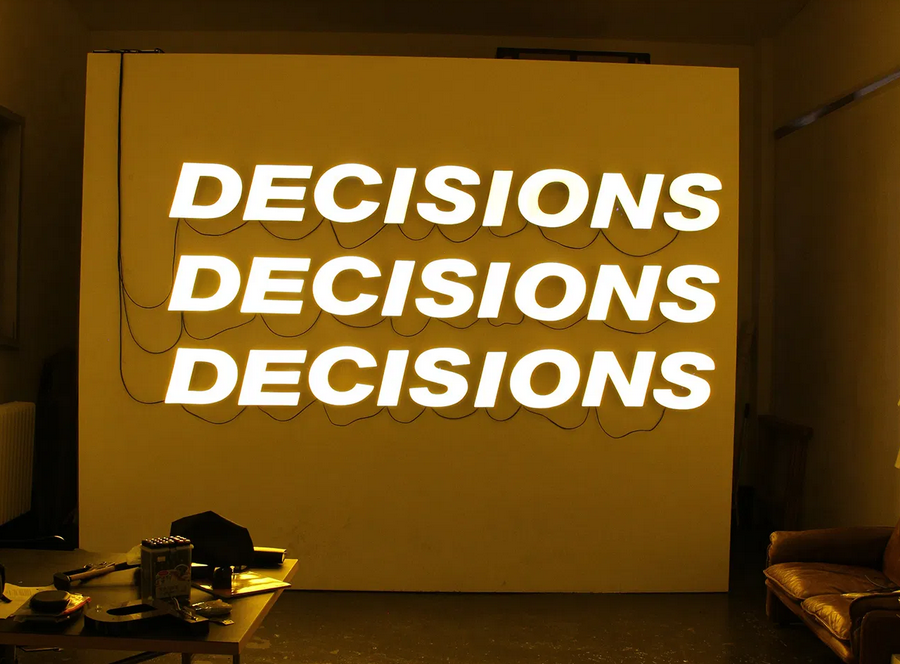
The work DECISIONS DECISIONS DECISIONS seeks out the imperfections in the logistic systems in which nowadays computers calculate nearly all necessary decisions. To do so, 27 packages were shipped out from Berlin via the logistics services provider DHL. Each package was, however, given two delivery addresses: one for Aksioma in Ljubljana and one for Drugo More in Rijeka. One address on each side of the parcel.
The resulting installation at the two exhibition spaces is formed from the letters that randomly arrive at each location, leaving the authorship of work as much to the artists as the postal machines.
Before reaching their final destinations, many of the parcels travel back and forth between different postal facilities. Depending on which side is scanned, they change directions multiple times. A TV screen in the gallery shows the recordings of the movements for each parcel, documenting the surrealist journey of the piece.
The now-empty boxes are presented in the gallery as the remaining envelope of the work and skeletons of the process. The work experiments with forcing a decision-making process on the postal system which does not usually decide – only routes. The work reinterprets The Postman’s Choice by Ben Vautier from the year 1965 in which a postal worker decides where a postcard that has two delivery addresses is finally to be sent. As it was back then, the standard rule in digital shipping operations is that for every shipping unit there must be one sender and one clear recipient. In today’s fully automated logistics systems, it is no longer the postman’s choice, but rather a question of which side of a parcel is “up” for the automated scanning process to read. The logistics system works mechanically by means of barcodes, scanners and programmed directives. Until the human supervisor spots and corrects the anomaly of the undecided recipient.
A 1500-page ‘Black Book’ that documents the horrific violence suffered by over 12,000 people at the hands of authorities on the EU’s external borders has been released today – International Migrants Day – by The Left in the European Parliament. Compiled by BVMN and printed over two volumes, the ‘Black Book of Pushbacks’ is a collection of hundreds of testimonies of migrants and asylum seekers who have experienced human rights violations at external borders.
December 2020 the New Normal artistic research book has been co-published by Strelka Press and Park Books. The New Normal publication encompasses the breadth, diversity, and intensity of activity that has taken place throughout the three-year project. From 2017–2019, The New Normal think-tank at Strelka Institute investigated the impact of planetary-scale computation on the future of cities in Russia, and globally. The work was conducted by ninety interdisciplinary researchers from thirty different countries and over forty faculty members, drawn not only from the field of architecture but also from the areas of computer science, philosophy, art, cinema, economics, and more. Projects ranged from short-form cinema and software design to proposals for new political systems and economic models. At stake for the work is not only what the urban future looks like, but also how it works; how it circulates ideas, value, and power. The twenty-two interlinked projects which were developed show how speculative urban design can move upstream in the decision-making processes.
Coined by Carl Schmitt and expanded by Giorgio Agamben, a “state of exception”—the exhibition’s Chinese title—refers to a political situation in which the normal laws and regulations of a society are abruptly suspended, replaced by temporary conditions that in turn become a new status quo. States of exception have been imposed at moments of crisis throughout modern history. Crisis today is constant, as ideals of freedom, equality, and openness, once held by some as universal values, give way to mass shootings, aborted ceasefires, violated norms, and tainted elections. In 2015, the Chinese leadership introduced “the new normal,” a way of talking about economic growth rates that, while lower than during the exuberant years of the early 2000s, continue to trump those of most other major economies. China’s assertively capitalist, internationalist response to these increasingly acute dynamics—recently typified by President Xi Jinping’s address to the World Economic Forum in Davos—might also be considered a “state of exception,” one that runs parallel to the new patterns of globalization that inform artistic cosmopolitanism today.
Journalists, activists, advocates, lawyers, researchers and critical thinkers unveil the persecution, control, and cultural violence around borders & migration.
BORDERS OF FEAR aims to shed light on wrongdoing in the context of migration by investigating the reasons and practice of rising borders and walls, leading to cultural and physical violence, persecution and human rights violations. The conference focuses on the discourse of borders both at a concrete level, and as a strategy of cultural violence on the part of right-wing propaganda. On the one hand, we analyse the closure of frontiers, creation of refugee camps, escalation of security; on the other hand, we investigate how border policing and the datafication of society are affecting the narrative around migrants and refugees in Europe and the west.
“Technical definitions, concepts and categories of migrants and migration are necessarily informed by geographic, legal, political, methodological, temporal and other factors.”
World Migration Report 2020
The terms “refugee”, “asylum-seeker” and “migrant” are used to describe people who are on the move, who have left their countries and have crossed borders, as defined by Amnesty International. Each category is treated differently by the law; however, many people who do not fit the legal definition of a refugee could be in danger if sent back home. For BORDERS OF FEAR we have decided to focus on the general terms of migration in relation to human right abuses and cultural violence, although we are conscious that legally there are specific differences.
The language used in the media to describe migrants, refugees and asylum seekers often blurs the line between those leaving their countries for economic betterment and those forced to leave to protect themselves and their families from war, conflicts and destruction of their countries of origin. Our perception of the situation in these diverse countries — be it North Africa, the Middle East or world wide — and the depiction of these people is heavily influenced by geopolitical strategies, financial plans, and the white Western perception of the diverse, unfamiliar and “the other”.
Brexit and other political developments have shown how the arrival of a relatively large number of migrants in areas that historically experienced low levels of immigration also makes it easier for populists to steer the debate and to claim immigration as the cause of social failure and declining standards of living, while more complex explanations of the often very different causes of the problems are drowned out by xenophobia.
Alongside, anti-immigration propaganda legitimises the construction of walls, the escalation of security, and forms of surveillance and controls at borders and frontiers. Cultural and physical borders become the context of discrimination, human rights abuses, violence and justification of pushbacks or detention centers, where people are locked away for years or are exploited by traffickers.
BORDERS OF FEAR brings together journalists, activists, media experts, lawyers, researchers and critical thinkers to unveil persecution, control, and cultural violence in relation to refugees and to people with a migration background. Furthermore, we want to hear directly the voice of the migrants and refugees themselves, to reflect collectively on forms of social justice in search for a deeper political awareness.
In order to lay the foundations for a discussion around the argument that the adoption of artificial intelligence (AI) technologies benefits the powerful few, focussing on their own existential concerns, the paper will narrow down the analysis of the argument to social justice and jurisprudence (i.e. the philosophy of law), considering also the historical context. The paper explores the notion of humanised artificial intelligence in order to discuss potential challenges society might face in the future. The paper does not discuss current forms and applications of artificial intelligence, as, so far, there is no AI technology, which is self-conscious and self-aware, being able to deal with emotional and social intelligence. It is a discussion around AI as a speculative hypothetical entity. One could the ask, if such a speculative self-conscious hardware/software system were created at what point could one talk of personhood? And what criteria could there be in order to say an AI system was capable of committing AI crimes?The paper will discuss the construction of the legal system through the lens of political involvement of what one may want to consider to be powerful elites. Before discussing these aspects the paper will clarify the notion of “powerful elites”. In doing so the paper will be demonstrating that it is difficult to prove that the adoption of AI technologies is undertaken in a way which mainly serves a powerful class in society. Nevertheless, analysing the culture around AI technologies with regard to the nature of law with a philosophical and sociological focus enables one to demonstrate a utilitarian and authoritarian trend in the adoption of AI technologiesThe paper will then look, in a more detailed manner, into theories analysing the historical and social systematisation, or one may say disposition, of laws, and the impingement of neo-liberal tendencies upon the adoption of AI technologies. The regulatory, self-governing potential of AI algorithms and the justification by authority of the current adoption of AI technologies within civil society will be analysed next. The paper will propose an alternative, some might say practically unattainable, approach to the current legal system by looking into restorative justice for AI crimes, and how the ethics of care, through social contracts, could be applied to AI technologies. In conclusion the paper will discuss affect and humanised artificial intelligence with regards to the emotion of shame, when dealing with AI crimes.
The conferences “Taboo – Transgression – Transcendence in Art & Science” include theoretical presentations and artists’ talks focusing (a) on questions about the nature of the forbidden and about the aesthetics of liminality, as expressed in art that uses or is inspired by technology and science, and (b) on the opening of spaces for creative transformation in the merging of science and art.A brainchild of Dalila Honorato, Assistant Professor at the Ionian University, the first two conferences, TTT2016 and TTT2017 were held in Corfu, Greece, organized by the Department of Audio & Visual Arts and supported by public and private institutions, mostly local. In the first two years the conferences were attended by Stelarc, Roy Ascott, Adam Zaretsky, Manos Danezis, Polona Tratnik, Gunalan Nadarajan, Irina Aristarkhova, Marta de Menezes, María Antonia González Valerio, Andrew Carnie, and Kathy High as guest speakers. The third TTT conference, TTT2018, took place in Mexico City, hosted by the Universidad Nacional Autónoma de México (UNAM) and the Centro de Cultura Digital as part of the N Festival. At the invitation of Marta De Menezes, Ana Ventura Miranda, and María Antonia González Valerio, the conference was co-organized by the Research and Creation Group Arte+Ciencia, UNAM (MX), Arte Institute (USA), Cultivamos Cultura (PT) as well as the Department of Audio & Visual Arts, Ionian University (GR).Since its beginning TTT seeks to provide a comfortable setting for the interaction of its participants and the students of the academic institution hosting it. This is accomplished through coordinating the conference’s agenda with the development of other activities such as art exhibitions, screenings, live performances, book presentations, poster exhibitions, and workshops developed within the hosting institution in collaboration with other organizations.In 2016 and 2017, among other events, TTT teamed up with the Audiovisual Arts Festival and the Municipal Gallery of Corfu to host the exhibitions “Stelarc: Alternate Anatomies”, “iGMO: Adam Zaretsky”, and “Body Esc” which included works by artists Andrew Carnie, Alkistis Georgiou, Marne Lucas, Joseph Nechvatal, Kira O’Reilly & Manuel Vason, Nikos Panayotopoulos, Ayse Gul Suter, Hege Tapio, and Adam Zaretsky. TTT2018, coordinated in partnership with the program of the FACTT 2018 – Festival Art & Science Trans-disciplinary and Trans-national within the N Festival, included in its agenda the opening of the exhibition “Espacios de Especies” with artworks, among others, by Brandon Ballengée, Andy Gracie, Bios ex Machina, Jaime Lobato, Kathy High, Lena Ortega, Marta de Menezes, Plataforma Bioscénica, Robertina Šebjanič, and Victoria Vesna. The conference in Mexico was preceded by the TTT Satellite Physiological Bioart – Body Performance Live Art Event “BioCuerpos Perfor|m|ados”, organized by the Grace Exhibition Space in collaboration with Casa Viva Gallery, Paranoid Visions UTA, and Anemonal, with performances, among others, by Boryana Rossa, Alexander Romania, Praba Pilar, Adam Zaretsky, Alejandro Chellet, Marita Solberg, Jacco Borggreve, Margherita Pevere, Cecilia Vilca and Lorena Lo Peña.The conference proceedings of 2016 and 2017, available as free e-books published by the Department of Audio & Visual Arts – Ionian University, can be accessed via the official TTT website. Both are edited by Dalila Honorato and Andreas Giannakoulopoulos, Associated Professor at the Ionian University and webmaster of the conferences’ webspace. Selected texts from the TTT2017 and TTT2018 were published in the Special Issue vols. 15:2 and 16:3 of the journal Technoetic Arts: A Journal of Speculative Research, at the invitation of Roy Ascott (editor-in-chief) to Dalila Honorato (guest-editor). The free digital edition of the proceedings of TTT2018, edited by Dalila Honorato, María Antonia González Valerio, Marta de Menezes and Andreas Giannakoulopoulos was released in November 2019 by the Ionian University Publications.The fourth international conference “Taboo – Transgression – Transcendence in Art & Science”, taking place November 26–28, 2020, would be in Vienna, hosted by the University of Applied Arts Vienna, at the invitation of Ingeborg Reichle, Professor and Chair of the Department of Media Theory. Due to the COVID-19 crisis the conference will be exclusively online: TTT2020 Vienna/Online.The TTT conference series is supported by its Steering Committee whose members include Roy Ascott, Plymouth University (UK), Andreas Floros, Ionian University (GR), Dalila Honorato, Ionian University (GR), Gunalan Nadarajan, University of Michigan (USA), Melentie Pandilovski, Riddoch Art Gallery (AU), Stelarc, Curtin University (AU), Polona Tratnik, Alma Mater Europaea (Slovenia), and Adam Zaretsky, Marist College (US).