The Pirate Cinema and Citation City

A live network data performance by Nicolas Maigret and Brendan Howell. / World-premiere of new audiovisual collage performance by People Like Us. (This is an adults only event. Visitors must be 18 years or older to attend.)

THE PIRATE CINEMA from N1C0L45 M41GR3T on Vimeo.

CAT: Performance
DAY: Thu 29.01.
DUR: 90 min
PLC: auditorium hkw

(Please note that this is an adults only event. Visitors must be 18 years or older to attend.)

The Pirate Cinema
The hidden activity and geography of real-time peer-to-peer file sharing via BitTorrent is revealed in The Pirate Cinema, a live performance by Nicolas Maigret and Brendan Howell. In their monitoring room, omnipresent telecommunications surveillance gains a global face, as the artists plunder the core of restless activity online, revealing how visual media is consumed and disseminated across the globe. Each act of this live work produces an arbitrary mash-up of the BitTorrent files being exchanged, in real time, in a specific media category, including music, audio books, movies, porn, documentaries, video games and more. These fragmentary contents in transit are browsed by the artist, transforming BitTorrent network users (unknown to them) into contributors to the audio-visual composition that is The Pirate Cinema.
Nicolas Maigret (Conception and live performance) & Brendan Howell (Software development and voice over)
The Pirate Cinema performance at transmediale 2015 is presented in parallel to a series of Pirate Cinema events commissioned by Abandon Normal Devices (uk), Aksioma – Institute for Contemporary Art (si) and Kunsthal Aarhus (dk).
> thepiratecinema.com
> aksioma.org/pirate.cinema

Citation City
A world premiere of the new audovisual performance of renowned collage artist People Like Us (Vicki Bennett). The project is a further development of the artist’s database approach to cinema, deconstructing cinematic clichés and representations into unique associative and playful narratives. Citation City sources, collage and edits 300 major feature films where content is either filmed or set in London – creating a story within a story, of the film world, living its life, through extraordinary times of change, to see what happens when these multiple narratives are combined… what will the story tell us that one story alone could never tell?

Inspired by The Arcades Project by Walter Benjamin, this audiovisual performance is created from 1000s of clippings of text and visual media, collaged using a system of “convolutes”, collated around subjects of key motifs, historical figures, social types, cultural objects from the time. By gathering and assembling such groups of similar yet unrelated, he revealed a hidden, magical encyclopaedia of affinities, a massive and labyrinthine architecture of a collective dream city. In the live performance a series of story lines (convolutes) sit side by side with a soundtrack sourced both from the movie content, as well as new sample compositions thematically related to the visual content.
> http://peoplelikeus.org/citationcity

nicolas_maigret_p1854_round

Nicolas Maigret (fr)

The artist Nicolas Maigret exposes the internal workings of media, through a reflection on their errors, dysfunctions, limitations or failure thresholds. As a curator, he initiated the disnovation.net research, a critique of the innovation propaganda. After completing studies in intermedia art, Maigret joined the LocusSonus lab in France, where he explored networks as a creative tool. He teaches at Parsons Paris and co-founded the Art of Failure collective in 2006.

Glossary of Subsumption: Enclosed Athens Disclosed

Presentation / Discussion. Would a collective “Glossary of Subsumption” be a meaningful way for registering enclosures and subsumptions in our hypermodern present?

FriedrichEbertStiftung_150

DAY: Thu 29.01.
DUR: 180 min
PLC: hkw foyer

Presentation / Discussion
At Foyer Hub 3

Would a collective “Glossary of Subsumption” be a meaningful way for registering enclosures and subsumptions in our hypermodern present? The originally marxist term of (real) subsumption is currently circulating anew as it allows for descriptions of capitalist power and ‚enclosure’ beyond simplistic ideas of coercion, corruption or exploitation. Its idea of capitalism capturing all that is outside existing capitalist valorization and of internalising it by different and historically specific means seems immensely helpful at a time where new post-digital and post-democratic grids of power enclose us anew – and sometimes in new ways. As a term also open to non-marxist semantics – see the notion of ‘subsumption architecture’ describing frameworks for distributed post-cybernetic control – it can prove to be especially helpful when collating different types, formats and layers of power, including current digital re-articulations thereof.

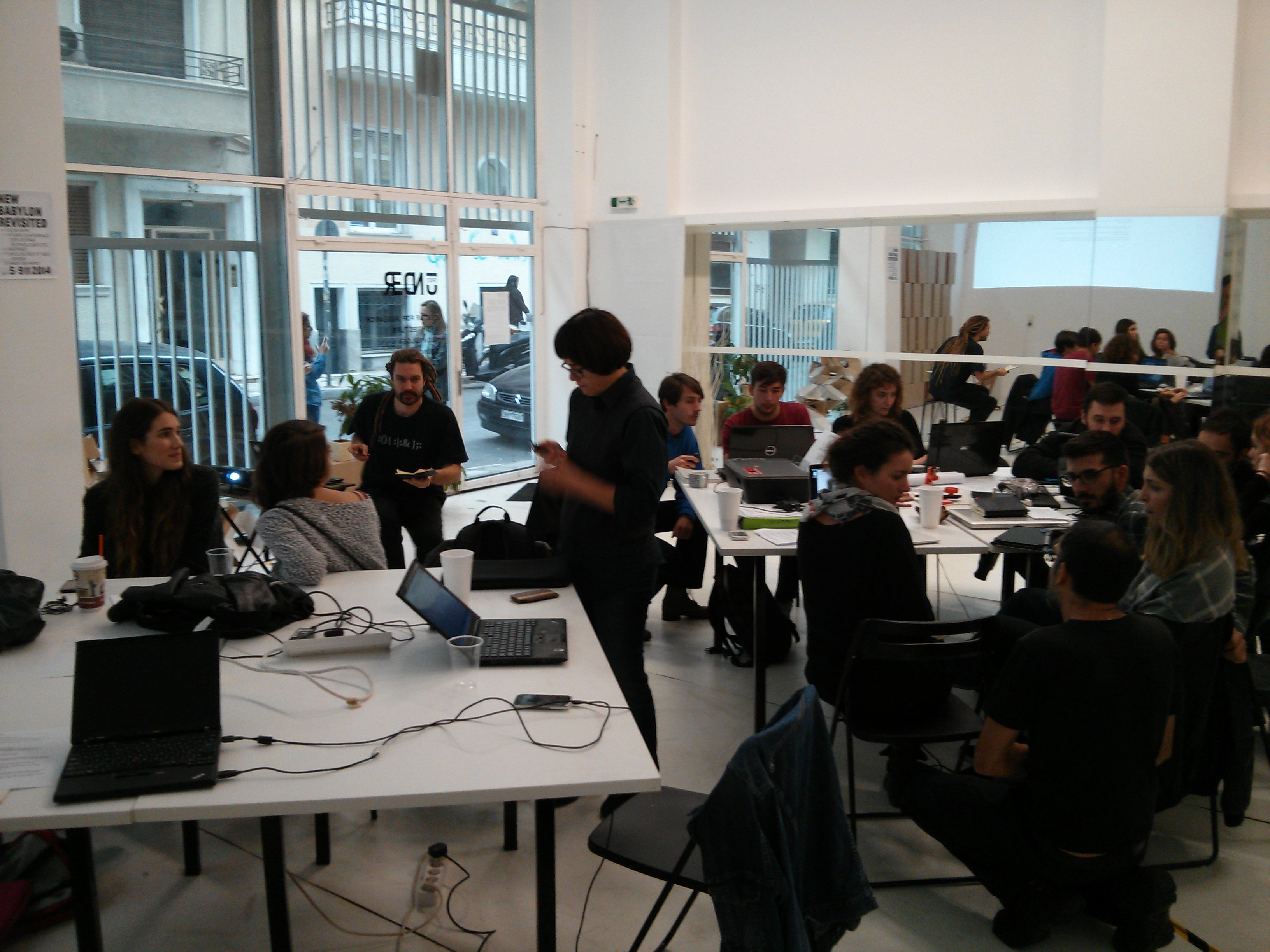
The project will kick off with a presentation under the heading Glossary of Subsumption: Enclosed Athens Disclosed. It will be given by a group of researchers, artists and architects that by now have formed an open-ended working-group. This first assembled in Athens last November during a workshop initiated by Oliver Lerone Schultz as part of New Babylon Revisited, a project by Goethe-Institut Athen. The aim was to trace old and new subsumptions of urban space. The initial concept, their goals and follow-up projects will unfold while outlining the fate of an avatar named Andrea/s, a semi-fictitious figure whose  lifetime is related to fundamental elements of our general metropolitan ‚story‘ of subsumption such as energy, time, sleep, sounds, landscapes, the extended mind, or the ‚public/private bi-polar‘.

These elements will also inform the second event, the Glossary of Subsumption: Collective Edition workshop. Taking into consideration the findings of the first workshop, a new workgroup will cluster those with other existing ideas and keywords and aim to set up some fleeting ‘methodological devices’ set that will capture conceptual noise and enlist circulating issues and terms throughout the festival. Using analog and digital tools, the goal would ultimately be to collectively build a Glossary of Subsumption and reflect on the possibilities, stakes and potential (social) formats of such an endeavour related to social theory building and the ‘knowledge commons’  to mediate different experiences and concepts of enclosure.

The audience is invited to join the workgroup discussions and participate in the overall process.

Athens Enclosure workgroup:  Ismini Epitropou, Maria Trogada, Maria Tzioka, Konstantinos Venis, Anthia Verykiou, Jeff Andreoni, Maria Byck

The ‘Glossary of Subsumption’ was first born in the Post-Media Lab in 2012 and was further developed -as a “Collective Edition”- in the context of the Common Media Lab (Center of Digital Cultures, University of Leuphana).

– Further information for both events, additional activities and the overall trajectory of The Glossary of Subsumption – Collective Edition will be listed at:  http://subsumption.xyz

Workgroup Discussion
At the Foyer Hub 2

These elements will also inform the second event, the Glossary of Subsumption: Collective Edition workshop. Taking into consideration the findings of the first workshop, a new workgroup will cluster those with other existing ideas and keywords. There will also be some fleeting ‘methodological devices’ (like the Hybrid Letterbox) that will capture conceptual noise and enlist circulating issues and terms throughout the festival.

The goal would ultimately be to collectively build a Glossary of Subsumption and reflect on the possibilities, stakes and potential (social) formats of such an endeavour. This is also to ask: what is a social way of constructing theory and the ‘knowledge commons’ – one that mediates different experiences and concepts of enclosure.

The audience is invited to join the workgroup discussions and participate in the overall process.

see also: http://unmonastery.org/transmediale/

Oliver_Lerone-Schultz_p1879_round

Oliver Lerone Schultz studies in philosophy, history of science, and ethnology, followed by research in media theory, embodiment and theory of performativity (FU Berlin 1999-2003). Oliver co-initiated several independent media projects like the globale-Filmfestival, laborB* (both 2003-2010) and Visions of Labor (2007/08). Bridging different fields of reflection and theory, he was active as curator (e.g. Zerklüftete Zukunft/Fractal Future, 2007; labor mov[i]e, 2003-2010). He was also active in the conception of trans-academic events: Utopische Körper/Utopian Bodies (2003); Travestien der Kybernetik/Travesties of Cybernetics (2005); Mapping Anthropotechnical Space (2007) – some collected under the label eXpolar.de (2005-2007). This was followed by research on Imagecultures at Berlin-Brandenburg Academy of Sciences (2010-2011). Oliver joined the Center for Digital Cultures in its early formational phases (2011), becoming co-curator of Post-Media Lab. As such he is deeply immersed into network-building in the contexts of new media culture, as conceptioner/curator of a whole range of post-media related events, workshop and exhibitions, among this Video Vortex #9 : ReAssemblies of Video. He is co-editor and -author of the PML-Books series, that just recently published Plants, Androids and Operators – A Post-Media Handbook (http://www.postmedialab.org/provocative-alloys-post-media-anthology). Currently Oliver is Principal Investigator at the Common Media Lab and works with Art + Civic MEdia at the CDC – scrutinizing questions and contexts of collective vision and social change in globalized societies and media-spheres.

> lerone.net
> postmedialab.org

Panels, Sessions, Film Screening – a preview of the program

Quoted from CDC blog at trans­me­dia­le fes­ti­val: Panels, Sessions, Film Screening – a preview of the program

Everything is visible, everyone is tracked. How will life, work and play change in world rules by algorithms? This year transmediale wrestles with the question under RTEmagicC_01.2015_transmediale_1the motto “Capture all” from 28 January to 1 February. You can read about the contributions CDC researchers will be making here.

How much space re­mains in a pro­gram­med world for things that can­not be writ­ten in a code? Do we have to learn to play with al­go­rithms? Prof. Dr. Ma­thi­as Fuchs, Head of the Ga­mi­fi­ca­ti­on Lab in the In­cu­ba­tor re­se­arch pro­ject Art and Ci­vic Me­dia, dis­cus­ses the­se and other ques­ti­ons with re­se­ar­chers Ned Ros­si­ter and Kris­ti­an Lu­kic on 29 Ja­nu­a­ry at 3:30 p.m. In the panel discussion “Calculated Play? Games as a metaphor, medium and method”, game play­ers go up against the al­go­rithm whi­le pa­ne­lists spe­cu­la­te about how it will end. Cri­ti­cal thoughts about ga­mi­fi­ca­ti­on and the quan­ti­fied-self mo­ve­ment are ex­pres­sed by a pa­nel that in­clu­des Ga­mi­fi­ca­ti­on Lab em­ployee Pao­lo Ruf­fi­no. The panel discussion “All Play and no Work: The Quantified Us“ at 3 p.m. on 30 Ja­nu­a­ry will also take up the wins and los­ses in an in­cre­a­sin­gly ga­mi­fied world.

At 11 a.m. on 29 Ja­nu­a­ry, the re­se­ar­cher Oli­ver Le­ro­ne Schultz (CDC/​Com­mon Me­dia Lab) pres­ents the pro­ject “Glossa­ry of Sub­sump­ti­on – Collec­tive Edi­ti­on”. A preli­mi­na­ry pre­sen­ta­ti­on en­t­it­led “Enclosed Athens Disclosed” will fea­ture re­sults of pro­ject work in­vol­ving a “cri­ti­cal city tour” of Athens in No­vem­ber. The “Athens En­clo­sures” team will re­port on the mul­ti-en­clo­sed life of the fic­ti­tious la­bo­ra­to­ry ava­tar An­drea. Then work con­ti­nues at 11 a.m. on 1 Fe­bru­ary in a work­shop on the long-term pro­ject “Glossary of Subsumption” with the goals of do­cu­men­ting the new era of “in­te­gra­ti­ve power” and “va­lue extrac­tion” in the post-me­di­al age and crea­ting collec­tive ways of theo­ri­zing.

The Creative Commons documentary “Preempting Dissent”, ba­sed on the book of the same name by Greg El­mer and Andy Opel, will be shown at 8 p.m. on Fri­day. The film ques­ti­ons the spre­ad of the so-cal­led “Mia­mi mo­del” for mo­ni­to­ring pu­blic pro­tests. The fol­low-up dis­cus­sion will be di­rec­ted by Oli­ver Le­ro­ne-Schultz. With his col­le­ague Dr. Cle­mens Apprich, Oli­ver Le­ro­ne Schultz is also working on the on­go­ing trans­me­di­al pro­ject “The Post-Di­gi­tal Re­view”, which brings to­ge­ther ex­perts in di­gi­tal art and cul­tu­re, po­li­tics and re­se­arch and cu­ra­tors. The session “The Post-Digital Review: Cultural Commons” at 4:30 p.m. on 1 Fe­bru­ary will take up the ques­ti­on of what cont­ri­bu­ti­ons art and cul­tu­re can make to new stan­dards in the post-di­gi­tal ci­vil so­cie­ty. Dr. Nis­hant Shah, mem­ber of the In­sti­tu­te of Cul­tu­re and Aes­t­he­tics of Di­gi­tal Me­dia (ICAM), will launch the dis­cus­sion with his pre­sen­ta­ti­on.

reSync All

Workshop. Make sync code badges and configure your media, message and phone to reSync All at the festival. Registration required.

CAT: Workshop
DAY: Fri 30.01.
DUR: 180 min
PLC: hkw foyer

Workshop
At Foyer Hub 3

During transmediale 2015, reSync will promote open synchronisation services and introduce a growing P2P exchange network of free media resources synchronised between those in London [own], Athens [awmn] and Berlin [freifunk] that sidestep the rising sense of network surveillance and preserve privacy whilst continuing to enjoy free media exchange in public and over free information infrastructures wherever they flourish.

Workshop participants will be able to claim a reSync ‘key’, print posters and press their own badges. Each featuring the unique QRcode to promote media stored on their smart phones, tablets and pc’s using Bit Torrent Sync app. Anyone then scanning the code or exchanging the key will be able to receive updates as new images texts and sounds are added during transmediale and therafter. See the howto for more details.
Each reSync is then automatically relayed across our international network nodes using Syncthing (floss) then available on open wireless networks in Athens, London and Berlin (so far!)

It is no secret that ‘pirate’ sites are amongst the most popular in the world. There are already huge numbers (hundred of millions) of P2P users, and the number continues to grow despite technical and legislative attempts to slow or censor P2P technologies. Media industries are quite unwilling to accept the inevitability of filesharing as a significant, if not the most significant, global media distribution system.

Join Adnan Hadzi and James Stevens in the foyer to make sync code badges and configure your media, message and phone things to reSync All at the festival.

http://www.transmediale.de/content/resync-all
https://www.eventbrite.de/e/resync-all-registration-15402396984

James_Stevens_p2061_round

James Stevens (uk)

James Stevens (uk) is the founder member of SPC and lives with his family in Deptford SE London. Whilst directing operations at web boutique Obsolete in 1996 he launched Backspace, the proto cybercafe on Clink Street, London Bridge; it became a touchstone to a thousand web coders and inventors, and inspiration for the technology spaces and businesses that boomed in the years that followed. He teamed with Julian Priest in 2000 to present wireless network primer Consume.net which advocated the open wireless networking that today thrives at OWN in Deptford SE8, AMWN and around the world.

Adnan_Hadzi_p2060_round

Adnan Hadzi (uk/ch)

Adnan Hadzi (ch/uk) undertook his practice-based PhD on FLOSSTV – Free, Libre, Open Source Software (FLOSS) within participatory TV hacking Media and Arts Practices’ at Goldsmiths, University of London. Adnan’s research focuses on the influence of digitalization and the new forms of (documentary-) film production, as well as the author’s rights in relation to collective authorship.

http://transmediale.de/festival/blog

reVeal Transmediale

“What does the ‘Capture All’ logic entail and what does it mean to live in an algorithmic world?

How does the desired ‘full take’ shape not just the contemporary lived environment but our very being, working and acting within it?

The idea behind a ‘Capture All’ society is not one based on a totalitarian model; it rather reflects a new system of organisation which, based on the datafication, quantification and correlation of everything, can be predictive and to some extent pre-emptive, allowing new modes of regulation and control.

Playful, competitive and productive as a ‘capture all’ society claims to be, it constantly aims for an accelerated optimisation surpassing any limitations between life and work. Its rankings and ratings, mappings and visualisations depict a gamifying condition where individuals never rest but are continuously connected and active, allowing behavioural patterns to become detectable and recognisable. But are we then faced with a new type of governmentality towards a calculative life?

And how do we respond to it? Which discourses are still needed and which counter-practices can be employed to provoke change in a datafying world?”

future project collaboration on Dowse

reSync was invited to collaborate on the Dowse project.

By replacing the outdated proprietary ISP ‘gateway’ with an open and user-visible device, Dowse creates a new platform that leverages its topologically unique access and influence in the domain of the local-area network. It introduces a visible, malleable, knowable communications hub to the language of the small network.

Dowse seizes on the power of the technologically/topologically necessary gateway/hub role to create development opportunities which cannot exist on other platforms. Dowse becomes the locus of a specific new class of end-user-visible applications which are able to perceive and affect all devices in the local sphere, whether they are open or closed.

Moving above the platform of Dowse, it is in touching upon the Internet of Things that a glimmer appears of what may be Dowse’s killer app(s). These are the applications of Dowse in which human opportunities appear to interactively define the Internet of Things at a high level. The entrance or departure of a device from the local IoT ecosystem is accompanied by audiovisual interactive aspects. Such interactions extend to the new presence or absence of a communications channel, for example between an electrical meter and a corporation. The software explorations that can appear in this domain, enabled by the Dowse platform, can bring individual awareness, preference, and empowered influence to the network/IoT as its own organ.

Further information can be found here.

FOSdem 15

From 31 January until 1 February FOSSem 2015 will take place.

FOSDEM is a free and non-commercial event organised by the community for the community. The goal is to provide open source software developers and communities a place to meet to:

  • get in touch with other developers and projects;
  • be informed about the latest developments in the open source world;
  • attend interesting talks and presentations on various topics by open source project leaders and committers;
  • to promote the development and the benefits of open source solutions.

Participation and attendance is totally free, though the organisers gratefully accept donations and sponsorship.

reSync All

During Transmediale 2015, reSync will promote collaborative synchronisation services and introduce a growing P2P exchange network of free media resources, synchronised between those in London [own], Athens [awmn] and Berlin [freifunk], that sidestep the rising sense of network surveillance and preserve privacy whilst continuing to enjoy free media exchange in public and over free information infrastructures wherever they flourish.

IMG_20141107_152203lunatic03Join us in the lobby area of Haus der Kulturen der Welt on Friday 30th January to make sync code badges and configure your media files, messages and phone things to reSync @ Capture All.

reSync-badgepressPick up a flyer sheet and claim a reSync ‘key’, print posters and press your own badges. Each badge features the unique QRcode to promote media from your smart phones, tablets and pc’s using Bit Torrent Sync app. Anyone then scanning the code or exchanging the key will be able to receive new images texts and sounds as you add them during Transmediale and therafter.


See the howto for more details.

Each reSync is then automatically relayed across our international network nodes using Syncthing (floss) then available on open wireless networks in Athens, London, Lueneburg and Berlin (so far!)

see this reSync All video for some instructions on the process…(ish)

This follows on from ‘reStreet’ workshops in Athens 2014 and will run parallel to the “Enclosed Athens Disclosed”/”Glossary  of Subsumption – Projecting a Collective Collation” sessions.

It is no secret that ‘pirate’ sites are amongst the most popular in the world. There are already huge numbers (hundred of millions) of P2P users, and the number continues to grow despite technical and legislative attempts to slow or censor P2P technologies. Media industries are quite unwilling to accept the inevitability of filesharing as a significant, if not the most significant, global media distribution system. The continued belief that intellectual property protection, Digital Rights Management, regulation of ISPs etc. will solve the ‘filesharing problem’ prevents tinkering in this area is being overturned.

Many thanks Rob Canning for the Imagemagic qrcode compositing!

31C3: Reconstructing narratives

“Surveillance, cryptography, terrorism, malware, economic espionage, assassination, interventions, intelligence services, political prisoners, policing, transparency, justice and you.
Structural processes and roles are designed to create specific outcomes for groups. Externally facing narratives are often only one of many and they seek to create specific outcomes by shaping discourse. We will cover a wide range of popular narratives surrounding the so-called Surveillance State. We intend to discuss specific historical contexts as well as revealing new information as part of a longer term research project.” (CCC 2014)

“Freedom in your computer and in the net

For freedom in your own computer, the software must be free.
For freedom on the internet, we must organize against
surveillance, censorship, SaaSS and the war against sharing.

To control your computing, you need to control the software that does it. That means it must be _free software_, free as in freedom. Nonfree software is inherently unjust, and nowadays is often malware too. We developed the GNU system as a way to avoid nonfree software on our computers.

That assumes you’re running your own copy of the programs. That means shunning Service as a Software Substitute, where someone else’s copy in someone else’s server does your computing.

Beyond that, we face the danger of censorship, and surveillance both on and off the internet. Lurking behind them is the menace of the War on Sharing, the publishers’ decades-long campaign to control what we do in our computers. Increasingly, computer hardware itself is becoming malicious.” (CCC 2014)

Plus the Offline Network session took place. There will be a follow up session during Transmediale 15, so stay tuned:

The future is offline! An assembly all about offline networks.

Everyone interested in the growing offline networks community is welcome!

Basic concepts:

  1. Community developed and running networks which enable citizens to gain benefits from networked infrastructures, while maintaining control of their data and how it is used.
  2. Community networks do not need to be connected to the wider internet (hence “off-nets”), however they may have connection hubs with the internet. Off-nets may be complementary to the internet, as well as an alternative.
  3. off-nets and the internet are not necessarily mutually exclusive, and can work together to offer more robust benefits to its participants.
  4. (A poetic approach): in particle physics, the “observer effect” is when an electron, whilst under observation, alters its course due to the fact that it is being observed. in contemporary society, people might alter their habits due to the idea that they coud be observed. What if there were islands within the monitored, fungible, and quantified world that permitted human to interact with each other unobserved, albeit digitally? What sort of unexpected reactions would that cause?
  5. One of the central characteristics of offline networks is that they are offline. We can‘t possibly anticipate all the reasons why people or groups would need to operate offline. Therefore it would be important to design applications that can be appropriated, adapted and used as “infrastructure”.
  6. Keywords: #diversity #serendipity #intimacy #temporality #place

Offline Networks Manifesto

The future is offline.

(Mark Gaved: ) 1. Community developed and run networks enable citizens to gain the benefits from networked infrastructures  while maintaining control of their data and how it is used.
(Mark Gaved: ) 2. Community networks do not need to be connected to the wider internet (hence “off-nets”), however they may have connection points with the internet
(Mark Gaved: ) 3. Off-nets may be complementary as well as an alternative to the internet: these are not necessarily mutually exclusive, and may work together to offer greater benefits to participants

Bezdomny (A poetic appraoch): in particle physics, the “observer effect” is when an electron, whilst under observation, alters its course due to the fact that it is being observed. Elsewhere, people might alter their courses in life due to the idea that they are being observed. What if there were islands within the monitored, fungible, and quantified world that permitted human to interact with each other unobserved, albeit digitally?  What sort of unexpected reactions would that cause?

Addie (underlying infastrutucre/why)  The feedback system built into traditional networks necessitates the sharing of information. A problem arises, however, when the distribution of metadata conflicts with the notion of transparency —a core ideological component of the value of cultural neutrality. Since the principles of global capitalism and government can now determine value based on data, we are left with a fundamental friction in the distribution and creation of culture through networks. Off-nets will focus on the contradiction of creation and control by exploring new forms of networks and access.

Panayotis (brainstorming): Offline networks keywords: diversity, serendipity, intimacy, temporality

(Andreas Unteidig): One of the central characteristics of offline.networks are that they offline. We can‘t possibly anticipate all the reasons why people or groups would need to operate offline, hence it would be important to design applications that can be appropriated, easily altered and used as “infrastructure” for many different scenarios of use.
(Matthias) Maybe we can create a “best practice to your offline app” list. This can contain  pitfalls like try to request a fontset from google 🙂

(Matthias) We should maybe add some development rules, which says “don’t be evil” and should promote certain mind sets about problematic functionalities. On bad example is: Create a Facebook login page to fish username & passwords   ==> I can do this with PirateBox in 10 Minutes (that it looks confident)….
IMHO: We have to point out that having an offline.network is a responsibility for all the other projects. If the reputation of offline.network is damaged because of such an action, we can all stop trying to recover it…
Another point is, that this manifesto should be in a form, that you can make it easily available on the offline device like “learn more about offline networks”, and it should include a link list for further informations.
Maybe we need a “ruleset” or “guidlines” , that each devices behaves the like the same.. like a Hotel captive portal on the first access (which may not fit on each concept, I think).. this can be a good to have rule.
(Panayotis): One challenge is that you can never control what others are doing. Creating rules could make things worse (because people could develop some level of trust and thus make it easier to cheat). In my opinion it is better to uncover the whole informality and lack of control in order to make everyone responsible and cautious. One way to do this is to rely on face-to-face interactions which could be encouraged somehow …
Agreed.

Off.networks @Transmediale

Here is the almost final description of the off.networks event at Transmediale:

Title: off.networks discussion

Date & Time: Saturday, 31st January 2015, 3 – 6pm

Venue:  Central Foyer Stage, House of Worlds Cultures in Berlin

The  ‘off.networks’ mailing list started as an attempt to bring together researchers, activists and artists that work on the idea of an offline network, operating outside the Internet. Such networks could range from
artistic projects (eg. deadrops or wifitagger) and  “personal networks” (eg PirateBox.cc or subnod.es), to community networks (eg commotionwireless.net, nethood)  and large city-scale mesh networks (eg. guifi.net, freifunk.net,  awmn.net.). The first assembly of off.networks took place at the CCC last month. In their second scheduled meeting during Transmediale Festival, the members of this network wish to make their first effort to build a diverse and dynamic community around the design, implementation and deployment of offline networks in different contexts. They wish to reflect critically on the role of such local networks in shaping the evolving hybrid urban space and  in addressing the threats which are posed by internet corporations and  surveillance states on citizens’ privacy and freedom of speech.

In other words: How  can the under construction “offline networks” allow us to join  forces  in reaching our common visions without sacrificing pluralism and  independence? The answer might not be so simple as offline  networks are subject to hybrid design and therefore require the  collaboration between people with different expertise; they are  context-specific and thus need to be easily installed and customized by non-savvy  users; they have to compete with more and more commercial initiatives  that now pop up claiming a similar logic; like all networks they are  vulnerable and often subject to ambiguities and contradictions.

The discussion will open by existing members of the off.networks community: Aram Barholl (deaddrops),
Jeff Andreoni (unmonastery), David Darts and Matthias Strubel (piratebox), Andreas Unteidig (hybrid letterbox),  Sarah Grant (subnod.es), Minuette Le (Rough Scholar Research Group), Panayotis Antoniadis and Ileana Apostol (nethood.org).
Practitioners working on this field from the foyer program of Transmediale will also be invited to join.
An inclusive and open-ended mode of discussion will be followed. After the initial statements,
the stage will be given to participants from the audience who will have 2-3 minutes each to present
their thoughts and ideas forming a big round table.

off.networks@librelist.com.

references to prior art/offline networks:
occupy everywhere
drop deads
wifitagger
pirate box
hybrid letter box
etc etc etc

Related work 🙂

http://issuu.com/urbanixd/docs/urbanixd_manifesto/12?e=7204297/10623455
http://criticalengineering.org/
http://www.arthistoryarchive.com/arthistory/dada/Dada-Manifesto.html
https://ec.europa.eu/digital-agenda/futurium/en/content/onlife-manifesto-being-human-hyperconnected-era

And an anti-manifesto manifesto:
http://cloudhead.headmine.net/post/2075216682/the-anti-manifesto-manifesto

Documenting Random Darknet Shopper: «Here, but Invisible»

Today we documented Aram Bartholl’s workshop «Here, but Invisible» and the «The Darknet – From Memes to Onionland. An Exploration» exhibition, featuring !Mediengruppe Bitnik’s Random Darknet Shopper.
«The Darknet – From Memes to Onionland. An Exploration»

There is a parallel world beneath the surface of the Internet: the Darknet is an encrypted, invisible network that cannot be accessed by conventional browsers or search engines but is nevertheless used by millions. This digital territory is the impulse for cooperation between the artist collective !Mediengruppe Bitnik (Carmen Weisskopf and Domagoj Smoljo), the project :digital brainstorming from Migros-Kulturprozent and Kunst Halle Sankt Gallen. Forms of organisation, structures and communications systems which penetrate everyday life but which are largely unknown to the public will be examined with the help of other artists, theoreticians and hackers. The exhibition «The Darknet – From Memes to Onionland. An Exploration» will open Kunst Halle Sankt Gallen for interdisciplinary expeditions and encompass themes such as copyright, privacy, illegality and resistance.
Public awareness of the Darknet, also called Deep Web or Onionland, has increased as a result of recent events. It has a bad reputation: drugs, weapons, pornography, stolen data and forged documents can be bought there. However, Edward Snowden’s revelations seem to have shifted this one-sided perception. The Darknet is an apparently power-free space with potential that is still little-known and even less used. The participants want to take this factor seriously as critical individuals and articulate its non-transparent mechanisms and systems. Some artistic contributions directly access data and visual worlds from the Deep Web. For example, !Mediengruppe Bitnik transports goods and games from this Internet subculture into the art space while Eva and Franco Mattes present reactions to a video from Onionland. Cory Arcangel’s work remains concealed from exhibition visitors. He is concerned with the
visibility of the Kunst Halle on the World Wide Web. Other artists deal with Internet phenomena that also exist on the Surface Web and which are located in the tension-filled area between anonymity and commerce: Robert Sakrowski is curating YouTube films on the history of Anonymous, Valentina Tanni is making available her archive of memes and Simon Denny will provoke questions about business models, income and property in times of global data interchange. In contrast, Heath Bunting examines
data storage in relation to identities. These are constructed by means of shopping cards, credit cards or mobile phones. The artist thus also broaches the subject of class systems. Conversely, an identity can also be deleted – as Seth Price demonstrates with How to disappear in America.
With this show the Kunst Halle Sankt Gallen links the visible and the invisible which are interlocked – From Memes to Onionland. Aware of the uncertainties in this regard an approach from multiple perspectives is intended. It is an attempt to grasp this extremely controversial phenomenon of our times with artistic contributions, archive material, workshops and discussions. The format of the exhibition gives visitors access to the digital underground and questions familiar notions – Kunst Halle Sankt
Gallen can now also be found in Onionland at http://vtw7g7wcdsgxq4ru.onion/

In cooperation with !Mediengruppe Bitnik and :digital brainstorming
With contributions from: Anonymous, Cory Arcangel,!Mediengruppe Bitnik, Aram Bartholl, Heath Bunting, Simon Denny, Eva and Franco Mattes, Seth Price, Robert Sakrowski, Hito Steyerl, Valentina Tanni

The Random Darknet Shopper

The Random Darknet Shopper is an automated online shopping bot which we provide with a budget of $100 in Bitcoins per week. It goes on a weekly shopping spree in the deep web where it randomly choses and purchases one item and has it mailed to us. The items are exhibited in «The Darknet» at Kunsthalle St. Gallen, each new object adding to a landscape of traded goods from the Darknet.
The Random Darknet Shopper is a live Mail Art piece, an exploration of the deep web via the goods traded there. It directly connects the Darknet with the art space. The items bought in the Darknet by the Random Shopper are commonly contraband and range from drugs to counterfeits, ebooks, software, electronics and services including security and hacking services.

All these items share as a common characteristic the most interesting aspects of hidden online markets: They exemplify how the internet in general and the darknets most notably are helping to increasingly blur the lines of national legal dictates: What is legally produced and sold in one country is not necessarily legal in another [1]. Being global, these markets connect diverse jurisdictions, questioning the notions of legality and producing a vast greyzone of goods available virtually everywhere.

Furthermore, the goods traded in the darkweb show the manner in which trust is successfully established in anonymous networks. Although the hidden market is based on the anonymity of its participants, rating systems and anonymous message boards ensure a certain level of trust. The ability to rate your dealer is radically changing the way people are buying drugs and other controlled items. Buying contaband online means having access to a reliable rating system, while at the same time staying anonymous, all from the comforts of your home.

By randomizing our consumerism, we are guaranteed a wide selection of goods from the over 16’000 articles listed on Agora market place. We want to see what goods come out of the deepweb, where they are sent from, how (and whether) they arrive. We want to find out how the goods are packaged to be concealed from the postal services.

Agora
The random darknet shopper shops at Agora, a marketplace in a part of the Darknet called Onionland. The Darknet and Onionland are hidden niches of the Internet which are not discoverable by search engines and which are accessible only for visitors who cloak themselves by using the anonymous Tor Browser. In the Darknet, people meet, chat, trade. Activists and dissidents use the cloaking mechanisms of the Tor Browser to cover their tracks.

Agora launched in 2013 and has become the largest and most popular online hidden marketplace since the take-down of Silkroad in October 2013. Its customers are able to buy or sell virtually anything, including illicit goods like drugs, contraband or weapons.

The Agora Market uses the anonymous cryptocurrency bitcoin to pay for transactions. To protect customer privacy, Agora uses anonymous courier services and camouflage for shipping regulated and prohibited items. Site transactions, despite anonymity, are surprisingly reliable. Like in similar surfaceweb market places, all transactions can be rated, allowing customers an assessment of the seller and his or her goods.

There are already more than 16,100 listings on Agora, according to a new report from Digital Citizens Alliance, a U.S. crime research group [2]. That popularity is enough to make Agora more popular than Silk Road 2.0, the black market that sprouted when the FBI closed down the original incarnation in October 2013.

The Random Darknet Shopper is a temporary exploration of the Darknet through the greyzones of hidden online markets. We regard it as crucial that art must inevitabily expand to include new formats and subject matters if it is to stay relevant. That is why we consider the Darknet to be a valid subject matter for art because not only the Internet but also the Darknets are changing the fundamentals in which societies work. How does building trust relationships work in a global market that is based on the anonymity of its participants? How do we maintain notions of legality and illegality when these markets
connect diverse jurisdictions with differing concepts of what is lawful. How do we as societies deal with anonymity online while offline identifiability, trackability and surveillability become the norm?

Viewed under Swiss art laws

The Swiss art law expert, Bruno Glaus, also considers the work to be legitimate and legal under criminal law. In his book “Kunst- und Kulturrecht” (Art and Culture Law) to be published in 2015, he outlines the preconditions that justify a violation of law in an art work.
In the Swiss constitution freedom of art is explicitly referenced. This requires judges to carefully balance interests between the interests of free art production and an exceptional breach of law [3]. According to Bruno Glaus, the preconditions that justify a violation of law in an art work are a plausible interest of scientific, artistic or informational nature. Also the infringement should be comprehensible and described in a written statement or concept. The breach of law should be temporary and the means used should be
appropriate [4]. Additionally, in accordance with Swiss law, the prosecuting authorities can refrain from prosecuting due to minor fault [5].

[1] See for example how eBay und Paypal, two US-american companies, restrict certain items on European eBay/Paypal sites because of trade restrictions in US law. They do this for example for Cuban goods where by doing this, they override European laws. See German Wikipedia: “Beim Handel mit Waren aus Kuba gilt nach US­Recht, dass eBay Deutschland – ebenso wie z.B. eBay Österreich und eBay Schweiz – als Tochterunternehmen eines US amerikanischen Konzerns „denselben Handelsbeschränkungen unterliegt wie die Muttergesellschaft“. Folgerung von eBay: „Daher dürfen  grundsätzlich nur solche kubanischen Artikel bei eBay angeboten werden, die ‚informativ‘ oder ‚lizenziert‘ sind oder die vor dem Inkrafttreten des US­Handelsembargos gegen Kuba am 8. Juli 1963 auf den Markt gekommen sind.“ Daher ist es zum Beispiel nicht möglich, kubanische Zigarren auf eBay anzubieten.
Nach Expertenansicht verstösst diese Handhabung, die auch für die eBay-Tochter Paypal angewendet wird, jedoch gegen die Verordnung (EG) Nr. 2271/96, die sogenannte EU Blocking Regulation. Diese verbietet es europäischen Unternehmen, also auch europäischen Tochterunternehmen außereuropäischer Muttergesellschaften ausdrücklich, die US-Sanktionsbestimmungen gegen Kuba und verschiedene andere Länder zu befolgen. “ Wikipedia (in German): http://de.wikipedia.org/wiki/EBay#Handelsbeschr.C3.A4nkungen_nach_US-Recht
Also (in German): http://www.welt.de/print/die_welt/wirtschaft/article13516280/Die-Bank-gewinnt.html
[2] Report by Digital Citizens Alliance, published 22.08.2014: http://www.digitalcitizensalliance.org/cac/alliance/content.aspx?page=Darknet
[3] “Die ausdrückliche Erwähnung der Kunstfreiheit in der Verfassung führt dazu, dass Richter im Einzelfall vermehrt eine Güterabwägung vornehmen und entscheiden müssen, ob das Interesse an künstlerischer freier Produktion ausnahmsweise die Rechtsverletzung zu rechtfertigen vermag .” From the manuscript of “Kunst- und Kulturrecht”, Bruno Glaus et. al., 2015
[4] “Grundvoraussetzung für die Rechtfertigung einer Rechtsverletzung im künstlerischen Kontext ist ein nachvollziehbares Informations, Kunst- oder Wissenschaftsinteresse. Der Eingriff sollte so weit als möglich erkennbar sein oder jedenfalls im Konzept nachvollziehbar erläutert und als begrenzter „Laborversuch“ deklariert werden. Zweck kann ja beispielsweise eine Untersuchung der durch ein Projekt ausgelösten Proteste sein (vergleichbar den Blind- und Doppelblindversuchen bei Medikamenten). Meist wird ein – gewöhnlicherweise widerrechtlicher – Eingriff, nur für eine beschränkte Zeit durch ein überwiegendes Kunstinteresse gerechtfertigt werden können (z.B. Aktionskunst, Einsperren eines Tieres, Belästigung von Personen auf der Strasse durch Theatermacher, Ausstellen von illegalen Gegenständen usw.). Die zum Zweck eingesetzten Mittel müssen notwendig, verhältnismässig und zumutbar sein (dies in Analogie zu den Datenschutzgrundsätzen).” From the manuscript of “Kunst-und Kulturrecht”, Bruno Glaus et. al., 2015 [5] “Unter strafrechtlichen Aspekten ist folgendes zu berücksichtigen: Die Strafbehörden haben gestützt auf Art.52 StGB die Möglichkeit (und die Pflicht) von einer Strafverfolgung oder einer Bestrafung abzusehen, „wenn Schuld und Tatfolgen“ gering sind (beschränktes Opportunitätsprinzip). Insbesondere bei der Schuldfrage muss das Interesse an freier künstlerischer Entfaltung berücksichtigt werden.” From the manuscript of “Kunst- und Kulturrecht”, Bruno Glaus et. al., 2015