reCapture Transmediale

tm2015-arrivalJust returned from a week away at Transmediale in Berlin, ‘Capture All’ where reSync co-habited with a set of social forum and offline network workgroups to explore respective exhaustion with social media, find fresh approaches to localised practice, celebrate a sense of disconnectedness as well as reunite old friends and baptise new.
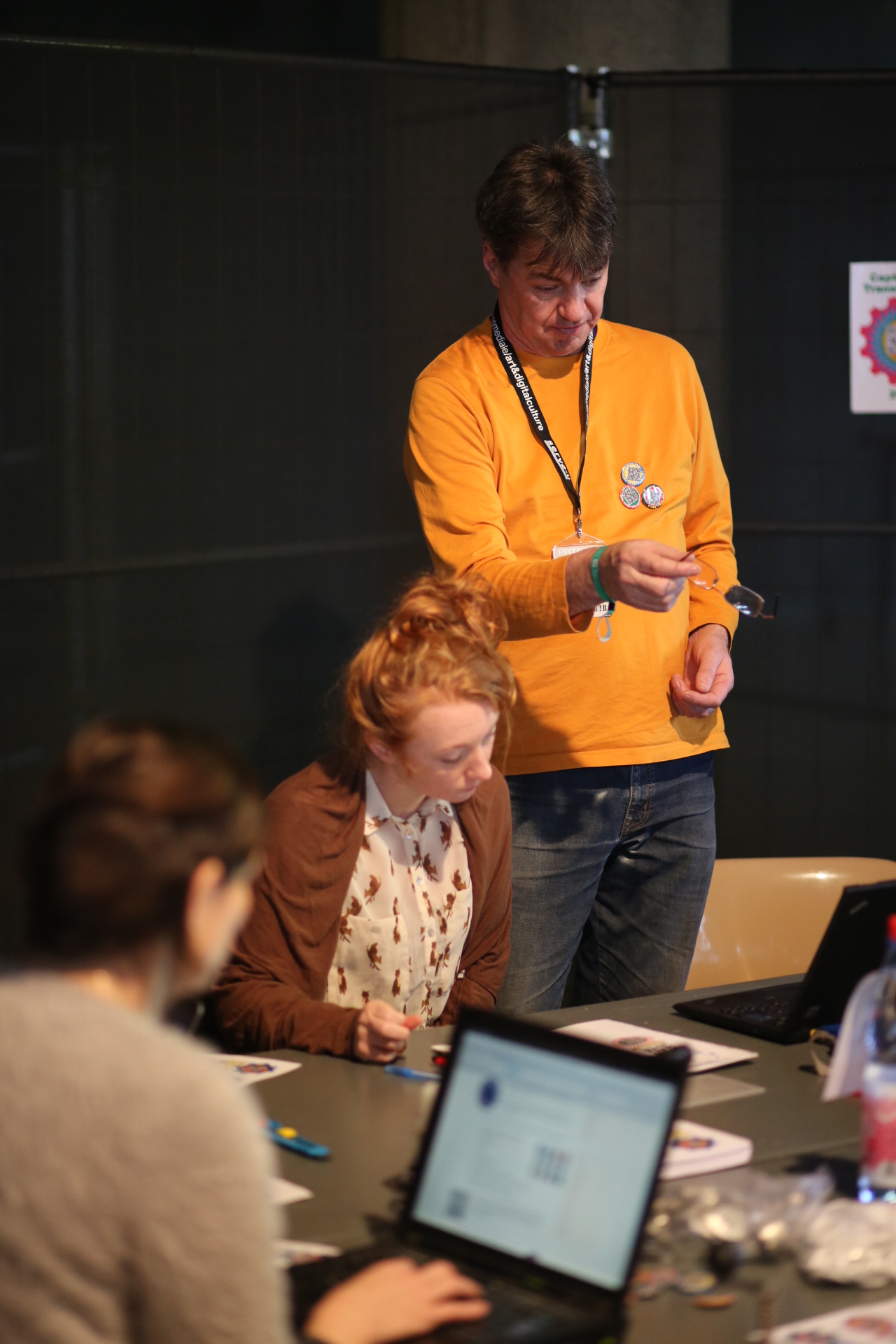
IMG_0174So, in a noisy and overloaded foyer environment, we bumbled through a few hours of strained explanations and half understood activities until the 16 or so attendees clicked to our reGroove to spark up some add-hock badge pressing and kitten synchronisation.
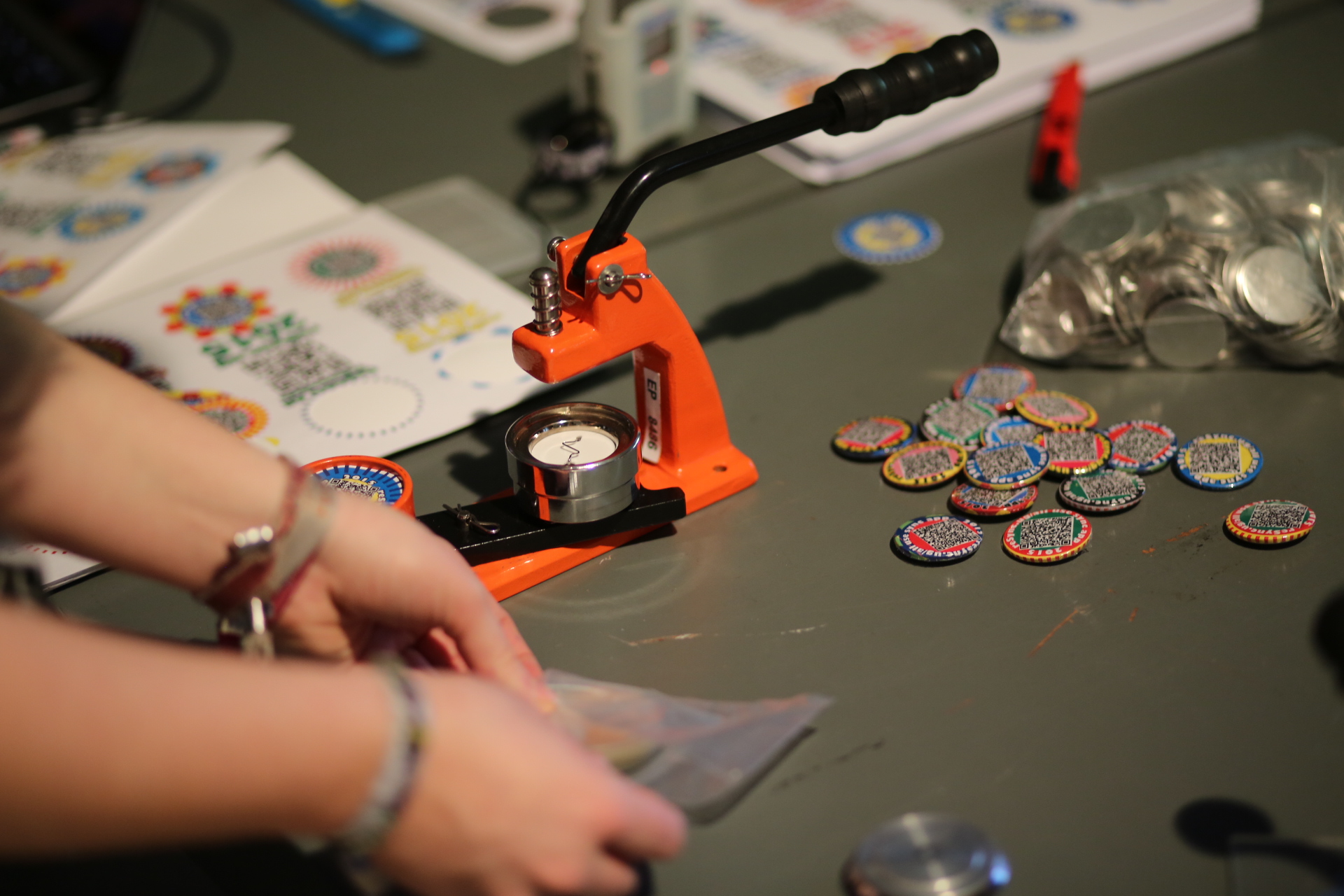
IMG_0151To be honest we have performed better than this but despite all, some delight and pleasure was expressed by many involved! Our ‘reSync All‘ workshop could have well been called ‘reCapture Transmediale’ in acknowledgement of the sense shared by many, on our self surveillance and semi consciousness of the issues exhibited. Elsewhere, more earnestly expressed anxiety and abstractions were deliberated over until the jitter cut of one session on another bewildered and perplexed YT.

The Off-Networks reviewOut in the bar, on the terrace and about town the conversations flowed more realistically from where we eventually dragged our soles through to each new day reset and rarified for another go. There were no midnight trains (too early) but trawls through the 90’s ‘scape of tobacco overload and tinnitus trials. No massage but a shrinking scrape with urban imagination and cultural preposterousness.

Just before leaving we popped over to Tactical Tech for lunch and final farewell to hosts Oliver and X Londoner Adam.. yes we ran all the way to the airport.. Cheers All !
The Post-Digital Review: Cultural Commons

The Post-Digital Review gathers experts to discuss shifting forms of cultural practice, of organisations, of the economy.

CAT: Conference
DAY: Sun 01.02.
DUR: 120 min
PLC: auditorium hkw

The ongoing transmediale project of The Post-Digital Review gathers experts from the fields of digital culture art, policy, curating and research to discuss shifting forms of cultural practice, of organisations, of the economy as well as of politics in a post-digital world. This particular session will focus on the question of how art and culture contribute to build new forms of commons for a post-digital civil society. The first event of the Post-Digital Review, Understanding Post-digital Cultural Forms was an intensive One-Day Review Summit organised by transmediale in cooperation with the German Federal Foreign Office and hosted by the Haus der Kulturen der Welt, 10 November 2014. In the festival edition of The Post-Digital Review, we invite further experts as well as open up the discussion to the audience. An impulse lecture will be given by Nishant Shah followed by short position statements from the participants and an intensive open discussion.

Superglue Demonstration

Demonstration. Make you own websites and host them at home.

DAY: Sat 31.01.
DUR: 60 min
PLC: hkw foyer

Demonstration
At Foyer Hub 3

Over the last 18 months a team of artists, engineers, programmers, designers and researchers have been building Superglue – a visual web authoring tool and personal server, which enables you to make your own websites and host them at home. The Superglue visual web authoring tool comes as a handy browser add-on, which enables you to create websites directly in the browser window. To host your website at home the team of the project developed the Superglue personal server, which comes as a preconfigured device which you plug into the wall and instantly have your own Internet server. Superglue is a tool based on the original DIY (Do-It-Yourself) ethos of the Internet.

After its test launch in October 2014, Superglue is now open for public trials. For transmediale 2015, team members Michael Zeder, Abigail Smith and Teresa Dillon will provide a short overview of Superglue, demonstrating how the author tool and server works and discussing the ideas behind the project.

Participants can bring their own routers (TP-LINK TL-WR710N or D-Link DIR-505) or try the pre-configured devices that will be available for public test.

Bringing a laptop will be in any case necessary.

Superglue is developed by Danja Vasiliev, Joscha Jaeger, Michael Zeder in collaboration with Teresa Dillon, VERBALVISUAL and zerbamine.

Facilitated by: WORM.

Supported by: Greenhost
>superglue.it

offline networks unite!

Discussion. The ‘off.networks’ mailing list started as an attempt to bring together researchers, activists and artists that work on the idea of an offline network, operating outside the Internet.

DAY: Sat 31.01.
DUR: 120 min
PLC: hkw foyer

Discussion
At Foyer Stage

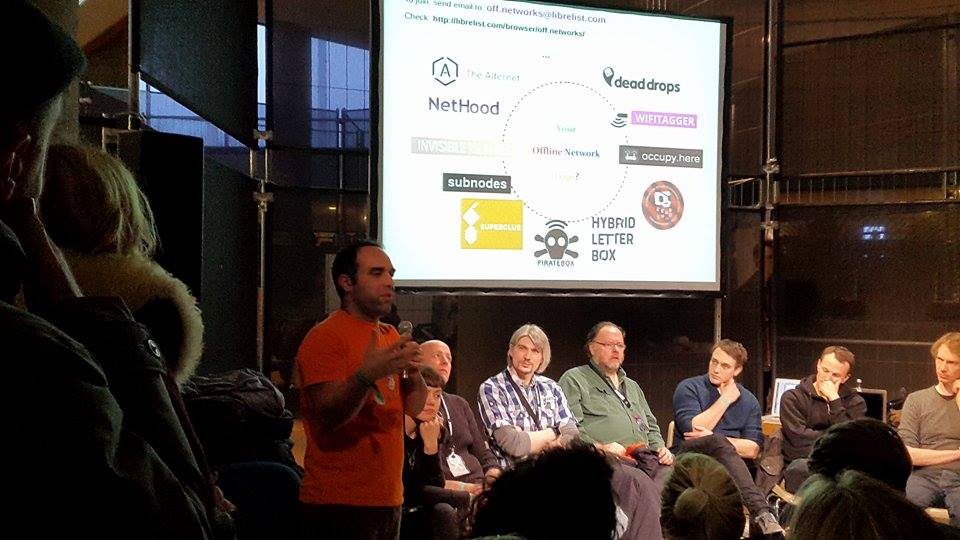
The ‘off.networks’ mailing list started as an attempt to bring together researchers, activists and artists that work on the idea of an offline network, operating outside the Internet. Such networks could range from artistic projects (eg. deadrops or wifitagger) and “personal networks” (eg PirateBox.cc or subnod.es), to community networks (eg commotionwireless.net, nethood) and large city-scale mesh networks (eg. guifi.net, freifunk.net, awmn.net.). The first assembly of off.networks took place at the CCC last month. In their second scheduled meeting during transmediale Festival, the members of this network wish to make their first effort to build a diverse and dynamic community around the design, implementation and deployment of offline networks in different contexts. They wish to reflect critically on the role of such local networks in shaping the evolving hybrid urban space and in addressing the threats which are posed by internet corporations and surveillance states on citizens’ privacy and freedom of speech. In other words: How can the under construction “offline networks” allow us to join forces in reaching our common visions without sacrificing pluralism and independence? The answer might not be so simple as offline networks are subject to hybrid design and therefore require the collaboration between people with different expertise; they are context-specific and thus need to be easily installed and customised by non-savvy users; they have to compete with more and more ambiguous commercial initiatives that now pop up claiming a similar logic.

The session will open by short presentations by existing members of the off.networks community: Aram Barholl, Jeff Andreoni, David Darts and Matthias Strubel, Andreas Unteidig, Sarah Grant, Panayotis Antoniadis and Ileana Apostol. Other artists and practitioners taking part in transmediale will also join and an inclusive and open-ended mode of discussion will follow. The stage will be given to participants from the audience who will have 2-3 minutes each to present their thoughts and ideas forming a big round table.

> off.networks@librelist.com

The off.networks community (international)

The offline networksor ‘off.networks’ community has started as an attempt to bring together researchers, activists and artists that work on the idea of an offline network, operating outside the Internet. Such networks could range from artistic projects (eg. deadrops or wifitagger) and “personal networks” (eg. PirateBox.cc or subnod.es), to community networks (eg. commotionwireless.net) and large city-scale mesh networks (eg. guifi.net, freifunk.net, awmn.net). In their second scheduled meeting during transmediale Festival, the members of this network wish to make their first effort to build a diverse and dynamic community around the design, implementation and deployment of offline networks in different contexts. They wish to reflect critically on the role of such local networks in shaping the evolving hybrid urban space and in addressing the threats which are posed by internet corporations and surveillance states on citizens’ privacy and freedom of speech.

off.networks_transmediale

Panagiotis Antoniadis (ch) DIY Networking

Panayotis Antoniadis is a senior researcher at ETH Zurich. He has an interdisciplinary profile with background on the design and implementation of distributed systems (Computer Science Department, University of Crete), Ph.D. on the economics of peer-to-peer networks (Athens University of Economics and Business), post-doc on policies for the federation of shared virtualized infrastructures (UPMC Sorbonne Universités), and an on-going collaboration with urban planners on the role of ICTs for bridging the virtual with the physical space in cities (project nethood.org). Panayotis is currently active in the organization of various interdisciplinary events that aim to bring together researchers, practitioners, and activists from various fields around the participatory design of hybrid urban space with a focus on wireless and peer-to-peer technology. In this context, his personal conviction is that there is an urgent need for a global social learning framework, a toolkit, that will allow citizens to build their own local networks for supporting local interactions, and claim their right to the (hybrid) city.

Aram Bartholl (de)

Aram Bartholl‘s work creates an interplay between internet, culture and reality. The versatile communication channels are taken for granted these days, but how do they influence us? According to the paradigm change of media research Bartholl not just asks what man is doing with the media, but what media does with man. The tension between public and private, online and offline, technology infatuation and everyday life creates the core of his producing.

Sarah Grant (us)

Sarah Grant is a Brooklyn-based artist, technologist, and educator. She is a former artist in residence at Eyebeam Art and Technology Center and is currently a Technical Lead at The Barbarian Group in NYC. As an artist, she has been experimenting with both the practical and expressive properties of mesh networks for connecting people together in ways that encourage participation with your immediate geographical location. She is also an Adjunct Professor at NYU Polytechnic in Digital Media.

Hot Probs is a simple chat room designed to run on a Raspberry Pi and within the subnod.es platform. To join the chat room, visitors need to connect to the ‘HOT PROBS’ wireless network, open up a new browser window and navigate to hotprobs.com.

Subnodes is an open source initiative that facilitates the process of creating a portable local area network and a mesh node for anonymous, local communication. Its source code can be found on github.

Telekommunisten (de)

Telekommunisten is a Berlin-based collective whose work investigates the political economy of communications technology. Core themes include the incompatibility of capitalism with free networks and free culture, and the increasing centralisation and enclosure that results, as well as the potential for distributed producers employing a collective stock of productive assets to provide an alternative economic basis for a free society.

deadSwap 2.0 is an android app which lets you coordinate a clandestine communications and off-line sharing network. The technique is the same as the old classic spycraft one of ‘dead drop’, Participants share a flash memory archive, e.g. a USB stick, hiding it in public space. Participants are informed about the current location of the archive through SMS on their cell phones. The deadSwap 2.0 system allows anyone to initiate a distributed sharing session which continues until all members of the network have found the memory device.

Most participants remain ‘sleepers’ who become activated by SMS to go look for a hidden memory device. When they are activated, they become ‘rabbits’. Once they successfully find the hidden device they become ‘agents’ and, after completing any necessary operations on the device (such as copying or adding data), they must hide the device again and inform the system of the new Swap location.

Participants in the network can contribute whatever data they like to the sharing round by simply copying it onto the deadSwap storage device. For the transmediale edition, deadSwap 2.0 comes pre-loaded with DATAFIELD3, as special selection of Henry Warwick’s massive offline shared archive.

David Darts (us)

David Darts is an artist, technologist, and Associate Professor of Art at New York University. His work focuses on the convergences between society, technology and contemporary art and design. He is Co-Director of the NYU Artistic Activism Working Research Group and former Curatorial Director of Conflux, the annual art and technology festival for the creative exploration of urban public space.

Matthias Strubel (us)

Matthias Strubel is the Lead Developer for the PirateBox. He is known for his work on the PirateBox Forum where he provides support for users and developers from around the world. Matthias works as a freelancer for several projects, focusing on software-Integration across different technical systems (i.e. Mainframe and Web). He also provides technical support for the LibraryBox project and actively participates in several open source communities.

In an era of mass-surveillance programs, filtering, and censorship, offline data sharing and communication is becoming more and more important for freedom of communication. The PirateBox is a DIY anonymous offline file-sharing and communications system built with free software and inexpensive off-the-shelf hardware. The system creates offline wireless networks designed for anonymous file sharing, chatting, message boarding, and media streaming. You can think of it as your very own portable offline Internet in a box! PirateBox has been featured in over 175 international online and print publications, including New Scientist, Le Monde, Ars Technica, and Wired Italia.

Participants will build and experiment with PirateBoxes and will also learn about the history and philosophy of the project, including recent updates, ongoing challenges, and future possibilities.

Participants should bring a laptop, an OpenWrt compatible router (TP-Link MR3020) and a USB Flash Drive (4GB or larger).
The PirateBox toolkit (router and usb flash drive) can also be bought upon online registration.

http://www.transmediale.de/content/offline-networks-unite

hybrid publishing toolkit

Presentation. This publication is part of the Digital Publishing Toolkit research project, next to a set of tools for digital publishing.

DAY: Fri 30.01.
DUR: 60 min
PLC: hkw foyer

Presentation
At the Foyer Stage

This publication is part of the Digital Publishing Toolkit research project, next to a set of tools for digital publishing. The Toolkit is meant for everyone working in art and design publishing. It provides hands-on practical advice and tools, focusing on working solutions for low-budget, small-edition publishing. Editorial scenarios include art and design catalogues and periodicals, research publications, and artists’/designer’s books.

With Florian Cramer, Patricia de Vries, Miriam Rasch, Margreet Riphagen

All Play And No Work: The Quantified Us

Conference Stream Play. A discussion on the gains and the losses of an emerging gameful world.

CAT: Conference
DAY: Fri 30.01.
DUR: 90 min
PLC: auditorium hkw

Conference Stream Play

How does it feel when your FitBit score is taken into consideration as part of your job performance? Or when you know that your successful liked Selfies attract the attention not only of your network but also of your employers? Does this new form of playful and multilayered surveillance make us more productive and why do we willingly engage in an economy which driven by play translates everything into accelerated work? It seems that to fit in, in a world ruled by numbers , we need to become part of an endless feedback loop, constantly adjusting our image and habits to new scores and norms.

Taking into consideration the wide use of gamification and the popularity of the Quantified Self movement, the panel will look into how play can set behaviors and discuss the gains and the losses of today’s gameful world. Are we experiencing a preset game-of-data where play rules through freedom or can we still count on new forms of data-play and dis-measure that can oppose the logic of a life tied to playful but continuous work?

Presented in cooperation with Leuphana University of Lüneburg

Daphne_Dragona_p0_round

Daphne Dragona (gr)

Daphne Dragona is a curator, writer and researcher living and working in Athens and Berlin. Since 2001, she has been collaborating with centers, museums and festivals in Greece and abroad for exhibitions, conferences, workshops and media art events. Among them are the National Museum of Contemporary Art (Athens), LABoral Centro de Arte y Creacion Industrial (Gijon), Alta Tecnologia Andina (Lima), Goethe-Institut Athen and the Hybrid City Conference organised by the University of Athens. Daphne has worked extensively on game art, net and network based art as well as on artistic practices connected to the urban and digital commons. Her current research and curatorial practice particularly involves critical data-driven art, playful exploits and off-the-cloud initiatives, explored as tools for users’ empowerment and emancipation. Articles of hers have been published in numerous books, journals and magazines.

Preempting Dissent: A Creative Commons Feature Documentary Film

A screening and conversation about the creative commons documentary Preempting Dissent (2014).

Preempting Dissent from Preempting Dissent on Vimeo.

CAT: Conference
DAY: Fri 30.01.
DUR: 90 min
PLC: hkw k1

A screening and conversation about the creative commons documentary Preempting Dissent (2014) that builds upon the book of the same name written by Greg Elmer and Andy Opel. The film is a culmination of a collaborative process of soliciting, collecting and editing video, still images, and creative commons music files from people around the world. Preempting Dissent interrogates the expansion of the so-called “Miami-Model” of protest policing, a set of strategies developed in the wake of 9/11 to preempt forms of mass protest at major events in the US and worldwide. The film exposes the political, social, and economic roots of preemptive forms of protest policing and their manifestations in spatial tactics, the deployment of so-called ‘less-lethal’ weapons, and surveillance regimes. The film notes, however, that new social movements have themselves begun to adopt preemptive tactics so as not to fall into the trap set for them by police agencies worldwide.

Enclosures of Toxicity

Open Workshop / Discussion. We will present a brief overview of the concept of “toxic enclosures”, citing examples from contemporary history.

CAT: Workshop
DAY: Fri 30.01.
DUR: 120 min
PLC: hkw foyer

Open Workshop / Discussion
At Foyer Hub 1

We will present a brief overview of the concept of “toxic enclosures”, citing examples from contemporary history in which invisible linkages between sites and objects of contamination have succeeded in creating a “toxic commons”.

The growth of these areas throughout the world has formed a porous barrier through which people may pass, but not without taking a bit of contamination with them as it penetrates their corporeal encasement, thus shortening life expectancy (while potentially enriching the quality of their lives). It is the ultimate toll for crossing a barrier.

Ancient Greek mystery cults and technology will be paralleled to contemporary religious and industrial practice. The long lineage of Gods and mortals from antiquity to present will be explored, tracing chthonic and often mirroring personas such as Plouto (Underworld) and Ploutos (Wealth) or Demeter (de-meter / mother earth) and her daughter Persephone (pherein-phonon / to bring death). Participants will explore (hands-on) some of the benefits and ill effects of confrontations between inactivity/radioactivity, mortality/divinity, remedy/poison.

Tales of toxicity will be interwoven with mythology and possible ancient anti-solutions which are now being used to combat the toxicity and will influence our future civilisations.

The Enclosures of New Athens workshop, which took place in November 2014, illuminated the subsumptuous tunnels of exploration down which we’ll journey in the relative safety of our TBM (tunnel boring machine) during this session.

Requirements: Bring your geiger counters.

With Jeffrey Andreoni and James Lane

Jeffrey Andreoni: At the age of three Jeffrey Andreoni received his first memory. He was being chased. He saw it was his brother chasing him. He jumped under a table for safety but hit his eye on the leg of the table because he was no longer small enough to slide gracefully under it as he had at an earlier age. It was his birthday. Everyone at the party stared in horror as the birthday boy got up crying from under the table with a massive black eye. He blew out the candles in tears.

James Lane: James Lane is a Greek-born visual artist based in Athens, Greece currently utilizing transmedia, photography, video and performance. He has participated in solo and group exhibitions including the State Museum of Contemporary Art, Thessaloniki, Greece, Freud’s Dreams Museum, St. Petersburg, Russia, ACG Gallery at the American College of Greece, DESTE Foundation, Athens, Greece, Megaron Music Hall Athens, Beton7, Athens, Greece, Ileana Tounta Contemporary Art Center, Athens, Greece. At the core of the artist’s interests is the investigation of new strategies to draw parallels between current and past territories, fusing the mundane to the unearthly or the trivial to the orphic.

unMonastery, a place-based social innovation, addresses the interlinked needs of empty space, unemployment and depleting social services by embedding committed, skilled individuals within communities that could benefit from their presence. unMonastery is a non-profit project that aims to challenge existing dependency chains and economic fictions, developed in collaboration with EdgeRyders, a distributed think-tank wielding collective intelligence.

At transmediale:
Helen Kaplinsky, Maurice Carlin, Jay Springett, Vinay Gupta, Arthur Doohan, Noel Hatch, Mathew Trivett, Elina Makri, James Lane, Bembo Davies, Ben Vickers, elf Pavlik, Dorotea Mar, James Lewis, Juliana Maria van Hemelryck, Katalin Hausel, Kei Kreutler, Lauren Lapidge, Lucia Caistor, Luisa Lapacciana, Maria Byck, Muhammad Khaleel Jaffer, Nadia EL-Imam, Brian Degger, Jeff Andreoni, Noemi Salantiu, Anna Zett, Christopher Kulendran Thomas, Annika Kuhlmann, Ola Moller

> unmonastery.org/transmediale/
> unmonastery.org/bios

DATAFIELD2

Henry Warwick DATAFIELD2
A Temporary Autonomous Field Off the Internet

DATAFIELD is an ongoing artwork based in common computer technology operating as a Temporary Autonomous Field off the Internet. While DATAFIELD(1) was based on a mounted WIFI router, DATAFIELD2 and DATAFIELD3 – hosted at the foyer of transmediale 2015 – are units that can be moved and can be hidden.

DATAFIELD2 is a Network Attached Storage Unit that takes the theme of common ordinary household information appliances to the next level. Its low cost consumer unit is a significant part of the aesthetic and political choices surrounding the project – anyone can buy one of these devices, fill it with data and leave it in a public place. It is easy to programme and to access files, a common browser can be used. DATAFIELD2 of course has some limitations, in terms of bandwidth but at the same time it offers some freedoms. As it is battery-operated, it has the advantage that it can be moved constantly; it is nearly impossible to find or stop. DATAFIELD was and is *not* connected to the Internet – this is a strictly offline operation, a voluntary *post-Internet community*.

DATAFIELD
Henry Warwick (School of Media, Ryerson University)

DATAFIELD is a work in technology. It is similar to the PirateBox concept by David Darts, but differs in important ways, as this is not a box of piracy. This is a field of sharing. This installation, as an electromagnetic field, operates as a field of possibilities. It invites, indeed, requires participation to exist – otherwise, it’s just another electromagnetic field. To participate, the user must have a device that can access a WIFI router and mount a drive. How to locate the open WIFI connection DATAFIELD and access to the DATAFIELD drive will be provided with explicit instructions in the Conference space. If for some reason the WIFI stops working, Ethernet cables will be provided, as DATAFIELD is *not* connected to the internet. Within DATAFIELD, you can share files with others. The more people share, the more they gain from involving themselves with this piece and with others. While DATAFIELD responds to enthusiasm, as greater involvement creates a richer dataset, the WIFI router has a limit of ten users at a time. Operating as a Temporary Autonomous Field, this window will only be open the duration of this exhibit. Again, the DATAFIELD router has *no* access to the internet — this is a strictly offline operation, a voluntary *post-internet community*. This is for you, here, now. Remember, sharing is caring.

Calculated Play? Games as a Metaphor, Medium and Method

Conference Stream Play. A discussion on the future of algorithmic work and life, based on the scenarios of two new game projects designed by artists.

CAT: Conference
DAY: Thu 29.01.
DUR: 90 min
PLC: hkw k1

Conference Stream Play

Today’s algorithmic world looks more and more like a well-calculated game. Its set rules are meant to delimit the field of open possibilities towards the most precise possible predictions of all moves, preferences and interactions. Is this however for the benefit of the user/ the worker/ the citizen? Do gameful logistics change the way power structures function or do they rather intensify asymmetries pointing to an unfortunate impasse?

To respond to these questions, the panel turns to new game projects created by artists and theorists working in this direction. Placing the player against the algorithm, different game scenarios that speculate on the future of algorithmic work and life can be discussed. Can cracks in the system still be located and exploited or do humans progressively lose all control? Does contingency, an integral element of the algorithmic logic, still allow room for the unexpected or is the battle already lost? Perhaps the algorithm can still be played as Alexander Galloway once wrote.

Presented in cooperation with Leuphana University of Lüneburg