Art+Feminism Date and Time: Friday, 9th February 2018, 7:00pm– 9:00pm Venue: Blitz, Santa Lucia Street, Valletta
Art+Feminism is an international project aimed at improving Wikipedia content on women and the arts and to encourage women’s participation in the online encyclopaedia. Flora Katz – a curator, art critic and organiser of three wiki edit-a-thons in Paris – will present a talk on the 2017 Paris edition and discuss some of the issues at the core of the project, such as how art and Wikipedia can be a driving force to gather a community and act upon feminist issues, and what is at stake in the elaboration of an activist and co-creative project within artistic institutions.
More information can be found here.
Wikipedia Editing Workshop Date and Time: Thursday, 15th February 2018, 3:30pm – 6:30pm Venue: Space A, (St James Cavalier)
During the opening day of the “Art from the Fondazzjoni Kreattività Collection: Documenting 2007-2012” exhibition, Spazju Kreattiv will host a workshop on editing Wikipedia. The workshop will also include an information session on how Wikipedia and wiki technology are being used to document the art scene in Malta. In collaboration with Wikimedia Community Malta and the M3P Foundation, Dr Toni Sant will explain how wikis are being used to catalogue art works and exhibitions, and how Wikipedia can act as a collaborative encyclopaedia of artist biographies and works that will preserve their legacies in the long term.
More information can be found here.
Edit-a-thon: Wiki Loves Art Dates and Times:
Friday 2nd March 2018, 15:30 – 18:30
Saturday 3rd March 2018, 10:00 – 16:00
Venue: Space A (St James Cavalier)
This hands-on wiki edit-a-thon, led by Toni Sant and other collaborators from Wikimedia Community Malta and the M3P Foundation, guides attendees about how to edit wiki pages about the visual arts scene in Malta. We are particularly eager for artists to attend, edit pages about themselves, their work and their exhibitions over the years. We also encourage you to bring along any printed or digital media files that would help document art works, such as copies of exhibition flyers, photographs of events, etc. Please also bring a laptop computer or tablet device.
Archives and Libraries Brought into the 21st Century Through the Use of Technology
Date and Time: Wednesday, 7th March 2018, 7:00pm – 8:30pm Venue: Space A (St James Cavalier)
Alexandra Angeletaki of the Norwegian University of Science and Technology discusses the challenges of integrating VR and mobile technology tools in disseminating archival material, and whether its introduction has led to a change in the experience of the contemporary museum-archive. Using the case of the University Library’s Mubil and ARK4 projects, she explores how 3D technology workshops, gaming and mobile technology were used in the Mubil lab in order to develop open access educational workshops for university students and schools with source material drawn from archives and museum objects; and how the ARK4 project focuses on archaeological context, experimenting with user interactivity, digital technologies and gaming.
Edit-a-thon: Art+Feminism, Art in the Arena of Activism Dates and Times: Friday 9th March 2018, 15:30 – 18:30
Saturday 10th March 2018, 10:00 – 16:00
Venue: Blitz, Santa Lucia Street, Valletta
As part of the Art+Feminism project, Blitz is hosting a wiki edit-a-thon across two days to bring together people who are interested in learning how to edit Wikipedia to create new articles and improve existing content about women and the arts. This hands-on event will be facilitated by Wikimedia Community Malta and the M3P Foundation, in collaboration with Spazju Kreattiv. Please bring a laptop computer or tablet device.
The Snake Show exhibition presents art works by contemporary artists as well as research material, archival, documentary objects and found objects. Artists Ryan Falzon, Karine Rougier, Sharon Kivland, Sarah Maria Scicluna, Pippin Barr, Carl Gent and others will present snake-related work.
The exhibition “The Snake Show”, brought to you by FRAGMENTA MALTA, tells the story of the changing perception of snakes throughout history – from prehistoric examples to contemporary perceptions. Having been a symbol of wisdom, fertility and life, the snake lost its positive meaning with the arrival of St. Paul to Malta, his encounter with a snake, and the advent of Christianity. The symbolic power of the snake symbol, however, has remained undiminished from prehistory to her incorporation into popular Christian devotion and beyond. The objects are brought together in an associative way that allows visitors to discover new and old readings of snake tales. Archive films and photography will accompany the exhibition.
Artists Ryan Falzon, Karine Rougier, Sharon Kivland, Sarah Maria Scicluna, Pippin Barr, Carl Gent and others will present snake-related work.
The exhibition is open to the general public from February 2nd through February 11th. The opening ceremony will be held on February 2nd, Brigid’s day – who was an ancient goddess. Her festival day, “Imbolc” is traditionally a time for weather prognostication:
“The serpent will come from the hole On the brown Day of Bríde, Though there should be three feet of snow On the flat surface of the ground.”
Why was Filfla the next blip on the Fragmenta radar? Was it a logical step forward, in terms of your ‘CV’ so far and if so, why?
For 2015 and the coming years, Fragmenta has decided to work with a common theme: ‘Islands’. An island is an area of land entirely surrounded by water. An island is any object or place lost in an extension of a uniform element. Islands tend to be isolated. Islands can be natural or artificial. We could add that islands can make you dream, yearn for solitude or concentration, stimulate this “special holiday-feeling”, or form an escape.
The island is the elsewhere, the alternative solution. Islands can provoke Island Fever: the realization that you are stuck on whichever island you are living and not going anywhere… islands are real or surreal or unreal; islands are attractive and haunting; islands are projection ground, deceptive and miraculous; Islands are either too full or too empty; islands are wonderful. The little island of Filfla is the first in a series of “messages in a bottle” in order to explore possibilities of artistic islands.
Given that this is a collaboration between Fragmenta and two other artists, what would you say was the common guiding force of the exhibition?
It’s more of a conversation, rather than a collaboration. Fragmenta wanted to do an exhibition with the common theme of ‘Filfla’ and therefore conceived a collective exhibition and invited three artists to present works which take the little island of Filfla as their main subject matter for this event. Fragmenta ‘Filfla Findings’ presents a series of photographs by Ritty Tacsum and a collaborative work by Aksel Høgenhaug and Bettina Hutschek.
Assuming the event will primarily be a visual exhibition, what is the Filfla narrative you want to express and tell? How does it differ from popular perceptions of Filfla we may have?
Filfla is an exciting place because it becomes a small utopian island, visible from many places on the southern coast of Malta. It is even more exciting because it is inaccessible.
With the Fragmenta event we want to show works that imagine people living or having lived on this little rock. The collaborative work by Aksel Hogenhaug and Bettina Hutschek presents the remnants of the ‘Tribe of the Owl Cult’, or the so-called ‘Neil’s Tribe’. This fictitious Tribe is created through pictures, archeological artefacts and descriptions. Prehistoric T’eth, petrified fingers, various artefacts and stones give an almost complete picture of a fascinating ancient tribe which “could” have been living here.
The series of images, which Ritty Tacsum has specifically produced for Fragmenta’s project titled ‘Filfla Findings’, aims at recalling, exploring and revisualising a particular place from her childhood.
Għar Lapsi and Wied Iż-Żurrieq have undergone several changes throughout the years, yet the image she holds of Filfla remains untarnished in her mind: Filfla seen through the eyes of a five-year-old. She nostalgically admits that Filfla, its view and accompanying memories, remain a constant in her photographer’s life.
What do you make of the local art scene? What would you change about it?
The local art scene is growing and changing notably, which is exciting to see. But there is still a lot to do and to explore, and much space left for new and more contemporary ideas. It is still too easy to feel like the big fish in the small pond. The more there will be, in everything: artists, spaces, failures, curators, the better the quality will be eventually.
Competition is an essential factor for growth and positive challenge, and for now, there is not enough “there” to create truly challenging discussions. In general, we find the art scene still fairly rigid, and real dialogue – including art writing and art critique – is missing. Malta Contemporary Art (MCA) was fantastic and has been missed since its closure. It is a shame that it failed, but we think it had come too early for Malta…
But there is hope. For example, the Valletta International Visual Arts Festival (VIVA), where Raphael Vella is doing a great job curating and organising. BLITZ is also a great initiative in Valletta. They just started a fundraising campaign for the construction of an artist’s residency, and we encourage everybody to support this space. We wish there were more artist run or small initiatives like that, and more people daring to do projects outside of the institutional frame.
Institutions are important, but not everything. In a balanced art scene, there should always be a healthy ratio between institutional and non-institutional spaces; the more, the merrier. Work also has to be done on writing about art and the education of art, both in terms of educating the artists, but also the broader public.
What’s next for you?
Fragmenta will continue to do pop-up exhibitions in public space throughout the years 2015 and 2016. Fragmenta is dedicated to showing great stuff and offering experiences. It is also about the people seeing it. Ultimately, Fragmenta is about dialogue. In 2016, we will collaborate on some events with the Valletta 2018 Foundation. We also have several projects in the pipeline, but nothing is defined yet.
Things are what they are—but could they be different? Unter dem Titel face value soll die transmediale 2018 diejenigen Werte und Wertschöpfungsprozesse offenlegen, die zu den extremen politischen, ökonomischen und kulturellen Gräben unserer Gegenwart beigetragen haben. Im Angesicht von wachsenden populistischen Strömungen und immer lauter werdenden reaktionären Stimmen innerhalb und jenseits der heutigen Mediensphäre stellt sich die Frage, wie Künstler_innen, Kulturschaffende und Theoretiker_innen ihre eigenen Wertesysteme reflektieren – facing values – und darüber hinaus auf die gegenwärtige Tendenz reagieren können, Dinge in erster Linie nach dem äußeren Anschein zu beurteilen – taking things at face value. Das Festival findet vom 31. Januar bis 4. Februar 2018 im Haus der Kulturen der Welt statt und bringt wie immer eine Vielzahl von kuratorischen Formaten und Arten des Wissensaustauschs zusammen – von Keynotes über Performances und Workshops bis hin zu Screenings.
Critical design duo Metahaven have repeatedly participated at transmediale and also contributed to Holly Herndon’s new album ‘Platform’. On the occasion of Polymorphism #14, they created two limited edition long sleeve t-shirt designs in cooperation with independent journalist and internet activist Jacob Appelbaum and Holly Herndon – and supported by CTM and transmediale.
The t-shirts will be available for sale at the event on June 11th, all proceeds will be given to the Chelsea Manning Support Network.
The blockchain is widely heralded as the new internet—another dimension in an ever faster, ever more powerful interlocking of ideas, actions, and values. This landmark publication by the curatorial and publishing platform Torque and the art and social change organization Furtherfield brings together a diverse array of artists and researchers engaged with blockchain technology, unpacking, critiquing, and marking its arrival in the cultural landscape. The blockchain’s first and most notorious instantiation is Bitcoin, a highly volatile currency with an equally ambiguous value and cryptic future. Join editors and contributors of the publication for talks and discussions, to explore cryptocurrencies, alternate blockchain applications, and the launch of a free electronic version of the book.
Following the discussion, attendees are invited to buy and barter for the print edition in a live, radically inflationary situation, echoing the current state of cryptocurrencies, to explore a future in which we may increasingly use multiple modes of currency and exchange.
Moderated by Jaya Klara Brekke, Matthias Tarasiewicz
Workshop
Fri, 02.02.2018
16:00 – 18:00
K2
Registration
In this forkshop, the Laboratory for Future Cryptoeconomics will identify and work on future histories of data-driven and consensus-oriented cultures by investigating the face value of blockchain narratives. Despite a history of critical debates undermining the concept, consensus as truth exists and thrives in practice today. This is the evident in the emergence of post-truth media societies that have led to changes in society based on foundations of truth that are sustained only through consensus. Cryptoeconomics offers an alternative approach by reversing the incentivization of truth. In the cryptosphere, conflicts are the driving force of innovation; forking is a method of resolution. Conflicts appear in coding communities on a regular basis, and protocols for resolution have to exist in order to continue development. A “fork” in software engineering describes the situation when developers create their own “branch” and start individual development on it.
Yesterday when I took this image to send to our Garry of Redraw Internet I had just no idea today we would hear bad news.. After 17 years we got just two days to clear out of Deckspace notice to grab work in progress and decant to Bitspace on the first floor.
Greenwich council have been reviewing all their public buildings in the wake of Grenfell Tower disaster and earlier this week visited us at Borough Hall for the first time in a decade.. Our hosts Greenwich Dance have had a series of nasty shocks and SPC are not the only casualty this week, as most sublets of rooms seem likely to be terminated as well. Will find out more this coming week.
The grade2* listed building has been systematically neglected by RBG and it’s in a terrible state, all flat roofs have been leaking for years, doors are off hinges and most of the toilets failed long ago.. but they were shocked to discover we were up there doing what we do (whatever that is?) and threw a massive fit, threatening to shut the whole building if we didn’t clear the deck immediately!
Seems a bit harsh really but we have always operated on the basis we would yield to such a request – really expected a bit more notice though.
This will have a big impact on community wireless infrastructure and all the local connections that use the fast network provided by connection provider Redraw. We have the weekend to reconfigure what we can before the doors will be locked. So if you think you have something special stored or just want to get a final look out from the roof over Deptford and Greenwich visit this afternoon or Sunday morning until 1pm..
Great response from friends and subscribers, here are some images from the weekend grind.
We will continue with use of Bitspace until we hear different, it’s stacked with the materials and equipment dragged down the stairs. The weekly Wednesday workshops will also continue between 2 and 8pm. See you there!
A unique project focusing on the exchange of language, poetry and potatoes. Malta and Leeuwarden share strong agricultural ties,exchanging potato crops and seeds twice a year. From these seeds, Maltese farmers grow potatoes which are then shipped back to Leeuwarden. Poetry in Potato Bags makes use of this relationship by exchanging poetry along with the agricultural produce. Poetry in Potato Bags is a Valletta 2018 – European Capital of Culture collaboration with Potatoes Go Wild, Inizjamed, Appoġġ, and, of course, Leeuwarden 2018.
The seminar will be addressed by a number of individual researchers and public entities carrying out qualitative and quantitative research across a number of sectors. Also addressing the conference will be Szilvia Nagy, who forms part of Local Operators Platform (LOCOP), a research network dedicated to critically assessing cultural policies and supra-regional funding strategies such as the European Capital of Culture programme.
Wiċċna / Our Face project, led by Zvezdan Reljic, Yugoslav/Maltese photographer, is planned to be a book of around 200 photographic portraits of individuals from different backgrounds, generations and ethnicities who currently reside in Malta and accompanied by a short caption taken from the individual’s answer to the often complicated question “Where are you from?” Wiċċna / Our FaceZvezdan Reljić Prints by Zvezdan Reljic
Italian post-rock outfit Mokadelic, renowned for their breathtaking soundtracks, besides their albums proper, played two exclusive nights at the University Campus Theatre (ex MITP) in Valletta last weekend. In a rather unique experience for Malta, the five piece Rome-based band, who have scored soundtracks for Oscar-winning director Gabriele Salvatores amongst others, will play their soundtrack to the hit Italian TV series ‘Gomorra’ in its entirety; in what promises to be a special musical and visual experience.
Ħaġraisland is a collection of reflections by Isaac Azzopardi about the changing aesthetics of Malta. Through the use of construction material, appropriation and rubbing techniques, the show revolves around three main references: Austin Camilleri’s installation Stones from 1999, as a Maltese contemporary art canon, Anselm Kiefer’s ideas about art as alchemy and Malta’s changing urbanity.
Led by artistic director Mikiko Kikuta, European Eyes on Japan / Japan Today is a visual arts project that has toured over thirty European Capitals of Culture since 1999. In anticipation of our European Capital of Culture year, the project extended an invitation to Maltese photographer, Alexandra Pace, from Valletta 2018 and photographer Alice Wielinga from our twin European Capital of Culture, Leeuwarden-Fryslân 2018. Both photographers lived and work in Japan, looking to capture the country’s lifestyle through a European lens. An exhibition featuring the work of both artists will be hosted in Malta at Spazju Kreattiv, after which it will travel to Leeuwarden and Japan.
Latitude 36 – exhibition by Charlie Cauchi, a project stemming from Charlie Cauchi’s upbringing as a Maltese migrant’s daughter in the United Kingdom, brings real-life stories to the forefront to create “a more honest and open debate about migration”. For more information visit www.latitude36.org
Heba Shibani is a Libyan journalist and news producer who has worked in a number of Libyan and international media outlets such as Reuters, Libya’s channel, and Alaseema Television. After eight years in photojournalism and street photography, her approach has evolved to present heritage with a fresh edge, by illustrating the relationship between a place and its residents and focusing on the concept of home. During The Trail Heba will be running photoshoots for Trail visitors, with an option for visitors to keep their photos – a unique opportunity not to miss out on! Heba AlShibaniAllura – The Trail 2018
Malta Calls, a kaleidoscopic outdoor dance performance envelops the crowd in a 360-degree sensory experience. Drama, dance and film join forces in this pumping event, where projections representing ‘Present’ and ‘Future’ twist and turn, play and replay, as their movements capture aspirations, hopes and dreams in a moment of eternal anticipation. Malta Calls will be held on the grounds of St Clare’s College Secondary (ex Sir Adrian Dingli), Pembroke on Friday 20th July from 8pm onwards. ŻfinMaltaValletta 2018 – European Capital of Culture
‘Reflections and Connections’ and ‘Ħaġarna’ inaugurated as part of Art in Public Spaces. Two of the winning projects from the Art in Public Spaces competition which took place in 2015. 6 different projects intended for 6 particular spaces had won this competition. The two projects inaugurated are in Gozo, where ‘Reflections and Connections’ is a public staircase which has been adorned with mosaic in Għajnsielem and ‘Ħaġarna’ is a contemporary sculpture in Xagħra. Minister for Gozo Justyne Caruana was also present for the inauguration of the second project. ħaġarna
Decor Elly is a home-based 3D printing workshop which produces unique figurines for further processing, using decoupage & other finishes. Long before entering the world of 3D printing, Elaine was experimenting with photography and papier-mâché sculptures, as well as textile design including techniques such as weaving and macrame. Then, introduced to 3D design during her studies, she became interested in this process and the scope for creating her own products from start to finish. The range of objects she designed and produced started to grow; from a multi-coloured cow resembling contemporary dialogue with figurative arts (i.e. Damien Hirst), to creative remixes of classical art usually found only in established museums or galleries (e.g. the Venus de Milo, Michelangelo’s David) – all with an unexpected and quirky touch. Beyond Elaine’s intriguing choices of themes, her trademark approach lies in her use of experimental finishes, and how these unusual textures add another level of surprise for her audiences. Decor EllyElly LongLegsMichal Lubay Lubiszewski
We met up with Martha who literally does something out of nothing! Taking #upcycling to a whole new level.
The word MODS stands for “Music on D Spot”, which describes the mission of this collective of Portuguese musicians: to create improvised music with intimate connections to moving images in cinema or video. This edition of MODS COLLECTIVE investigates the work of Malta’s cinema pioneer, Cecil Satariano, an award-winning filmmaker of great artistic value whose work is still largely unrecognised in Malta and Europe. Taking as its starting point two short films by Satariano – “I’m Furious Red” and “Guzeppi” – Portuguese and Maltese musicians bring improvisational forms to table. Much more than a soundtrack, this is a piece of music that works symbiotically with cinema, creating a new layer of meaning alongside Satariano’s work. Created and organised by Capivara Azul – Cultural Association, in co-production with Fondazzjoni Kreattività with the collaboration of Marietherese Voice Studio and with the support of the Valletta 2018 Foundation and the Guimarães Municipality.
The Valletta 2018 Foundation was one of the main partners supporting the Malta Robotics Olympiad, which has now established itself as Malta’s major annual event for design, technology and education. Following two years of successful collaborations, the Valletta Design Cluster partnered with the Design and Technology Learning Centre to present the Design & Technology Expo at a special edition of the Malta Robotics Olympiad (MRO) in 2018. The event brought together educational institutions, technology and innovation-driven enterprises and agencies, as well as private exhibitors, while also hosting diverse national and international events, competitions, challenges and exhibitions. For more information about the event, visit https://www.mromalta.com/
MASTERCLASS by Liliana Cavani at Valletta Campus – University of Malta. During this class Liliana Cavani discussed the distinctive features of her craft of directing film. The event was introduced by Prof Gloria Lauri-Lucente and moderated by Prof Gaetana Marrone Puglia. The session was also be open to questions from the audience. University of Malta
Our European Capital of Culture year begins with a unique celebration that’s worthy of the traditional Maltese Festa. Visit the capital from the 14th to the 21st of January and participate in our island-wide festa!
Valletta 2018 is an exciting year-long celebration – a cultural programme that starts in our capital city and reaches out to towns and villages all over Malta and Gozo. Our Opening Week draws crowds to the heart of Valletta with music and entertainment, street artists and performers spreading word of the Opening around the capital’s streets, exhibitions set in diverse venues around the city, open days that re-discover Valletta’s fascinating historical spaces, community storytelling events centred around the city’s residents and the spaces they use, and much more.
At the centre of our grand festa are the joy, dance, music and reverie that fill Valletta’s four main squares – St George’s Square, St John’s Square, Castille Square, and the area around the Triton Fountain – where the Catalan theatrical group, La Fura dels Baus, blurs the line between audience and performer with outdoor acrobatics, while ŻfinMalta offer contemporary dance performances. Throughout our celebration, digital projections, video art and choral symphony lend the capital a wondrous and magical atmosphere. And all over on the city, travelling bands and performers take the festivities to the streets, inviting residents and visitors all over the Maltese Islands to take part in this spectacular celebration.
On the 20th of January, join us for Erba’ Pjazez, with shows every hour on the hour during the evening. Erba’ Pjazez will be hosted in Triton Square (Il-Qawma tat-Tritoni), St George’s Square (Qalbna), St John’s Square (Elfejn u Tmintax) and Castille Square (Minn Qiegħ l-Imgħoddi għall-Quċċata tal-Ġejjieni).
During the week of the 20th of January, from the 14th of January up until the 21st, come and join us for Opening Week. A variety of activities will be happening in an around Valletta for the entire week leading up to the opening as we prepare to host our European Capital of Culture year. Our Opening Week events are divided in six different themes:
‘Vitor’ was written and directed by Paul Portelli, and produced by Katya Hanna. Behind the camera, as cinematographer, was Michael Carol Bartolo, and the art direction was entrusted to Katrina Xuereb. ‘Vitor’ placed third at the 3rd edition of FICME, the International Student Festival of Short Film, Hammamet, Tunisia. Four short films by the students of the Master of Arts in Film Studies. Two, Vitor and Boy Wonder are by students currently following the course, and the other two are dissertations by the first graduates from the course, Lara Azzopardi (Kuzra) and Bruce Micallef Eynaud (The Inner Voice).
The programme is designed to provide emerging creatives in the community with an opportunity to access and learn from a nourishing pool of talent and a rich network of peers. Keit Bonnici recently graduated with a BA in Design, with 1st Class Honours, from Goldsmiths – University of London. The artist’s background includes studies in Design/(thinking), Art and Engineering. He has also received formation in circus arts and movement. “My aim is to carve out my own creative interdisciplinary practice; and become a freelance designer working with the space between art and design.”
MICAS kicks off its summer celebration with an art talk at MUŻA by Edith Devaney, contemporary curator and head of the summer exhibition at the Royal Academy of Arts, London. This will be followed by the launch of Jumpstart: An Incomplete Timeline and a reception at Castille Square. The MICAS Summer Celebration is happening in collaboration with the Valletta Cultural Agency and it is supported by Heritage Malta and Spazju Kreattiv. MICAS Summer CelebrationMICAS
MUŻA huwa l-isem magħżul għall-mużew ġdid ta ‘l-arti u l-proġett prinċipali ta’ Malta. Il-proġett huwa mużew ta ‘arti tal-komunità nazzjonali, l-ewwel wieħed li qed jiġi żviluppat f’sit storiku fil-Belt tal-Belt Valletta; Sit ta ‘Wirt Dinji tal-UNESCO mibni bħala belt-fortizza. Illum, fl-isfond tal-Belt Kapitali Ewropeja 2018, il-proġett tal-Muża se jkun qed juża prattiċi innovattivi flimkien ma’ tekniċi tradizzjonali biex jiġu indirizzati problemi strutturali maġġuri fuq il-binja storika. Il-prattiċi li qed jintużaw ġew użati l-ewwel darba fl-Italja biex jirristrutturaw binjiet li ġġarrfu bit-terremoti. Din l-esperjenza ġdida se tħalli legat ukoll fil prattiċi tar-restawr tal-bini antik f’pajjiżna u ġew attentati b’mod qalbieni għall-ewwel darba minn Heritage Malta.
Zahra Al-Mahdi hija artista, kittieba, novellista grafika u film maker. Bħalissa tagħmel parti mir-residenza ta’ l-artisti ġewwa l-Belt Valletta u qegħda taħdem fuq proġett kif in-nies jinteraġixxu ma’ spazji madwarhom. L-esebizzjoni tagħha ser tiftaħ fil-21 ta’ Ġunju ġewwa Blitz
On December 15th Open Incet will be the place where to talk about cybersecurity and validity of data at the BLOCKCHAIN FOR SOCIAL GOOD, an event that will bring together policymakers, startups, researchers and other representatives of academia, and anyone else interested in the space of blockchain and its potential.
The event will open with the launch of the €5m European Commission Prize: “Blockchains for social good”. The prize has been designed by the European Commission to promote scalable, efficient and high-impact decentralized solutions to social innovation challenges leveraging the technology used in blockchain.
The presentation of the prize will be followed by the panel ‘Uncovering the potential of blockchain’ with the participation of Andrea Bracciali (Lecturer, University of Stirling), Marcella Atzori (Blockchain Advisor and International Coordinator, TrustedChain) and Massimiliano Sala (Professor and Director of the Laboratory of Cryptography (CryptoLabTN), University of Trento). Leonardo Camiciotti, Executive Director at TOP-IX Consortium will moderate the discussion.
Among others, Alessandro Lombardi, Microsoft’s Digital Transformation Advisor, will also participate.
Francesca Bria (Chief Technology and Digital Innovation Officer, Barcelona City Council), Paola Pisano (Deputy Mayor for Innovation and Smart City, City of Turin), Cristina Tajani (Deputy Mayor, Municipality of Milan) and Fabrizio Sestini, Senior Expert for Social Digital Innovation, DG will present the ‘Benefits of blockchain in cities’, a panel chaired by Marco Zappalorto, Director, Nesta Italia.
Throughout the event, a few successful examples of blockchain applications will be showcased by corporates, startups and universities.
The event will close with a networking reception until 16:00 followed by a pitching session about the social goods security aspects introduced by the blockchain, moderated by TOP-IX Consortium.
The event is organized by City of Turin, University of Turin and Nesta Italia in collaboration with the European Commission, City of Milan, UK Government Science and Innovation Network in Italy, Open Incet and Top-ix Consortium.
White Memory – 1989/2018 Art in Malta and Poland is an exhibition curated by Irene Biolchini and Marinella Paderni. The exhibition revolves around the ties between Malta and Poland and the search for identity in the present – which also represents the promise for the future. White is the colour of pureness, but it is also the colour used to cancel, to erase, thus presenting the leitmotiv of this exhibition.
The exhibition includes three generations of Polish artists whose works reflect a two-way movement between past and future, between cultural heritage and the invention of a new art, an aesthetic self-expression that is a symbol of Poland today. In the same way, three Maltese generations are called to confront each other in the spaces of the exhibition. The three generations are represented by: the Modernist generation, which achieved artistic maturity before the independence; the generation that grew up artistically in the Republic; the youngest generation that started to work while Malta was entering into the European Union.
The theme of identity is perceived as one of the fundamentals of contemporary art and culture. The definition of identity, in fact, urges a definition and a reflection upon the European collective memory and history, especially in relation to the events happened between the end of the 20th Century and the beginning of the 21st Century. It is clear that there is no future and memory without the awareness of what our memory and past are.
The exhibition will be held at Spaces A, C1 – C4, Spot A and B at St James Cavalier, Valletta.
This project is supported by the Malta Arts Council and the Polish Institute in Rome and endorsed by the Valletta 2018 Foundation.
Reverso brings together the workers of the Occupied Housing, surburban Favelas and those traveling to Sao Paulo from Central Saint Martins in London to explore MAZI offline publishing tools, Active Archiving, Photogrammetry and DIY networking.
The project began in December 2017 with Favelas Arise at Escola da Cidade, in the context of an open forum where each of the participating groups nominated by Sao-Paulo based coordinators Marcos Batata (Casa Redonda) and Nelson Che (MMRC) introduced their communities’ specific histories and the cultural, social focus of their respective spaces. This was followed by a series of digital technology led workshops delivered by a small team of London based researchers and educators coordinated by Central Saint Martins in close collaboration with representatives from eight favelas – Morro do Macaco, Brasilândia, Paraisópolis, Jardim Ângela, Favela do Moinho, Heliópolis, Diadema and Guaianazes – and Ocupação Maua.
These early workshops also covered ‘Active Archives’, a process of gathering and organising material related to social histories and ‘Photogrammetry’ an open/source 3D digital photographic modelling capture process. The aim was to provide practical methods for recording memories and social histories associated with communities under perpetual threat of eviction and displacement by making alternative technologies available, better understood and configured through customised toolkits relevant to the needs of each of the respective sites. In addition to free/shared internet access and offline communications these portable technologies may also enable community autonomy and self-representation. This website is available to the groups as a Forum to support ongoing network building and for the upload of material related to their network. The groups are self-representing and uploading their own content.
Use Mazi Toolkit BETA to help your community with communications and development of ideas and actions.
Configure the Mazi toolkit to present a set of tools to suit your needs. Mazi development work is ongoing and continues until end of 2018.
The Mazi toolkit offers a set of open source tools that each have their very own development group and community of users. Please read through the information held here in this WordPress publishing system. Administrators can login and configure this Reverso website
There are also specific pages here to introduce each of the tools and guide in their configuration and use.
Additional sensors and peripheral devices are also described and presented.
Extra tools and applications for smart phones and desktop computers are held in shared directories to support extended use.
1. Low cost hardware, currently the Toolkit is using the Raspberry Pi computer. Designs for making your own hardware casings will be available soon.
2. Software and applications, specifically developed by the MAZI Project including a set of local web applications ready to be activated on the captive portal. The functionality will range from very simple communication services, like chatting, forums, wikis, and polls to more sophisticated collaborative applications for social networking, deliberations, community organising, project development, etc.
3. Guidelines and knowledge, including examples and inspirations. Installation scripts and step-by-step guides are part of the toolkit, enabling you to build and deploy your own network zone, to configure a user-facing captive portal, and to select and customise software applications.
The Department of Philosophy of the University of Malta is hosting the 4th edition of Engaging the Contemporary at the University of Malta (Msida Campus) on 16-17 November 2017. This year’s theme is Issues in Contemporary Political and Social Philosophy. EtC17 addresses current debates in political and social philosophy by examining different theoretical approaches as well as their application to existing political and social realities. The aim of EtC17 is to serve as a platform for interdisciplinary thinking and dialogue.
It raises questions about the possible shape of critique in contemporary times, its objects and its scopes. It seeks to identify spaces where critique – within and without academic discourse – can intervene in public spheres. It attempts to invigorate a sense of democracy beyond populism, and aims to explore a political language of responsibility beyond burden-sharing. It hopes that attempts to think of a world without unjust economic inequalities, or of solidarity that is not reducible to economic gain, do not amount to thinking the impossible. It questions whether we are, after all, living in times of crises: crises of democracy, refugee crises, environmental crises. It invites sensible urgent transformations – at the levels of discourse, law, and institutions – and the necessary work of thought to complement them.
Prof. Claude Mangion, Head of the Department of Philosophy, commented: ‘Every year, the Department of Philosophy at the University of Malta organises a conference and invites the public to attend, and listen to the speakers who will be coming from all over the world, as well as local speakers, to discuss issues in contemporary political and social philosophy. There will be discussion of topics which are very topical in the contemporary world and contemporary political discourse.’
With two keynote speakers, and over 40 papers from Masters/Ph.D. students and academics, this conference will encourage a critical consideration of a wide range of topics, including but not limited to panels on Contemporary Critical Theory, Post-Truth Politics, Foucault, Democracy and Resistance, Capitalism and Biopolitics, Epistemic Injustice, as well as Political Issues in Contemporary Malta.
There are no registration fees, and students and members of the general public can attend any panels of their choice. For any information, visit the conference website, Facebook event page, or send an email on engagingthecontemporary@um.edu.mt
The full conference programme can be found online.
Over 40,000 people visited The Glass Room in London and New York City. Hear how Tactical Tech and Mozilla are using immersive art to inform people about data security and privacy.
The Glass Room is an immersive, hands-on art experience that teaches people about personal data.
During two exhibitions, in New York City and London, over 40,000 people learned about how personal data is gathered, how it’s used, and the myriad types of data companies, governments, organisations and others access. A collaboration between Tactical Tech and Mozilla offers lessons in communicating about technical issues like data and privacy. It also provides insights into innovative public engagement strategies.
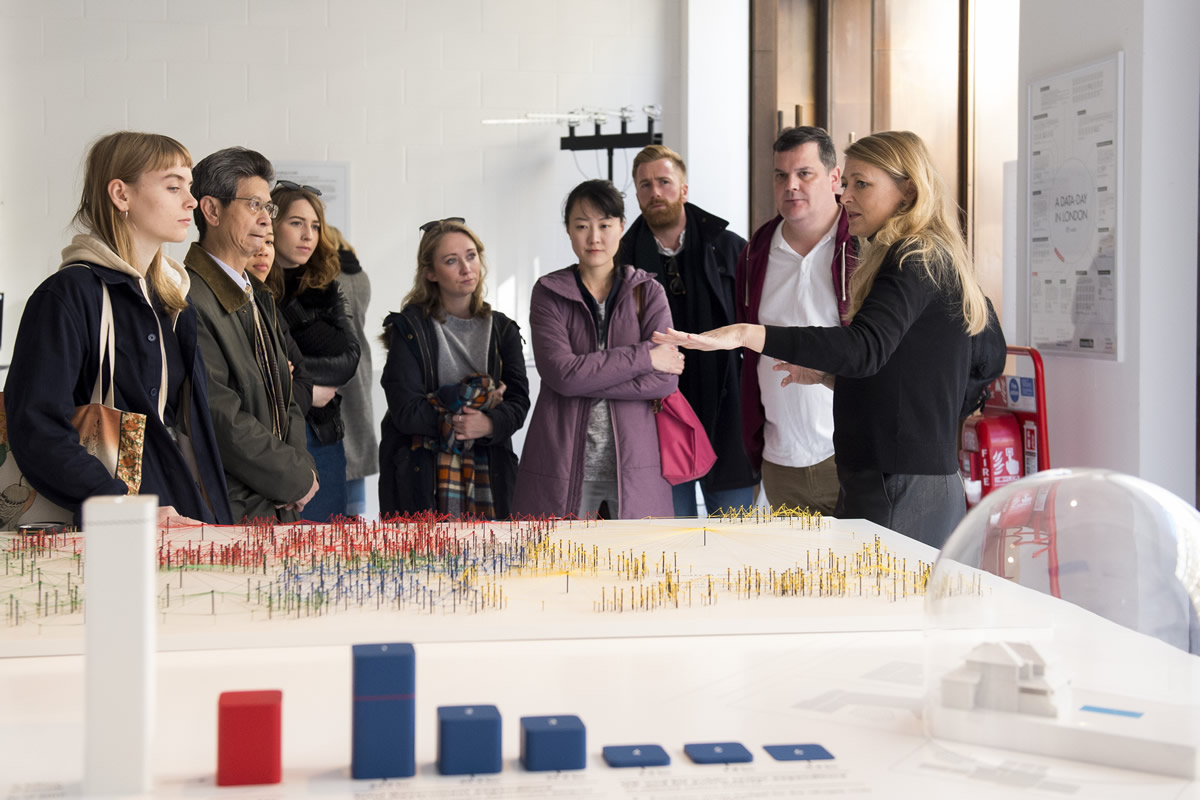
For a pedestrian on a busy street of London or New York, The Glass Room is a pop-up “tech store with a twist.” At first glance, it seems to offer the latest in shiny digital consumer products, such as the newest tablet or fitness tracker. But as you go inside, you find there’s nothing for sale. Instead, as you explore you’ll find a selection of art works exploring who is collecting our personal data and why, and what we can do about it.
The Glass Room brings together art, technology and the aesthetics of consumer retail. Visitors are presented with political questions about the data we share online with or without our knowledge. The exhibition creates a welcoming and accessible space that enables visitors to question their own assumptions about their digital lives and data, and to explore difficult and suppressed questions about their online activities.
A Glass Room tour. Photo by David Mirzoeff.
Tactical Tech has partnered with Mozilla to open Glass Room exhibitions in New York and London in the two years since opening “The White Room” in a larger exhibition at the Berlin Haus der Kulturen der Welt.
Following The Glass Room New York, the New York Times reported:
“To move through the Glass Room…was to be reminded of the many ways we unwittingly submit ourselves and one another to unnecessary surveillance, with devastating consequences… I left the Glass Room invigorated by the ways artists are exploring the dark side of our digital footprint.”
Tactical Tech has worked on data and privacy for some years. We’ve seen many public awareness campaigns on data, privacy and surveillance, struggle to make a significant impact.
Putting together the Glass Room, we saw an opportunity to work with artists and their work to lead people outside their comfort zone and test their assumptions. By creating an immersive space we were able to test different forms of engagement through art objects, animations and products visitors could take away, such as our Data Detox Kits.
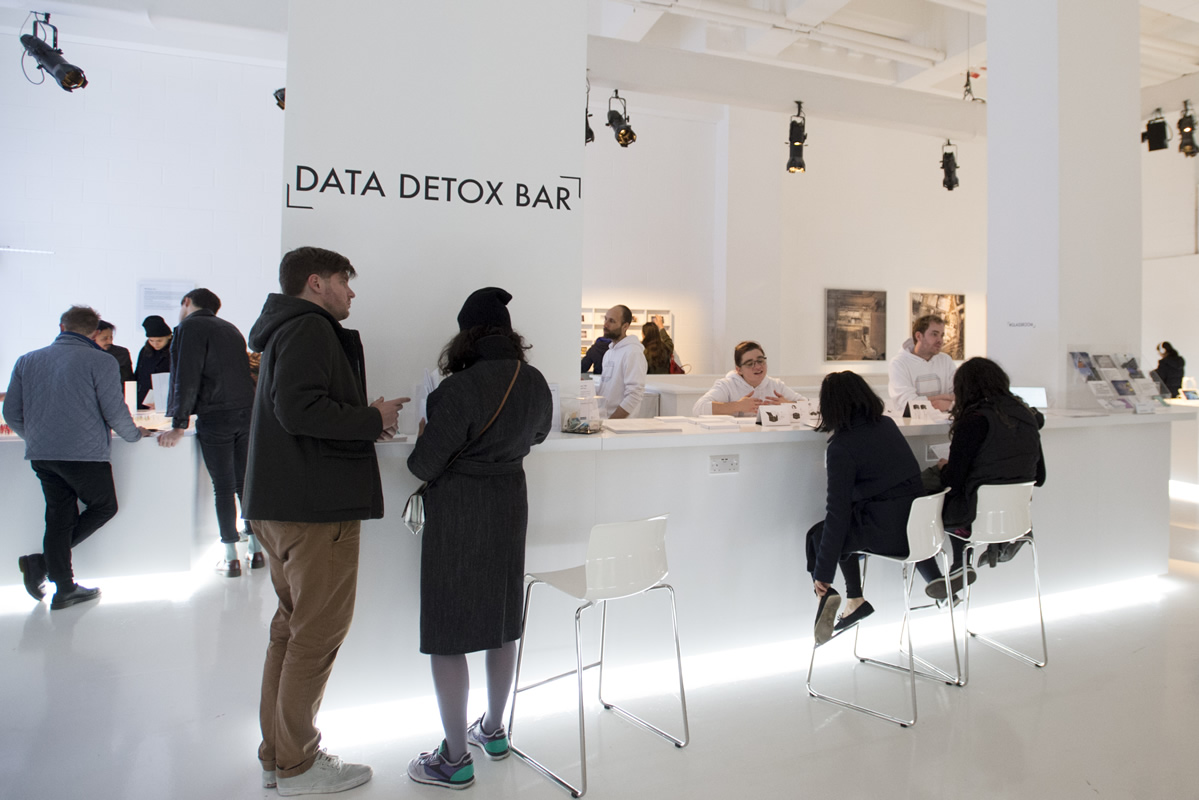
People interacting at the Data Detox Bar. Photo by David Mirzoeff.
With The Glass Room we hoped we could bring debates and discourse highly prevalent in academia and technology activism to a broader audience. In a sense we hoped to fill the perception gap between niche discussions and issues on technology and popular media depictions of technology, such as Black Mirror, by presenting abstract and often speculative issues as a real-life, tangible, and even tactile, experience.
It turned out to be a timely intervention as large-scale data harvesting conversations enter more mainstream discourse. We challenged the audience’s willingness to engage with a broader and deeper reflection about the “quantified society,” the impact all-pervasive data sharing is having on our public sphere – transport, health, education – as well as on our sense of ourselves.
Following the success of the White Room in Berlin, we worked closely with Mozilla, artists, and designers from an experiential agency to expand and develop the concept to work in a retail context.
In both cities before opening, we launched advertising campaigns on billboards, in subway stations and online.
The exhibit was open for around three weeks in each city and over that period visitor numbers kept growing. By the final weekend in London we had reached our capacity inside and queues formed down the road.
The results: over 40,000 visitors attended, and there has been widespread media coverage, including articles in the New York Times,Channel 4 News, the BBC, New Scientist, Vogue and tech media such as The Verge. Social media activity was also sparked; for example, a Facebook Live event attracted over 47,000 viewers.
Audiences have been diverse. The majority of the visitors were ordinary passersby,who were either drawn in when walking past or heard about the exhibition from word of mouth. We attracted tourists, hipsters on the way to the cinema, families on a day out or simply people wandering in while shopping.
For the exhibits, we partnered with local artists to curate art works to add context and relevance so that the facts about how our personal data is being collected and used could come alive for non-technical visitors. We also installed a “Data Detox Bar” – at the back of the space in New York and right in the centre of the store in London – where people could pick up a “Data Detox Kit,” our easy 8-day guide to a digital makeover. We also created dedicated event spaces where we curated programmes involving activists, technologists, journalists, and some of our partner artists, where their own work around data and privacy was presented and discussed.
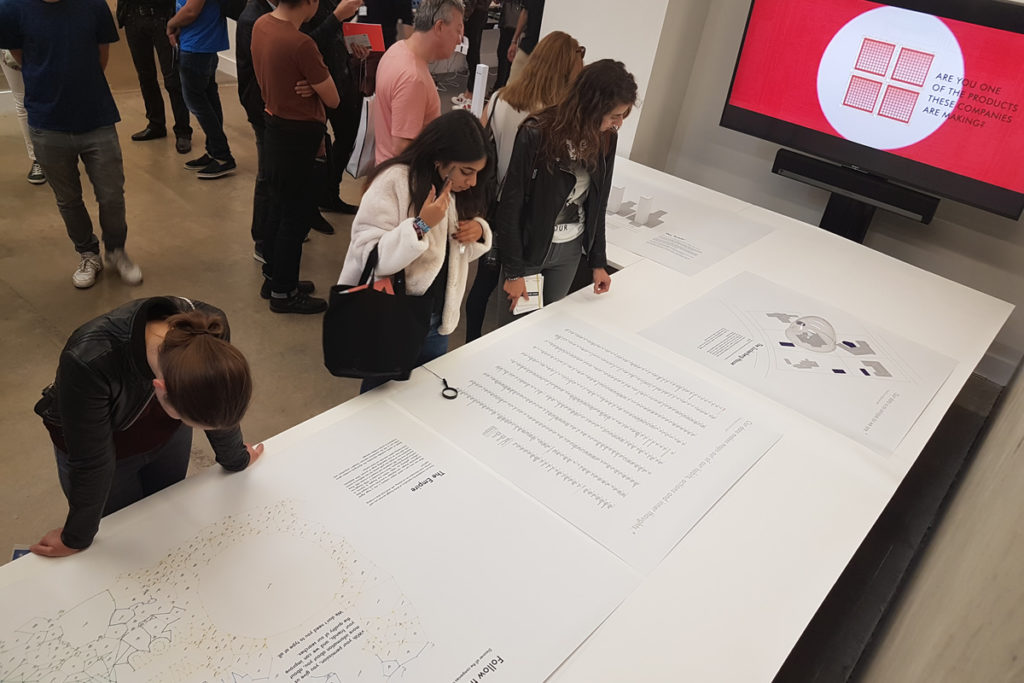
Glass Room visitors, 2017. Photo by Alistair Alexander.
Critically, for both cities, we recruited and trained a local group of “Ingeniuses” from diverse backgrounds and communities. Many had no experience in technology or privacy but after a four-day training camp, had enough knowledge to give privacy help and advice. They were a constant and welcoming presence in the space, engaging visitors in conversations, providing explanations, and even offering some recommendations when such were sought. They also led workshops, free and open to everyone and to all levels of technical knowledge, with titles such as “WTF – What the Facebook,” “Mastering your Mobile” and “DeGooglize your Life.”
The exhibitions sparked a depth of engagement rarely seen in awareness-raising campaigns. Many visitors stayed for an hour or more; some stayed for an entire day to take free workshops. Lots of people came back for repeat visits, often bringing with them friends or family.
The Glass Room was open for around 3 weeks in both cities and over that period visitor numbers kept growing. By the final weekend in London we had reached our capacity inside and queues formed down the road.
In New York and London visitors filled out over 840 feedback cards. Some typical feedback:
After visiting the Glass Room I feel…
As if I’m finally accessing the vault control room. Shocked, enlightened, provoked.
Happy someone is showing us how our data is being used.
Interested in technology and data. I want to study technology and data. (from an eight-year old youngster)
Glad there is so much research keeping watch on corporate surveillance.
My mind has been opened.
Healthily paranoid.
After visiting the Glass Room I want…
To cleanse my online life and move away from Google.
To know more. It is not about becoming paranoid, it’s about being more prepared.
To get involved in protective steps to recover privacy for all.
To be more creative how I talk to people about privacy and security.
To talk to human beings more than ever.
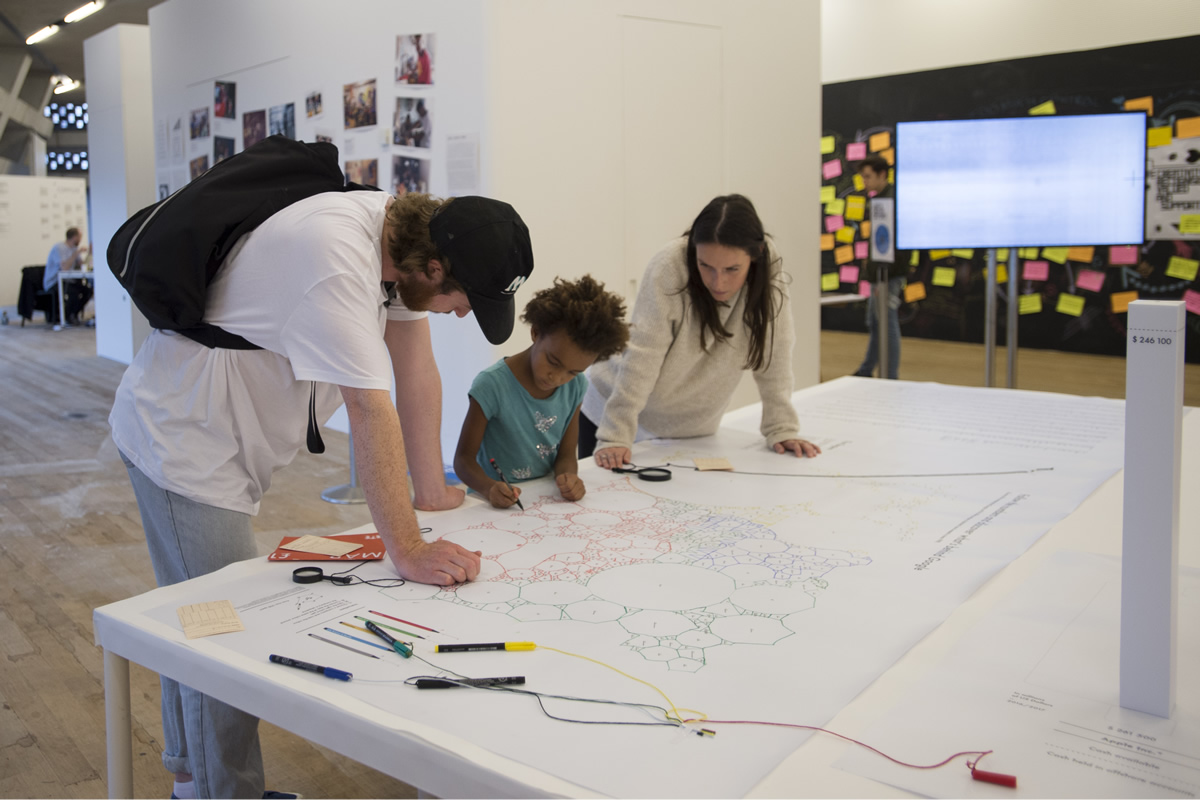
A child at interactive Glass Room exhibit in London. Photo by David Mirzoeff.
What we learned
What can be taken away from this project? We think at least these things:
By setting up an exhibition in prime shopping locations, we were able to take issues of data and privacy to where people are, rather than hoping they‘d come to us.
By using art to explore these topics, we were challenging peoples’ assumptions in ways a conventional narrative can never achieve, and we were opening avenues for further enquiry.
By mirroring the design cues of tech stores, we used a visual language that everyone understands, and thus we were able to attract people who might well be put off by an art exhibition.
By taking the issues off line and creating an immersive physical space that was free and open to everyone, we created a public spectacle – an inclusive space where the experience of discovering these curious objects was shared with others, making the whole experience memorable and impactful.
And perhaps most crucially, by having a team of Ingeniuses who were from the local communities, we made the exhibition a vibrant, warm and human space – where visitors always had someone they could talk to.
Challenges
Of course, putting on a project of this scale has its limitations and challenges.
Renting prime retail locations and launching outdoor advertising campaigns doesn’t come cheap and we – like most small non-profits would – needed additional support. We were lucky that Mozilla proved to be the perfect partner. Not only did they have resources to do the project justice, but as the project progressed it became clear that their objectives and values were closely aligned with ours, and they gave us the freedom and support to develop the concept as far as we could.
Even with such an ideal partner though, an exhibition like this can only be temporary and will only reach a limited number of people in a very specific location. So we need to figure out ways of reaching more people, in more places, at substantially less cost.
Easier said than done, but we’re working on it. Over 2017 we developed a portable version of the exhibition, the Glass Room Experience. This kit recreates some of the objects from the main exhibition as 3D cardboard shapes and posters. We trialed this at around 10 events in Europe as we iterated the design. The kit development, production and distribution cost only a fraction of the main exhibition. And it provides small organisations and groups with materials that they can use to help explain these issues to their communities.
Although far smaller, the effect we have achieved on Experience visitors – over 7,000 of them to date – we believe, has been highly positive and has allowed us to take the Glass Room to places and people who would never see the full Glass Room.
The future
We are working again with Mozilla to produce a new edition of the “Internet of Things” that will be distributed to 75 events and organisations around the world in 2018. At the same time, we plan to find “multiplier” organisations that can print, distribute and support dozens of Glass Room Experienceevents themselves – allowing us to reach far beyond what our own capacity would allow.
The Glass Room experience kit development, production and distribution does have a cost, but it is a fraction of the main exhibitions. And crucially, The Experience provides small organisations and groups with materials that they can use to help explain these issues to their communities.
We’ll also be working with larger events and festivals to produce a mobile version of the exhibit, Glass Room Plus, which will be entirely self-funded. And we’ll be looking at developing new versions for schools and young people, libraries and universities, among many other audiences.
We’ll be looking at developing our self-learning resources online, so people can access more structured approaches to improving their online privacy.
We may yet open a major Glass Room pop-up store in another major world city in the future, but for now we’re working on promising avenues that can take Glass Room themes and narratives to yet new places and contexts: a hack lab in Lagos, a conference in Taipei, a crypto-rave in Brazil.
So the Glass Room project continues to evolve and develop. Indeed, it may be coming to you in 2018 – wherever and whoever you are. And if it’s not coming anywhere near, please get in touch – you could be the perfect Glass Room Experience host.
This story was written by Alistair Alexander of Tactical Tech. Alexander helped develop and implement The Glass Room project.
Top photo of Glass Room storefront by Nousha Salimi.
This past week, Mozilla and Tactical Techlaunched The Glass Room in London. This “store” is actually an exhibition that disrupts how we think about technology and encourages people to make informed choices about their online lives. Now, anyone can experience the exhibit online and in real life.
Like a Black Mirror episode come to life, The Glass Room prompts reflection, experimentation and play. At first glance, it offers the latest in shiny digital consumer products, such as the newest tablet, fitness tracker or facial recognition software. But as visitors go inside, they find there is nothing for sale.
A closer look at the ‘products’ reveals works of art that peek behind the screens and into the hidden world of what happens to user data. The ‘Ingenius’ team is on hand to answer questions raised by the exhibit, engaging the public in conversation and helping them with alternatives, privacy tips and tricks.
This 360° view will take you deep inside the space and allow you to experience the exhibit everyone in London is talking about.
As a pioneer in WebVR technology, Mozilla believes this is an excellent opportunity to make this unique experience available on the web to everyone, everywhere, without the need to install an app or proprietary VR software. You simply click on the link and enjoy.
If you have an Oculus Rift or HTC VIVE, you can click on the VR icon to launch the Glass Room experience in WebVR. You can then immerse yourself in everything The Glass Room has to offer without taking a trip to London. All you need is the latest version of Firefox. WebVR for Firefox is enabled by default on Windows, so simply open the web site and you can explore the virtual Glass Room with your headset and hand controls. Mac users with headsets can download Firefox Nightly for early access to WebVR.
As this revolutionary technology develops, there will be more opportunities to create interactive exhibits, like The Glass Room, in VR that tell immersive stories on the web.



 The MAZI Toolkit is made up of three elements.
 In addition, you can directly access the Toolkit guidelines on GitHub, which includes up-to-date documentation: