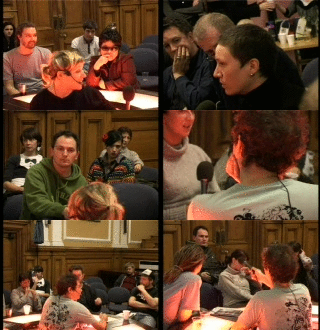
Moving Image Archive Conference UCL 8.1.2008

Deptford.TV was presented as a Living Archive at the Moving Image Archive Conference at the University College London (UCL). Using Moving Image Archives in Academic Research is a collaborative doctoral training programme sponsored by the Arts and Humanities Research Council, for doctoral students registered at U.K. universities in film, television, media or cultural studies, history, American studies, architecture, anthropology and other relevant disciplines. Leading academics, together with representatives from the BFI National Archive, the Imperial War Museum, The British Universities Film and Video Council, the Media Archive of Central England, the national archives of Wales and Scotland, the Broadway Media Centre, and others, will deliver training events between November 2007 and December 2008.

The training programme is led by Professor Roberta Pearson at the University of Nottingham and Dr Lee Grieveson at UCL.

see

Deptford Symphony of a City

Composer Rob Canning http://robcanning.info moved to http://dek.spc.org we started brainstorming about Deptford Symphony of a city in homage to Walter Ruthman “Berlin: Symphony of a great City” and Adnan Hadzi’s professorThomas Schadt who produced the remake “Berlin Symphony of a City” from http://www.filmakademie.de

see the film on archive

excerpt about “Berlin: Symphony of a great City” from wikipedia:

Berlin: Symphony of a Great City (German: Berlin: Die Sinfonie der Großstadt), a 1927 German silent film directed by Walter Ruttmann, and co-written by Carl Mayer and Karl Freund, is a prominent example of the city symphony genre.[1] A musical score to accompany the film was written by Edmund Meisel. As a “city symphony” film, it portrays the life of a city, mainly through visual impressions in a semi-documentary style, without the narrative content of more mainstream films, though the sequencing of events can imply a kind of “narrative” of the city’s daily life.

Other noted examples of the genre include Charles Sheeler and Paul Strand‘s 1921 film Manhatta, Dziga Vertov‘s 1929 film Man with a Movie Camera, Andre Sauvage’s 1928 film Etudes sur Paris, and the 1929 Dutch film Regen directed by Mannus Franken and Joris Ivens.

This film represented a sort of break from Ruttmann’s earlier “Absolute” films which were abstracts. Some of Vertov’s earlier films have been cited as influential on Ruttmann’s approach to this film, and it seems the filmmakers mutually inspired one another, as there exist many parallels between this film and the later Man with a Movie Camera.

The film displays the filmmaker’s knowledge of Soviet montage theory. Some Socialist political sympathies, or identification with the underclass can be inferred from a few of the edits in the film, though critics have suggested that either Ruttmann avoided a strong position, or else he pursued his aesthetic interests to the extent that they diminished the potential for political content.[2] Ruttmann’s own description of the film suggests that his motives were predominantly aesthetic: “Since I began in the cinema, I had the idea of making something out of life, of creating a symphonic film out of the millions of energies that comprise the life of a big city.”

excerpt about “Berlin Symphony of a City” from german films:

“I think most people who feel a rush of excitement watching my Berlin film don’t know where it’s coming from. If I managed to give people a sense of that excitement, of allowing them to experience the city of Berlin, then I achieved what I set out to do and proved that I was right all along.” (Walther Ruttmann)

In 1927, Walther Ruttmann shot his majestic documentary Berlin. Symphony of a City. In September of that same year, this milestone of the silent film era was premiered at Berlin’s Tauentzien Palast with a specially composed live soundtrack.

Seventy-five years later, Berlin is in the midst of a uniquely vibrant and exciting transition. Ten years after the fall of the Berlin Wall, the re-energized drive of history is bringing forth a new city. People from all over the world and from all walks of life are coming together to form a new metropolis, one reminiscent in many ways of 1920s Berlin.

While retaining some of the original’s basic dramatic principles and characteristics -organizing every shot in the film according to a symphonic structure, depicting one day in the life of the city using several main themes, and shooting on black-and-white 35 mm film – this remake also strives to establish its own cohesive pictorial language and narrative structure.

Presentation of VODO at IDFA 23.11.2008

During IDFA Adnan Hadzi presented VODO.net at the EDN General Assembly.

VODO is trying to help solve three problems:

(1) How do we get works (texts, films, music) distributed efficiently and widely using current P2P technologies?

(2) How do we draw attention to these works that can rival mainstream media?

(3) How can we help creators distributing through P2P systems with developing a sustainable, or even profitable, practice?

VODO approaches these problems by, first, gathering quality “unpublished” content (books, films, music) from a variety of sources. These may, for example, be commissioning agencies who know about works they have comissioned that could not be published; they may be “slush-piles” from literary agencies; they may be first albums submitted directly by bands, or offered by managers. The fact is that a lot of (perhaps even most) great content will never make it to a mainstream publication, for a variety of reasons that we won’t go into here.

Second, we filter the content. Once it’s ulpoaded, we allow visitors to VODO to download or stream any work they like, in order to vote on it. This results in a “winner” each month.

Third, we are bringing together some of the world’s largest P2P services and sites to help promote and distribute winning works. One work selected each month will be promoted prominently for 24hrs on sites that, collectively, have over 60m eyeballs. The promotions we place on these pages will link directly to the works, which will be seeded in partnership with our friends at Mininova.org and other Bittorrent services. Our estimate is that winning VODO works will obtain around 6m downloads, a not insignificant number!

Finally, at the core of VODO is a commitment to providing revenue for creators of media content, in a world in which the systems for distributing, copying and viewing that content are cross-territorial, rapidly changing and difficult to predict or control. Put simply, we provide a freely accessible “look up” table that stores hashes of works we’ve helped distribute, against payment details (e.g., paypal) for producers. With this table, any site that implements the VODO system can offer donation links for VODO works. In time we’re aiming to extend this to all sorts of works, even those not published by us. But as you can guess, this has some issues related to it!

With the system we’ve developed, we’ll be able to let consumers of media shared through P2P networks make voluntary donations to our creators wherever their works are shared.

If you want to know more, we encourage you to look at VODO, The Long Version.

Bitnik + 68septante: copyleft film

by peter

Uploaded to Archive.org is a full length one hour unedited recording of the Pirate.tv session which took place in bookshop Quarantaine in Brussels on November 20, 2008 in the framework of the Collaborative Online Video workshop.
Recorded by Bitnik Mediengruppe, the evening consisted of a Videotheque Nomade program compiled by 68septante. On television sets spread throughout the bookshop following films, published copyleft or under a cc license could be watched:

Qu’est ce que le copyleft?, LL de Mars 6′50 – vo fr (www.le-terrier.net)
Frontière de Jérôme Giller 6′ – vo fr st en (http://www.jeromegiller.net/video_frontiere.php) / la Vidéothèque Nomade : http://www.6870.be/spip.php?article204
Nécessaire(s) territoire(s), Benoit Perraud 21′ – vo fr (http://www.lafamilledigitale.org/fr/necessaire-s-territoire-s.html) et http://www.6870.be/spip.php?article222 dans la Vidéothèque Nomade

With bricolaged appearances by several protagonists of the workshop Collaborative Online Video

Collaborative Online Video 17th – 23rd November 2008

Presentation of the Deptford.TV method & the Free.TV work (Bitnik.org) post by constandvzw

A workshop Open Source Video exploring collaborative practices and tools.

Remixes, re-using imagery, recycling visuals and reworking the same source material is an exciting artistic field which gained momentum with the rise of the internet. Audio visual material that is free of author rights, films, clips and rushes published under open content licenses, offer the possibility of creating different types of audio visual productions, video databases, live streaming events, internet tv channels and collective documentaries.

The Open Source Video workgroup (osvideo.constantvzw.org) organise this workshop because we are enthousiastic about the possibilities the web offers for video collectives, artistic, journalistic and cultural organisations working together in remote locations using vlogs, internet tv, videofeeds, video-archives to give new impulses to their collaborative practices. The workshop attempts to give models of open source workflows; how video can be shared through the internet, contributing to a healthy ecology of knowledge exchange.

Guests among others: EngageMedia, Miro, V2V, Pirate Cinema Berlin, Pad.ma, Oxdb, Deptford.tv, Bitnik.

The workshop consists on the one hand of a series of hands on exercises in open source encoding, sharing (P2P) video, distributed editing and Content Management Systems for video sharing and archiving, and on the other hand of a series of evening presentations focusing on inventive practices of video-sharing by Brussels and international audio visual makers. The workshop explores the possibilities of open source codecs, non linear video browsing, collaborative working methods and collective approaches. Together this offers an intensive introduction to the possibilities of systems, practices and work ethics of collaborative video work.

What will New Cross be? & Black History Month documentation


New Cross is an area home to emerging creative businesses, deprived council estates and large numbers of students. How do these different communities interact? What is the future of New Cross? What will happen to the creative culture that has thrived in this area? On the 5th November, you are invited to Deptford Town Hall to air your views and envision possible futures around the Talkaoke table.

This Talkaoke was hosted for the first time by a rising star of Talkaoke: Jesse Darlin’.


Watch the video here

comment by transpontine

There’s lots of interesting (and indeed free) stuff happening in New Cross this week, not sure I can keep up with it all. To start with on Wednesday 5th September there’s an event – or rather couple of linked events – at Deptford Town Hall, New Cross Road, London SE14 6AF.

From 4.30-5.15pm, there’s ‘Deptford.TV Premieres: Black History Month’ – four short films made by Goldsmiths MA Screen Documentary students for Deptford.TV on Deptford’s black history. They look at the story of reggae sound systems in the area, the growth of the black community here, and the racist violence of the 1970s and 1980s, including the New Cross Fire.

Then in the same venue from 5.30-8.00pm it’s ‘Talkoake on se14 6af: What will New Cross be?’: ‘Goldsmiths, University of London is located in the heart of the dynamic and diverse neighbourhood of New Cross. The area is home to emerging creative businesses, deprived council estates and large numbers of students. How do these different communities interact? What is the future of New Cross? What will happen to the creative culture that has thrived in the area? On the 5th of November, you are invited to Deptford Town Hall to air your views and envision possible futures at a public Talkaoke, an interactive audience-led talk show on the future of the area’.

Talkaoke by The People Speak, supported by The Centre for the study of Global Media and Democracy, and The Centre for Urban and Community Research.

pure:dyne software party, 23rd October 2008

GOTO10 and pure:dyne host an evening dedicated to Free Software and art…

* BOOK PREVIEW: Be the first to check out FLOSS+Art, a new openmute publication reflecting on the growing relationship between Free Software ideology, open content and digital art. Edited by Aymeric Mansoux and Marloes de Valk.

* PANEL DISCUSSION: Anthony Iles moderates a panel discussion on communities of collaboration, online and off, with book contributors Matthew Fuller, Olga Goriunova, Aymeric Mansoux; and artist/activist Stefan Szczelkun.

* SOFTWARE PARTY: Check out the new Debian-based pure:dyne system – the GNU/Linux distribution for media arts. Meet the developers and hear about pure:dyne projects by our  friends at Folly (Taylor Nuttall), Access Space (James Wallbank), HTTP/Furtherfield (Marc Garret & Ruth Catlow), Dave Griffiths and Adnan Hadzi.

pure:dyne is an essential tool created to provide a  complete, Free/Libre/open source (FLOSS) custom and ready-made GNU/Linux computer environment for media artists. The pure:dyne CD can be inserted and run on a computer without the need to install anything, with an aim to make it simple to use on many types of hardware. It contains FLOSS programs for recording and manipulating sound, making live visuals and creating interactive media in installation, and more.

This event is part of the pure:dyne for everyone project, a national series designed to make pure:dyne more accessible through special events with partnering media arts centres across the country. * PLUS: pure:dyne promo goodies, Free Beer and more!

More info at:     http://www.goto10.org http://puredyne.goto10.org
Live interview 16 – 23 October on Netbehaviour:
http://www.netbehaviour.org/

Why Openness Matters

Why Openness Matters: The Deptford.TV Project

Hadzi, Adnan
Department of Media and Communication
Goldsmiths, University of London, UK
a.hadzi@gold.ac.uk

This paper was presented at the RIPE conference & Documentary now!

Deptford.TV is an online media database documenting the urban change of Deptford, in South-East London . It operates through the use of free and open source software, which ensures the users continued control over the production and distribution infrastructure. Deptford.TV (http://www.deptford.tv) was initiated by Adnan Hadzi in collaboration with the Deckspace media lab, Bitnik media collective, Boundless project, Liquid Culture initiative, and Goldsmiths College .

This paper argues for the importance of: a) The use of open source software, which ensures the users continued control over the infrastructure for distribution; b) The capacity building of participants in the technical aspects of developing an on-line distribution infrastructure that they themselves can operate and control, empowering them to share and distribute production work both locally and internationally.

This paper continues the debate raised in the Next 5 Minutes media conference (Amsterdam, 2003) regarding ‘tactical media in crisis’; a conference which in many ways marked the “crash” of an online activism based on a merely tactical approach. As McKenzie Wark and others asked during the conference, ‘Can tactical media anticipate, rather than be merely reactive?’

The aim of a strategy is to generate a form of social contract; not only by enunciation or discursive agreements, but by actual practice. Existing networks, applications, artefacts and organisations like The Pirate Bay, Steal This Film, Deptford.TV, the Transmission.cc network etc. in effect constitute strategic entities that re-write the rules of engagement with digital media on an everyday basis. The problem being, that many of these entities become deemed illegal, quasi-legal or illegitimate by the current copyright legislation, something which can only really be addressed through finding new ethical frameworks which can appropriate what is already happening but in terms which do not frame it in the old dichotomy of ‘legal’ versus ‘illegal’.

As Michel de Certeau makes us aware of, strategies differ from tactics in that they are not reactive to an oppressor or enemy. Rather, strategies are self-maintained, autonomous, and – more specifically – spatially situated. If the ‘temporary autonomous zone’ (Bey 1991) of pirates, nomads and vagabonds is characterised not by permanence but by transience, still it might be seen as a means to generate short intermissions of stability; the establishment of momentary connectors, stable points, islands in the stream. The establishment of such islands is dependent on location and manual effort: different types of strategies that will become apparent throughout this reader.

An overarching issue for this paper has been the concept of ‘data spheres’ and of strategies aiming to build, uphold and defend these generative spheres. Adnan Hadzi presents a case for the strategic use of copyleft licenses within the datascapes of peer-to-peer networks by establishing data spheres: basically, acknowledging the need for a social contract which can uphold an ethical viability for those data spheres that have already emerged, but are currently branded illegitimate or at least non-sanctioned.

The fourth bi-annual RIPE (9th-10th of October 2008) conference is hosted by ZDF (Zweites Deutsches Fernsehen), Germany’s national public service television broadcasting company, and two universities: The Medienintelligenz programme together with IAK Medienwissenschaften at the Johannes Gutenberg-University of Mainz and the Institute of Media Design at the Mainz University of Applied Sciences. Our theme is public service media in their role, obligations and development for relations with the publics such companies are mandated to serve. About sixty international scholars and researchers together with strategic managers and policy makers will be working collaboratively to generate analysis and uncover insights about media development of relevance to the practice of citizenship in 21st century. Participants will better understand the dynamics of collaboration and public partnership in the development of a genuinely participatory public service enterprise.

Documentary Now! returns this year (11th October 2008) sponsored jointly by Brunel and Roehampton Universities.  The conference brings together scholars, filmmakers, students and interested members of the public to discuss current trends, from the return of documentary as a theatrical box office phenomenon, to broadcast television, the web and beyond.  It explores questions of industry, audiences, aesthetics, political engagement, documentary’s relationship to the mainstream media and many other issues.  What’s new in documentary? Where is documentary headed?
Deptford.TV in Jamaica – iStreet.TV

I St. Lab Micro TV is a TV broadcasting unit to facilitate mobile TV broadcasts. It is being built by Container Project, a community media lab in a 40 foot shipping container in rural Jamaica. It was initiated in 2003 by media artist (h)activist Mervin Jarman, who fulfilled his dream of returning to Jamaica to start the Container Project in the community where he grew up in. !Mediengruppe Bitnik from Switzerland are contributing their know-how, experience and technical material to build up and start using the micro TV station in August 2008. look it up http://www.istreet.tv

this image of Verdie on the roof will give the basis for the logo

Code Sprint SVN cinelerra 1st – 11th july

Finally, the first prototype of a shared cinelerra .xml project file is realised. See the documentation on http://watch.deptford.tv/wiki/

report by peter:

Lisa Haskel, Bitniks & OS video discussed how can the functionalities of online and ofline systems to edit video be reviewed to facilitate open source ways of collaborative video-editing. We worked on imagining a system, exploring the possibilities of content managing systems and the capacity of timeline editors to export edit decision lists in open standards formats.

Workshop CIN XML SVN


During the last week a small group of people have been working with Deptford.tv at Deckspace, Greenwhich on setting up a system for collaborative video. Building on the proposals by the Echo chamber project to connect Final Cut Pro’s output XML to Drupal, thought has been spent on creating a system involving the XML output of Cinelerra, based on this first draft -see below- made by Adnan. The aim is to produce at the end of next week a flowchart that maps the process, and from which possible optimisations of the system can be derived before the next Deptford.tv workshop will take place in october. The database of Deptford.tv is excellent case study material for trying to set up such a system.

The above sketch shows a connection from the Deptford database to a version of the Bitnik Copyfight broadcasting system, indicated by the blue cloud on the right, and described on the site of Bitnik. A possibility for the future, but not the center of this workshop.

Lisa Haskel installed a SVN versioning system, which can be used by editors to exchange cinelerra output xml files. Meaning off course that all editors will have to work with Cinelerra, which I find excellent and exciting news. One way of permitting editors to opt working with Final Cut Pro could be to write a script that translates between the two software’s differently formatted project XML’s. SVN adds a particular potential to the project: Forking, making versions of the same project accessible and editable opens new avenues for a symphonic collaborative video project.