A State of Limbo

A State of Limbo explores the concept of identity in the Mediterranean at this time of migratory crisis. A multidisciplinary exhibition, large-scale paintings and installations are presented by artist James Micallef Grimaud a.k.a TWITCH. Curated by Rachel Formosa, the exhibition brings forward a visual narrative which examines the socio-political context of an unprecedented crisis in Europe. Featuring elements of street art, the exhibit illustrates the Mediterranean Sea as a paradoxical place, and how populations flock to it in search of freedom. Whilst some do so for pleasure, others seek refuge even though they may not reach their destination. As part of its programme, the exhibition will host hardcore punk band Double Standard, in the Theater of Spazju Kreattiv on Friday the 6th of December.

Curated by Rachel Formosa, a State of Limbo presents a multi-disciplinary exhibition of large-scale paintings and installations by James Micallef Grimaud a.k.a TWITCH, which explore the concept of identity in the Mediterranean at this time of migratory crisis.

FRAGMENTA – Art and Life in Public Space 2013 – 2018

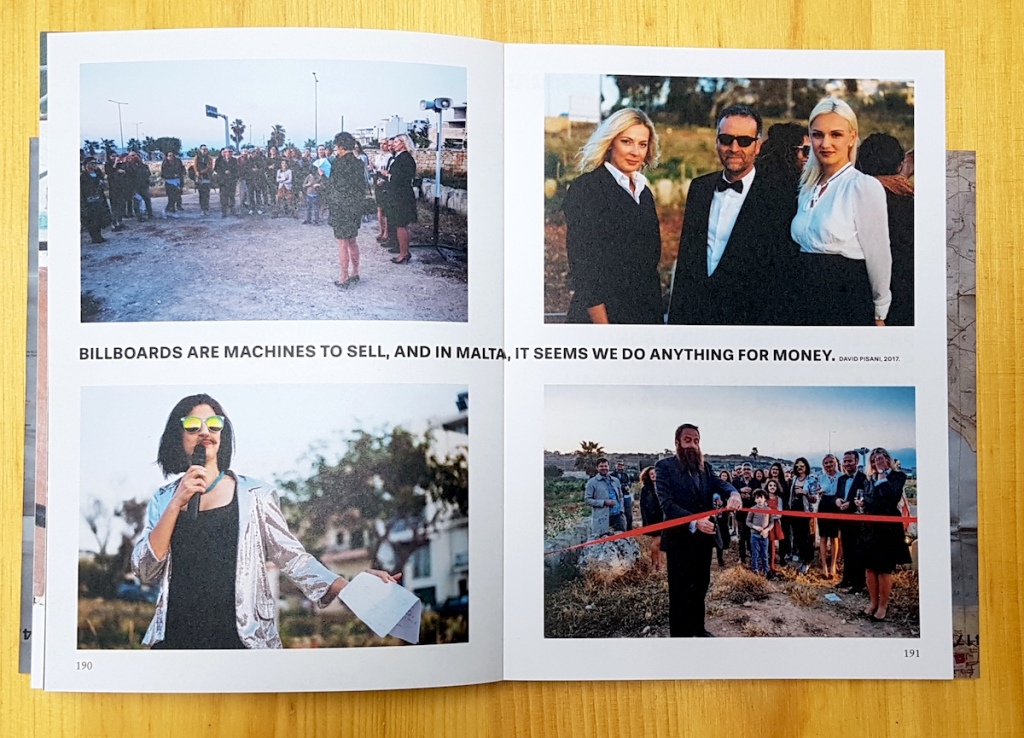
FRAGMENTA book launch “FRAGMENTA – Art and Life in Public Space 2013 – 2018”. You get to see the overview of all events, a mind-blowing selection of Maltese headlines (we wished the headlines extended to 2019 at this point) and celebrate art and life. You can buy copies of the book if you missed the indiegogo campaign. Or collect your preordered ones.

SUNDAY Dec 8th, 5 – 10pm at MAORI, Valletta.

With FRAGMENTA Artists: Jon Banthorpe, Gina Levante, Adrian Abela, Kris Van Dessel, Goele de Bruyn, Aksel Høgenhaug, Ritty Tacsum, Samir Ramdani, Jagna Ciuchta, Bettina Hutschek, Aiden Celeste, Stefan Nestoroski, Alexandra Pace, Hassan Khan, Teresa Sciberras, Roxanne Gatt, Erik Gong, Sandra Zaffarese, Aaron Bezzina, Christof Zwiener, Sonya Schönberger, Charlie Cauchi, Erik Smith, Darrin Zammit-Lupi, Karen Irmer, Anna Block, Sarah Maria Scicluna, Ryan Falzon, Sharon Kivland, Pippin Barr, Carl Gent, David Pisani, Karine Rougier, Kay Turner, Mario Asef

Designed by Jon Banthorpe, printed by LONGO.

The event is free of charge and open to all.
Come any time between 5pm and 10pm. Bring your protest posters.

TIME: Sunday, December 8th, 5pm – 10pm

Location: MAORI. Triq il-lanca, VLT 1820 Valletta

boattr.eu @AIS conference

Adnan presented boattr.eu – Awareness raising regarding the Central Mediterranean Migration crisis during the AIS conference.

In 2019, the  theme of the Association of Interdisciplinary Studies (AIS) annual conference will be Interdisciplinarity in Global Contexts. Since a defining feature of interdisciplinarity and transdisciplinarity is not to abstract or isolate problems but rather to approach them in their real-world contexts, this conference theme asks participants to consider the global and local contexts of interdisciplinary education and research. Obviously, contexts differ in scale and can be defined at microscopic or macroscopic levels: chemical properties are influenced by molecular configurations, for example, organic functions by bodily states, individuals by their societal environments, public health by geographical and climatic conditions, and cities by their world-wide connections. Adding to this complexity are various dynamic interactions across these dimensions, further making an interdisciplinary perspective necessary.

This paper presents the envisaged interdisciplinary boattr.eu research project. boattr.eu is planned as a European research project currently initiated by the Migration Research Cluster of the University of Malta. ‘boattr.eu’ (b.eu) stands for boat migrants, forced migrants, and the aims of the boattr.eu project is to stimulate discussion and offer counter-narratives surrounding the current forced migration situation in Europe, through the use of novel immersive experience (IX) technologies which provide a complete sensory experience for participants. To achieve this aim, four case studies on particular events that have triggered different reactions to the migration crisis in the dominant public discourse of four European countries, namely Malta (Solidarity), Italy (Containment), Greece (Criminalisation), and Spain (Militarisation), are planned to be used as a basis for developing the relevant sensory experiences.

As long as there is no option of safe passage to Europe, people will continue risking their lives, forced to take what is now the host of some of the the world’s most dangerous migration routes, the Mediterranean Sea. [Fargues Philippe, “Four Decades of Cross-Mediterranean Undocumented Migration to Europe” (International Organization for Migration, 2017)] Setting off in flimsy rubber boats, many soon find themselves heading for rocks or sand banks that can readily capsize or sink a dinghy. Others are abandoned by smugglers who drop them at beaches that are inaccessible via land. The majority of people are wearing fake life jackets, giving them a false sense of safety. [Hannah Al-Othman, “Tricked into death: 150,000 migrants’ life jackets – many of which are useless fakes- lie piled on the coast of Lesbos in a grim memorial to those who die crossing the Mediterranean” (The Daily Mail, 2017)]

The boattr.eu research project envisages using the expertise from the Immersive Lab project in order to allow researchers to create immersive experiences around the central Mediterranean migration crisis. Sound and image constantly surround us, their presence is ubiquitous therefore we are all part of an immersion, whether or not we are aware of it. Immersive experiences introduce audiences to digital journeys where they are transported through the content of, for example, a science project, an architecture simulation, a documentary, an art installation or a performance.

Goldsmiths College also hosts the Forensic Architecture agency and the Forensic Oceanography project, which recently published a report on the central Mediterranean migration crisis entitled Mare Clausum [Mare Clausum, a report by Forensic Oceanography (Charles Heller and Lorenzo Pezzani), affiliated to the Forensic Architecture agency, Goldsmiths, University of London, 2018] which offers the boattr.eu research project a conceptual awareness raising method for the unfolding migration crisis at the borders to Malta.

The mission of the University of Malta Cluster for Migration is to offer a dialogical space in which researchers from different academic disciplines can work towards understanding all the evolving aspects of international migration, including that of belonging across generations. The long-term goal is to thereby contribute to an equitable, more sustainable and more inclusive society that brings benefits to migrants and their families, communities of origin, destination and transit, as well as their sending and receiving countries. Today the migration crisis renders the Mediterranean an opaque space, removed from the public eye, where the key founding values of the European Union are put under strain, making the Migration Cluster initiative all the more necessary. The cluster can help to shed light and raise awareness among stakeholders, policy makers, and the general public about the unfolding crisis at the common maritime borders of the Member States.

EMM’s Annual General Meeting for 2019

During EMM‘s annual general meeting Adnan joined the board.

It’s been more than four years since Electronic Music Malta held its first ever meeting at Spazju Kreattiv. It was a meeting during which this, then new, organization set its primary goals and objectives with the aim of providing a different type of contribution to the electronic music community in Malta.

Following its successful application to become a recognized Voluntary Organisation, EMM established its first group of volunteers who, as a committee, charted its initial path and activities. According to EMM’s statute, this committee was renewed in 2017, and again, this saw us organize more events most of all our yearly conference, Circuits, which also formed part of the Valletta 2018 programme of activities. Circuits continued to be held year after year with 2019 being its fourth edition in a row!

What is Changing?

EMM’s work has received support from various private and public entities in Malta. Testimony to this is the EMM’s upcoming event which will see a world renowned theremin player coming to Malta to perform, thanks to support received from the Goethe Institute (through the German-Maltese Circle) and Heritage Malta who will be providing us with a magnificent venue! Also our forthcoming documentary will see its’ very film-maker participate in the event by holding a brief talk prior to the screening… and this thanks to the University of Malta. And there is more in store!

We have upcoming projects and collaborations with the University of South Africa (UNISA), the University of Malta, Black Box Pro, support from the Malta Arts Fund, the Malta International Arts Festival and, of course, Spazju Kreattiv!

EMM will no longer merely organize events but will commence training programmes, networking sessions, commission projects, exhibitions, performances and, yes, build its first synthesizer module!

EFAP Kick-Off meeting

EFAP, the European Forum for Advanced Practices, will be launched in a kick-off meeting in Madrid from October 10-13, 2019. The events will take place in CA2M Centro de Arte Dos de Mayo. The program on Thursday and Friday from 1800-2200 is open for the public. Participation in the working group sessions requires prior registration.

PROGRAM

THURSDAY, 10.10.2019

Public program
18:00: Welcome by Manuel Segade, Director of CA2M Centro de Arte Dos de Mayo
18:15: Presentation by Irit Rogoff.
18:45: Lecture by Maria Hlavajova
20:15: Conversation: Andrea Phillips & Jesús Carrillo
21:15: Conversation: Sybille Peters & Victoria Pérez Royo
22:00: El Drama de una realidad Sur Performing lecture by Javiera de la Fuente

FRIDAY 11.10.2019

12:00 – 18:00
Core group meeting

Conference/public program
18:00: Video Conversation with Brian Massumi by Florian Schneider
18.30: El texto como Notación (experimento de escritura). Lecture by Jon Mikel Euba
20:15: Conversation: Andrew Patrizio & Héctor Tejero
21:15: Conversation: Inés Moreira & Ethel Baraona 

SATURDAY, 12.10.2019

Working Group sessions

10:00 – 11:00: Welcome
11:00 – 12:00: General introduction into the WGs
12:00 – 18:00: WG parallel sessions

SUNDAY, 13.10.2019

Working Group sessions

11:00 – 14:00: WG parallel sessions
15:00 – 17:00: Debriefing (optional)


Finding the Soul in the Machine

Swiss artist, documentary filmmaker, and researcher Dr Adnan Hadzi has recently made Malta his home and can currently be found lecturing in interactive art at the University of Malta. He speaks to Teodor Reljic about how the information technology zeitgeist is spewing up some alarming developments, arguing that art may be our most appropriate bulwark against the onslaught of privacy invasion and the unsavoury aspects of artificial intelligence.

What does art really ‘do’? 

Right. Let’s step back and give this loaded thought a good, proper, well… think. 

Does art have any other function beyond its simple—and often much-maligned—ability to allow us to escape the humdrum or unpleasant realities of life by offering us an aesthetic transport of some kind? And if we’re talking about art on the opposite side of the spectrum—the actively political, the openly provocative—is that stuff not better served by organising protests, by petitioning politicians, by running for office ourselves?

Admittedly, this is a very crude characterisation of what art could potentially be and the kind of force it continues to radiate worldwide. But it’s also a handy crucible with which to preface my conversation with Dr Adnan Hadzi, a documentary filmmaker, transmedia artist, and now lecturer on interactive art (Department of Digital Arts, Faculty of Media and Knowledge Sciences, University of Malta).


Hadzi cut his teeth on various art collectives around Europe. In London, he spent a sizeable amount of time in institutions like Goldsmiths University, where he rode a wave of collaboration with new media art collectives which, among other things, seek to eviscerate our relationship with omnipresent and ever-more invasive technology. 

What emerges from our conversation is just how much the very assumptions we tend to have about both art and the technological hegemony are in dire need of analysis, dissection, and meditation. 

‘It’s not so much about revealing what’s out there,’ Hadzi tells me halfway through our chat, ‘because I think a lot of what underpins these technologies is actually quite obvious. And it’s not even about being provocative per se—which is the first thing that a lot of people mention when they look at some of the work I’ve documented or done. I think, really, it’s simply about creating a space in which these things can be discussed.’ 

It’s a discussion, however, that Hadzi fears we may be having ‘far too late, perhaps.’ The exponential growth of certain technologies we have invited into our lives may already have brought us to a point of no return. But if we stave off the doom and gloom, even for a little bit, we’re all likely to find that a better understanding of the evolving nature of the Internet would make us feel that little bit more aware, and that little bit more empowered. 

Hadzi’s work and research interests continue to fuel this strand of inquiry and creation. In parallel to his research focused on media ethics, Hadzi was a regular at the Deckspace Media Lab. There, he helped coordinate the Deptford.TV project. Together with his subsequent work on the Creeknet Project, Deptford.TV—accessible online—engages with the local community of Deptford in South London by creating an online ‘data hub’ of sorts.

The initiative’s website explains how Deptford.TV ‘functions as an open, collaborative system that facilitates artists, filmmakers, researchers, and participants of the workshops to store, share, edit, and redistribute media. The open and collaborative nature of the Deptford.TV project demonstrates a form of shared media practice in two ways: audiences become producers by managing their material, and the system enables contributors to organise their productions and interactions.’

In short, it is a plea for both democratic accessibility of data and a general transparency about how that data is disseminated and consumed, filtered through processes that could be broadly described as new media art.


‘I believe that art has a very strong claim on these realities, and can create a very necessary discursive space which is sorely missing,’ Hadzi says, bringing up the tragicomic case of how the internal dynamics of complex algorithms—such as those which underpin our financial system—tend to be opaque even to those who operate them.

It is an approach that is pushed to further refinement by one of Deptford.TV’s collaborators, the !Mediengruppe Bitnik collective. 

Hadzi has limited involvement with the collective, fully crediting the project’s founders, Domago Smoljo and Carmen Weisskopf, as its main driving force. Yet his close-to-the-bone involvement with the group makes him an astute commentator on the implications of their work.


Operating between Zurich and London, the collective has initiated a wide variety of projects, installations, and artistic ‘happenings’. All of them share one thing in common: their engagement with contemporary information technologies.


Among the most prominent was certainly Delivery for Mr Assange. The live video project documented the journey of a package sent by post to Wikileaks founder Julian Assange, famously exiled within the Ecuadorian embassy’s confines in London. Beyond the attention-grabbing effect of featuring Assange himself—’of course this added a political currency to the initiative,’ Hadzi says—the main aim of the project was really to delve into notions of privacy. The simple, picaresque journey of the little package, and the small camera that had been snuck into it to stream its travels live on Twitter, successfully undermined the privacy of all involved. 

‘The postal workers who were filmed wrapping and delivering the package, they have their own private spaces and their own rights too,’ Hadzi notes, rights which were compromised by the recording device which captured them as the package headed to its celebrity recipient. 

However, Hadzi is also quick to note that the operations of the collective are entirely legal, suggesting that this is somewhat part of the problem. If such a ubiquitous use of surveillance technology is perfectly fine with the authorities, then critiquing it becomes even more urgent. 

‘Indeed, the collective has very strong ties with media law and ethics experts, and they have fact-checkers in place to ensure that nothing they do crosses any clear legal lines,’ Hadzi adds. But the nature of the beast is that these lines tend to be murky. An explicit case is the collective’s 2014–2016 experiment, Random Darknet Shopper. 

As the title already suggests, the project involved a custom-made algorithm sent out into the ‘Dark Web‘ (the Internet’s black market) with a budget to purchase stuff at random. As was eventually displayed in an installation based on the intervention at the Kunst Halle Sankt Gallen, Switzerland, a lot of the algorithm’s $100 Bitcoin budget went to relatively harmless purchases. 

But the randomised system also ended up buying a pack of ten yellow ecstasy pills.

‘This of course brings up the question of whether a pre-programmed but randomly operating system can be held responsible for committing crimes,’ Hadzi observes. In fact, the artists were eventually cleared of any charges, precisely because the public prosecutor believed that the project raised questions that are of public interest. 

The idea of machine learning is an urgent concern for Hadzi and one that he believes should be addressed sooner rather than later. ‘We’ve reached a point, perhaps, where the machines are pretty well-fed; they have enough data to evolve and start talking to each other.’

It may be an alarming point, but it’s also yet another argument for art to be allowed to do its work with full autonomy–never averting its gaze from contemporary realities and technological developments, while also refusing to ‘ingest’ them without questioning their implications. 

Now that he’s settled in Malta, I find myself asking whether Hadzi deems the island an interesting space from which one can continue to observe these multidisciplinary—and highly topical—intersections. 

‘Yes, I believe so. One of the main things I find very interesting is how the academic sphere in Malta has made it a point to fuse media studies with the cognitive sciences. I think this particularly pertinent nowadays, when the effect of things like social media on our brains is becoming very much apparent.’ 

Among other projects, Hadzi also looks forward to helping create an ‘immersive pipeline’ in Malta, a space for all people to discuss pressing matters related to privacy, surveillance, and artificial intelligence in a welcoming space that acknowledges the problems but doesn’t shy away from them. 

Being immersed in the heady and uncertain world can do one’s head in. Having spent some years operating from a boat on the British Waterways, Hadzi and his partner have just moved from the bustle of Mosta into the comparatively sedate enclosure of Fontana, Gozo, and that feels somewhat relevant to our discussion. 

But ignoring these dynamics will not assuage our anxiety. Instead of endless polemics, let’s process it through art.

The Good Life

The good life is what we long for. Fantasies of the good life feed our habitats and identities, from personal desires to political projects and commercial culture. They inspire future visions and filter images of the past. Sara Cwynar’s practice across photography, collage and film toggles between different epochs and aesthetics, revealing how the quest for the good life has been driven by evolving ideals, values, and taste, yet always grounded in conventionality and predictable comforts. Exploring the backbone of iconographies and clichés, where common constructs meet reassuring genres, Cwynar tackles the critical concept of visual truth and deciphers a reality of mundane objects and pictures merely reformulated by algorithms. Responding to the way technology challenges our vision, she creates a timeless and indelible reservoir of upfront, non-hierarchical images that resist the internet, the primary source of visual knowledge and experience in the XXI century.

Exhibition dates: 12 July – 20 September 2019
Open times: Tuesday – Friday: 1.00 – 6.00pm, Saturday: 10.00am – 1.00pm

This exhibition is supported by the Government of Canada. Blitz is supported by Arts Council Malta through a Cultural Partnership Agreement.

#blitzvalletta #malta #contemporary_art #exhibition #art #artinmalta #artspace #valletta

ELIA Artistic Research Platform Meeting

University of Malta joins ELIA on the artistic research patform.

The Artistic Research Platform is a virtual and, occasionally, a physical forum for institutional, programme and project leaders; heads of departments; researchers; PhD students and supervisors of ELIA member institutions who are professionally involved in and want to contribute to, the development of artistic research.

You can join the VIRTUAL PLATFORM to receive specific updates on the topic of artistic research by registering below. Registration to the platform is free, however, it is restricted to professionals affiliated with ELIA member institutions.

The first Artistic Research Platform Meeting, which took place from 13-14 June 2019 in Vienna, dealt with the question of how higher arts education institutions can provide a substantial and sustainable framework for artistic research. Particularly, the discussion focused on what artistic research projects and artistic research doctoral programmes need in terms of:

  • Infrastructure and Spaces;
  • Critical Mass, Community and Feedback process;
  • Multidisciplinarity vs Discipline Specifics;
  • Dissemination, Open Access, Open Research Data;
  • Handling Stereotypes and Institutional Challenges;
  • Internal and External Funding schemes.

Interdisciplinary Conference “Does Nature Think?/La nature pense-t-elle ?”

Globally, our environment is no longer in a state about which we can be optimistic. Anthropocene compels us to fundamentally reconsider the modern conception of nature as a mere object. Augustin Berque, a French advocate of mesology (Uexkül‘s Umweltlehre, Watsuji’s fūogaku, i.e. the study of milieu) suggested the strange question “does nature think?” as the theme of this international conference. The aim of the conference is to reexamine the modern view of nature, whereby human beings are seen as holding atranscendental position. We will invite 25 to 30 researchers from different fields (anthropology, geography, philosophy, Buddhism, human environmental studies, primatology, agricultural science, oceanography, law, history of Western art, etc. ), as well as practitioners who directly face and work within nature, to discuss together, in an intercultural and interdisciplinary approach, a series of questions centering on the problem of what may or may not distinguish human thinking from the diverse types of selfawareness and communication, discovered by ethology and biosemiotics, to exist among other living beings.

There is a Beginning in the End in Venice

There is a Beginning in the End
San Fantin Church

Together with the Stella Art Foundation, the Pushkin Museum will present a special project of the “Pushkin Museum XXI” initiative in Venice: There is a Beginning in the End, a modern art exhibition in commemoration of the 500th anniversary of the Venetian artist Jacopo Robusti, called Tintoretto. This event will be held at the same time as the 58th Venice Biennale.

The San Fantin church, where Tintoretto’s paintings used to be displayed, will host works by contemporary artists Dmitry Krymov, Irina Nakhova and Gary Hill. These pieces will be in dialogue with a painting by Emilio Vedova, a modernist Italian artist and one of Tintoretto’s followers, and the historical context of the venue. An intervention project by the !Mediengruppe Bitnik team from Switzerland will complement the exhibition and stress the atmosphere of participation and affiliation with a secret Venetian brotherhood.

In contrast to a traditional exhibition, this project is arranged as a kind of contemporary liturgy where each act is a new artwork filling the entire space of the church. In addition to media objects, the exhibition will feature a painting by Emilio Vedova, an Italian abstractionist and main follower of Tintoretto in the 20th century, which is echoed by the works of contemporary artists.

Dmitry Krymov, a scenery designer, turns the San Trovaso Church into a performative installation inspired by the Last Supper. As an interpretation of this biblical story, he constructs in the altar of the San Fantin Church an alternative reality based on trompe-l’oeil, an optical illusion, thereby causing the viewers to doubt the correctness of their perception.

A media installation by Irina Nakhova consists of three parts, each being a reference to the works of the great master. All of them reinterpret biblical stories from the perspective of contemporary history. For this artist, an important theme of Tintoretto’s works is the vigorous movement of masses of people with their crucial emotional intensity. A swirling material born on earth searches for a way out in the transcendent outer space, which is hardly comprehensible but can be felt through Irina Nakhova’s dramatic media object.

Gary Hill, a classic of American media art, decomposes Tintoretto’s paintings into patterns and elements and uses those as a basis on which to create a new sounding and shimmering essence. The primary starting point for Hill is the realm of human consciousness rather than architectural space. The combination of visual images and intense electronic tones makes it possible to achieve a deep synesthetic experience.

Tondo, one of Emilio Vedova’s later works presented at the exhibition, is in the shape of a circle. It reflects the concept of an endless loop of time. For Vedova, the mission of an artist was to record and re-translate the eternal themes of disturbing worldwide collisions: wars, injustice, oppression. Like Tintoretto, he handles huge spaces and forces of nature rather than single images. He employs the circular shape to go beyond the depictive environment through the connection between space and time.

The Pushkin Museum exhibition will be the first event to welcome a wide audience to the San Fantin Church after a decade of restoration work. Its construction was finished in the 16th century, while the first local public worship buildings date back to the 10th century.

Another participant of the exhibition is the !Mediengruppe Bitnik team, which will hold a secret intervention project for the viewers to join Tintoretto’s Secret Brotherhood. The atmosphere of secrecy, affiliation and co-creation will connect their project with the Venetian brotherhoods.

Tintoretto, Russian theatrical artists, and the social realism of Geliy Korzhev will all be on show from May 11 to Nov. 24.

Visitors of this year’s Venice Biennale, which kicks on May 11, are in for a real surprise. The world’s most anticipated art show is hosting not one but three iconic Russian museums, each showcasing works from the last 100 years, complete with a subtle reference to the Renaissance in Venice.

According to the Director of St.Petersburg’s Hermitage, Mikhail Piotrovsky, the museum will curate the Russian Pavilion at the Giardini della Biennale. For the first time ever, the task of curating a pavilion will not fall on an individual or group, but an institution.

Russia’s entry will be a collective exhibit featuring Aleksander Sokurov, who scooped the Venice Film Festival’s coveted Golden Lion award with his film Faust, and scenic painter Aleksander Shishkin-Hokusai. Sculptures featuring in the latter’s installation are currently being made in workshops in St.Petersburg’s Tovstonogov Theater, which Piotrovsky says is partnering up with the Venice Biennale.

Moscow’s Pushkin Museum and Tretyakov Gallery are also preparing their own shows at different locations in Venice. The Pushkin is teaming up with the Stella Art Foundation for the exhibition called “At the end dwells the beginning…” at the Church of San Fantin, presented as a dialogue between Old Masters and contemporary artists. Among those being featured include Tintoretto and Emilio Vedova, theater director Dmitry Krymov, and conceptualist Irina Nakhova (who represented Russia at the 2015 biennale), American video artist Garry Hill, and the Swiss collective !Mediengruppe Bitnik.

As requested by the Venice-based Ca’ Foscari University, the Tretyakov will curate a monographic exhibit by Geliy Korzhev titled “Korzhev. Back to Venice.” The representative of socialist realism, who authored the famous “Raising the Banner,” is a favorite of Tretyakov Director Zelfira Tregulova. She featured his work at the Palazzo delle Esposizioni in Rome, not to mention organizing his first retrospective at the Tretyakov in 2016.

The word “Back” in the title of the exhibit relates to the artist’s participation in the 1962 biennale, when he represented Russia, among others. Today this exhibition space will feature some 50 works.

Both Moscow museums have also submitted their exhibits to the biennale’s parallel program, which will provide additional opportunities to promote their exhibitions. However, the Pushkin Museum told Russia Beyond that both applications have been declined.