
Alan Butler led a tour of the game environment of Grand Theft Auto V, focusing on topics of representation and simulation as well as the role of the in-game photographer. Viewers were able to follow the artist in his critical analysis of the game logics, and their social, political, and economic implications.
reports
Virtual Design Festival
Dezeen announces Virtual Design Festival, the world’s first online design festival, taking place from Wednesday 15 April onwards.
With much of the world in lockdown due to the coronavirus pandemic, the global architecture and design community is, along with many other sectors, facing unprecedented challenges.
Virtual Design Festival (www.virtualdesignfestival.com) is a platform that will bring the architecture and design world together to celebrate the culture and commerce of our industry, and explore how it can adapt and respond to extraordinary circumstances.
We will host a rolling programme of online talks, lectures, movies, product launches and more. It will complement and support fairs and festivals around the world that have had to be postponed or cancelled and it will provide a platform for design businesses, so they can, in turn, support their supply chains.
We are inviting individuals, companies and organisations to get in touch to explore how we can help each other. We would like to team up with other architecture and design publications as well.
While we cannot pretend that these are normal times, we can at least explore alternative ways of sharing design, helping others, coming together as a global community and doing business.
How Virtual Design Festival will work
From 15 April onwards, we will host a rolling programme of online talks, lectures, movies, product launches and more. Some of these activities will replace those that we would have hosted at fairs and festivals around the world, but we also want to explore new and innovative formats, specially tailored for the digital sphere and for our locked-down world.
We are particularly interested in hearing from technology companies and developers who could help us develop innovative formats to help connect the global architecture and design community and help them work more effectively in the current situation.
Well Now WTF?
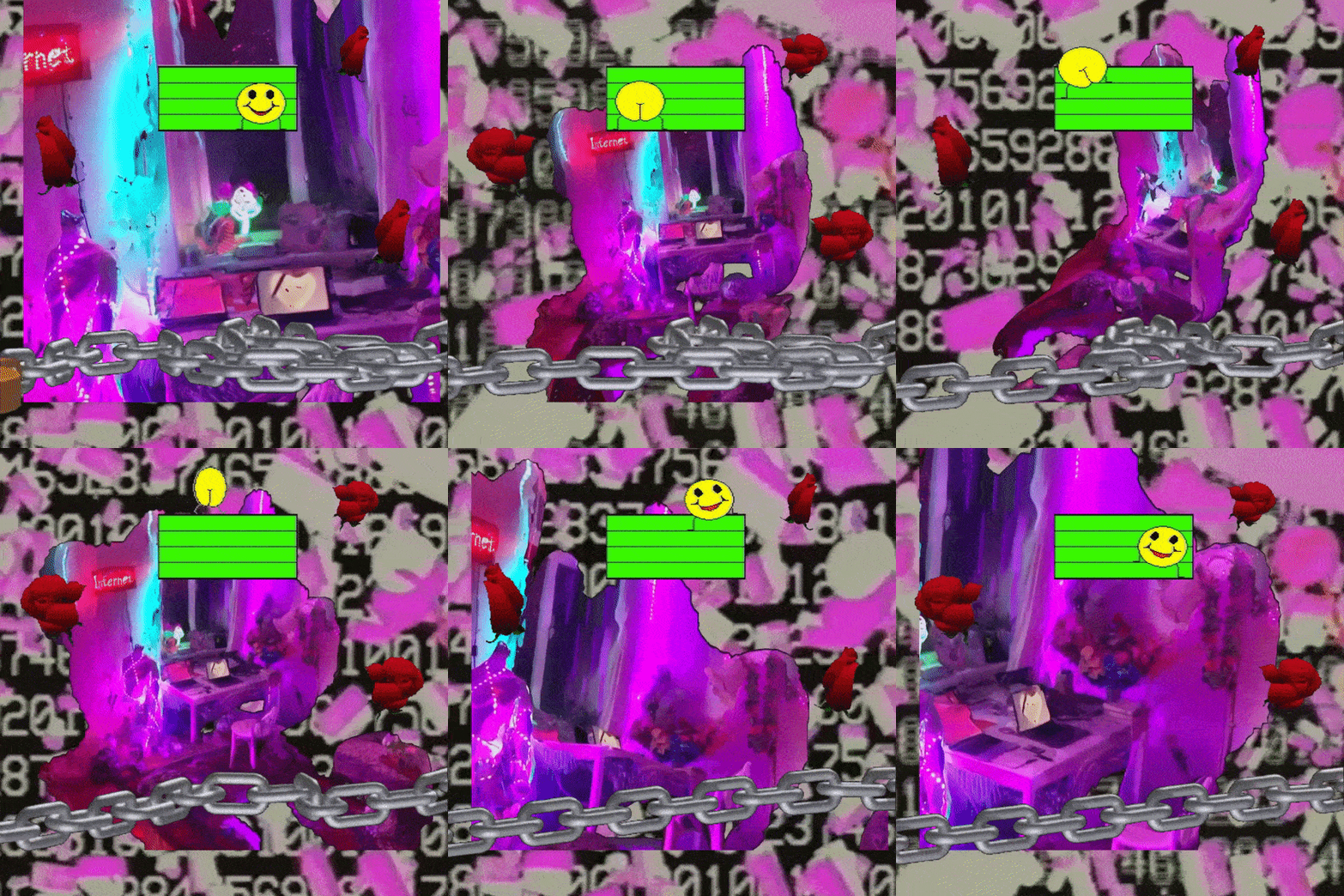
Museums are still closed. School is still cancelled. The world is still shut off and we’re still stuck indoors. The toilet paper is sold out and we change our Zoom backgrounds more often than we change our clothes. And Twitter…we won’t even go there. While everything is still cancelled, why not make our online show MORE?
Silicon Valet is pleased to present the re-opening of Well Now WTF?, an online exhibition curated by Faith Holland, Lorna Mills, and Wade Wallerstein—now with MORE WTF! The exhibition was designed and installed by Kelani Nichole.
Join us for a virtual opening party on May 2nd from 2PM – 4PM EST at http://wellnow.wtf/. We’ll be live streaming on Twitch, and (as always) kicking it in the chatroom.
With everything unrelenting, we continue to ask ourselves: Well Now WTF? We still have no answer, but we’re having a great time making GIFs. We’ve shown that we can come together and use the creative tools at our disposal to build a space for release outside of anxiety-inducing news cycles and banal social media feeds.
Well Now WTF? is as much an art show as a community gathering. Since the initial opening on April 4 and continuing past the virtual re-opening party on May 2nd, we will hold online events on the site itself and via Twitch where people can gather and talk as they would normally for a physical exhibition.
Well Now WTF? is available online at www.wellnow.wtf. The exhibition is free and open to the public, with a $5 suggested, pay-what-you-wish entry that will be redistributed to the artists contributing work.
Donors who contribute $100 or more to Well Now WTF? Will be rewarded with an advanced look at an unpublished GIF by Nicolas Sassoon, Rick Silva, or Wednesday Kim delivered directly to their inbox. These gifs are exclusive and available only to donors. All money will go to the artists in the exhibition. We will be releasing new easter egg GIFS for donors periodically—collect them all!
The exhibition is accompanied by essays by Wade Wallerstein and Seth Barry Watter.
Images & press information from the exhibition (including the original exhibition release) are available here. Please credit artists listed in file names when using.
Participating Artists: A Bill Miller, Ad Minoliti, Adrienne Crossman, Alex McLeod, Alice Bucknell, Alfredo Salazar-Caro, Alma Alloro, Ambar Navarro, Andres Manniste, Anne Spalter, Anneli Goeller, Anthony Antonellis, Antonio Roberts, Ben Sang, Benjamin Gaulon, Bob Bicknell-Knight, Carla Gannis, Casey Kauffmann, Casey Reas, Cassie McQuater, Chiara Passa, Chris Coleman, Chris Collins, Cibelle Cavalli Bastos, Claudia Bitran, Claudia Hart, Clusterduck Collective, Daniel Temkin, Devin Kenny & Morgan Green, Diego Ortega, Don Hanson, Dominic Quagliozzi, Elektra KB, Ellen.Gif, Eltons Kuns, Emilie Gervais, Emily Mulenga, Erica Lapadat-Janzen, Erica Magrey, Erin Gee, Eva Davidova, Eva Papamargariti, Everest Pipkin, Exonemo, Faith Holland, Felt Zine, Francoise Gamma, Graham Akins, Guido Segni, Hannah Neckel, Haydiroket, Hyo Myoung Kim, Ian Bruner, Jan Robert Leegte, Janet.40, Jason Isolini, Jazmin Jones, Jenson Leonard, Jeremy Bailey, Jillian McDonald, Juan Covelli, Kamilia Kard, Katherine Sultan Erminy, Keiken + George Jasper Stone, Kid Xanthrax, LaJuné McMillian, Laleh Mehran, LaTurbo Avedon, Laura Gillmore, Laura Hyunjhee Kim, Lauryn Siegel, Libbi Ponce, Lilly Handley, Lior Zalmanson, Lorna Mills, LoVid, Mara Oscar Cassiani, Mark Dorf, Mark Klink, Maurice Andresen, Maya Ben David, Miguel Martin, Molly Erin McCarthy, Molly Soda, Mohsen Hazrati, Nicolas Sassoon, Nicole Killian, Off Site Project, Olia Svetlanova, Olivia Ross, Ophélie Demurger, Pastiche Lumumba, Peter Burr, Petra Cortright, Pinar Yoldas, Rachel Rossin, Rafia Santana, Rah Eleh, Rick Silva, Rita Jiménez, Rodell Warner, Rosa Menkman, Ryan Kuo, Ryan Trecartin, Santa France, Sara Ludy, Sebastian Schmieg, Shana Moulton, Shawné Michaelain Holloway, Snow Yunxue Fu, Solimán Lopez, Surabhi Suraf, Stacie Ant, Sydney Shavers, Terrell Davis, Theo Triantafyllidis, Tiare Ribeaux, Tobias Williams, Travess Smalley, Tyler Kline, Wednesday Kim, Will Pappenheimer, Yidi Tsao, Yoshi Sodeoka, and Ziyang Wu.
About Silicon Valet
Silicon Valet is a virtual parking lot for expanded internet practice, serving as a hub for the global spread of artists working with the internet and digital materials. Silicon Valet also hosts a digital arts residency and an online exhibition program.
Free El Hiblu 3
In Malta, three African teenagers stand accused of terrorism. They were among a group of migrants who fled Libya on a rubber boat on the 26th of March 2019. At risk of drowning, 108 people were rescued by the crew of the cargo ship El Hiblu 1. Instructed by an aircraft of the European military operation Eunavfor Med, the crew sought to return the rescued to Libya, a war-torn country where migrants live in appalling conditions. The migrants protested their return and convinced the crew of El Hiblu 1 to steer north, to Malta. During the protest nobody was hurt and nothing was damaged. Three African teenagers were arrested and imprisoned for 8 months. Now before a Maltese court, the El Hiblu 3 face serious charges of terrorism and could, if convicted, spend many years in prison. On the 28th of March 2020, the campaign “Free El Hiblu 3” will be launched, several human rights organisations, rescue NGOs, international lawyers and local NGOs are involved in the solidarity campaign.
Digital Culture Overload
The last cultural event visited before the Lockdown of Malta due to Covid-19 was the talk of Klio at Valletta Contemporary on ‘Digital Culture Overload‘.
New media art curator Klio Krajewska gave a talk about the prevalence of digital culture in contemporary life.
During the talk works by the following artists will be presented and discussed: !Mediengruppe Bitnik, Disnovation.org, Guli Silberstein, Winnie Soon, Esmeralda Kosmatopoulos, Shota Yamauchi and others.
Klio is a member of the curatorial team of WRO Art Center and the WRO Media Art Biennale. She is also Head of New Media Arts at Watermans Arts Centre in London and associated with the Parisian environment of sound art.
CTM & TM: End-to-End 2020 Highlights
Double Counting: The Odum Oration
Exchange #1: The Wheres and Whens of Networks
Exchange #2:Empires and Ecologies of the Cloud
Exchange #3: Next to Devastation
Exchange #4: Deplatformization and the Ethics of Exclusion
Exchange #5: Neural Network Cultures
Revolutionary Networked Politics
SILENT WORKS. The Hidden Human Labor in AI-Driven Capitalism
THE HUMAN SEARCH ENGINE: On Smashing the Googlearchy and Other Millennial Pursuits
The Councils of the Pluriversal: Affective Temporalities of Reproduction and Climate Change
End to End Symposium The symposium of transmediale at Volksbühne Berlin features two intensive days of in-depth exchange, screenings, performances, and artistic interventions. More than 50 artists and thinkers will examine networks as social, technological, and artistic infrastructures. Looking back at an era of network idealism, they will ask if the network is still a viable model to react to urgent challenges such as climate change and the consequences of artificial intelligence—and what a future after the network society might look like. PhD Workshop Participants Autonomous Pirate Machinery Double Counting: The Odum Oration (Cycles of Circulation) John Julian and Jamie Allen during Double Counting: The Odum Oration Cycles of Circulation Asunder Present.Perfect. Welcome to the Federation. the What, Why and How of Alternative Social Media #1 Welcome to the Federation. the What, Why and How of Alternative Social Media #2 Revision: Neural 25+1, Critical Publishing and Archiving Revision: Piratbyrån (2003–2009) Piratbyrån CiTiZEN KiNO #84: Asymmetric Media and the Simulacrumbs (for the 20th Anniversary of Indymedia) The Eternal Network To Seek Nows, To Breed Futures #2 Forest Walk #3 Don’t Forget to Change The Beat From Time To Time—About Counter-Raving
Artistic Research Africa
Members of the European Forum for Advanced Practices (EFAP) network attended the Artistic Research Africa (ARA) conference, partnering with colleagues in Africa.
Can a conference be a machine for thinking through new ideas in a collectivity or from a multiplicity of perspectives? Since the question of artistic research in Africa is new and evolving, we have structured the conference to operate as an open-ended interrogative machine. This conference incorporates a wide variety of inputs, from traditional conference paper presentations and panels, to performances, interactive engagements and workshops.We have also been as inclusive as possible, treating postgraduate student work as having the same potential as the work of established figures in the field. All the work selected for this conference was chosen because of the vigour and freshness of the ideas expressed in the proposals, and the potential for the work to open up new ways of thinking about artistic practice and research in Africa in the 21st century.We have designed the conference to foreground the asking of questions, as well as sharing ideas and critique through recognising that artistic research, with its emphasis on embodied knowledge and new forms of subjectivity represents multiple challenges for traditional academic hierarchies. In programming of this conference, we have almost as many “performance-lectures” as we have traditional academic papers. More than one group of presenters have chosen to further question the format of the conference, with anti-panels; while others offer interactive workshops on indeterminism, decolonisation of the mind, and the potential of digital networked media to link embodied performances across the continent.With over sixty presenters, this promises to be a very exciting conference which will articulate the questions that need to be taken forward into the development of artistic research in Africa.
boattr.uk book & blog
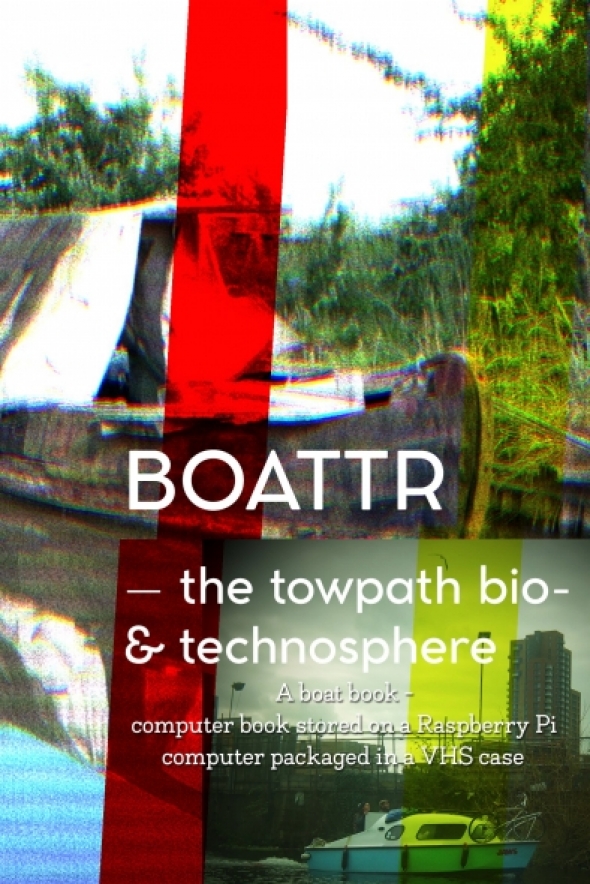
Digital Arts on the British Waterways
This boat book & blog documents our journey on our narrowboat ‘Quintessence’ and the development of the boattr prototype in collaboration with MAZI (for “together” in Greek), a Horizon 2020 research project. Boattr connects narrow boats to the ‘Internet-of-Things’ and allows for open wireless mesh-networking within the narrow boat community, by using affordable microcomputers. The main goal of this project is to provide technology and knowledge that aims to 1) empower those narrow boats who are in physical proximity, to shape their hybrid urban space, together, according to the specificities of the respective local environment, and 2) foster participation, conviviality, and location-based collective awareness of the canals.
This is an edited collection of assembled and annotated boat logs, photographs and video essays, manifested, in a scholarly gesture, as a ‘computer book’.
The boattr prototype was built on the MAZI toolkit and the capabilities offered by Do-It-Yourself networking infrastructures – low-cost off-the-shelf hardware and wireless technologies – that allow small communities or individuals to deploy local communication networks that are fully owned by local actors, including all generated data. These DIY networks could cover from a small square (e.g., using a Raspberry Pi) to a city neighbourhood (e.g., the Commotion Construction Kit used at the RedHook WiFi initiative) or even a whole city (e.g., guifi.net, awmn.net, freifunk.net), and in the case of boattr the UK canal network.
The boattr DIY infrastructures offer a unique rich set of special characteristics and affordances for offering local services to the narrow boat community, outside the public Internet: the ownership and control of the whole design process that promotes independence and grass-roots innovation rather than loss of control and fear of data shadows; the de facto physical proximity of those connected without the need for disclosing private location information, such as GPS coordinates, to third parties; the easy and inclusive access through the use of a local captive portal launched automatically when one joins the network; the option for anonymous interactions; and the materiality of the network itself. The prototype integrates existing FLOSS software, from very simple applications to sophisticated distributed solutions (like those under development by the P2Pvalue project, mobile sensing devices, and recent developments in open data and open hardware), allowing it to be appropriated by different non-expert users according to their respective context and use case.
Table of Contents
Research Journal
Adnan Hadzi
Boat Log
Adnan Hadzi & Natascha Sturny
Reflections
Natascha Sturny, Rob Canning & James Stevens
Videos
Adnan Hadzi
Images
Natascha Sturny
Resources
Franz Xaver & Anton Galanopoulos
Editor
Adnan Hadzi
Authors Collective
Adnan Hadzi
Natascha Sturny
Franz Xaver
Anton Galanopoulos
James Stevens
Rob Canning
Tech Team
Harris Niavis – MAZI Programmer
Giannis Mavridis – Micro-Computer Programmer
Producers
Adnan Hadzi – Format Development & Interface Design
Panayotis Antoniadis – MAZI Project Manager
Mark Gaved – Coordination Creeknet
Quintessence Logo: H1 Reber / Buro Destruct
Cover artwork and booklet design: OpenMute Press
Copyright: the authors
Licence: after.video is dual licensed under the terms of the MIT license and the GPL3
Language: English
Assembly On-demand
OpenMute Press
Acknowledgements
Co-Initiated + Funded by
Horizon 2020 – The EU framework programme for research and innovation
The Mazi project (2016-2018) has received funding from the European Union’s Horizon 2020 ICT CAPS initiative under grant agreement no 687983.
Thanks to
Ushi Reiter – Art Meets Radical Openness, Servus.at, Linz
Vince Briffa – Department of Digital Arts, University of Malta
Clemens Apprich – Centre for Digital Cultures, Lüneburg
Rob Canning – School of Art and Design, Coventry University
Gary Hall – School of Art and Design, Coventry University
Simon Worthington – OpenMute Press, London/Berlin
36c3 highlights
No roborders, no nation, or: smile for a European surveillance propagation
Human Rights at a Global Crossroads
Extinction Rebellion
Server Infrastructure for Global Rebellion by Julian Oliver
From Managerial Feudalism to the Revolt of the Caring Classes by David Graeber
Technical aspects of the surveillance in and around the Ecuadorian embassy in London
Hackers & makers changing music technology
Boeing 737MAX: Automated Crashes
The Eye on the Nile
Art against Facebook
Speaking Fiction To Power
Privatised Push-Back of the Nivin
Forensic Oceanography published the Nivin report.
In November 2018, five months after Matteo Salvini was made Italy’s Interior Minister, and began to close the country’s ports to rescued migrants, a group of 93 migrants was forcefully returned to Libya after they were ‘rescued’ by the Nivin, a merchant ship flying the Panamanian flag, in violation of their rights, and in breach of international refugee law.
The migrants’ boat was first sighted in the Libyan Search and Rescue (SAR) Zone by a Spanish surveillance aircraft, part of Operation EUNAVFOR MED – Sophia, the EU’s anti-smuggling mission. The EUNAVFOR MED – Sophia Command passed information to the Italian and Libyan Coast Guards to facilitate the interception and ‘pull-back’ of the vessel to Libya. However, as the Libyan Coast Guard (LYCG) patrol vessels were unable to perform this task, the Italian Coast Guard (ICG) directly contacted the nearby Nivin ‘on behalf of the Libyan Coast Guard’, and tasked it with rescue.
LYCG later assumed coordination of the operation, communicating from an Italian Navy ship moored in Tripoli, and, after the Nivin performed the rescue, directed it towards Libya.
While the passengers were initially told they would be brought to Italy, when they realised they were being returned to Libya, they locked themselves in the hold of the ship.
A standoff ensured in the port of Misrata which lasted ten days, until the captured passengers were violently removed from the vessel by Libyan security forces, detained, and subjected to multiple forms of ill-treatment, including torture.
This case exemplifies a recurrent practice that we refer to as ‘privatised push-back’. This new strategy has been implemented by Italy, in collaboration with the LYCG, since mid-2018, as a new modality of delegated rescue, intended to enforce border control and contain the movement of migrants from the Global South seeking to reach Europe.
This report is an investigation into this case and new pattern of practice.
Using georeferencing and AIS tracking data, Forensic Oceanography reconstructed the trajectories of the migrants’ vessel and the Nivin.
Tracking data was cross-referenced with the testimonies of passengers, the reports by rescue NGO WatchTheMed‘s ‘Alarm Phone’, a civilian hotline for migrants in need of emergency rescue; a report by the owner of the Nivin, which he shared with a civilian rescue organisation, the testimonies of MSF-France staff in Libya, an interview with a high-ranking LYCG official, official responses, and leaked reports from EUNAVFOR MED.
Together, these pieces of evidence corroborate one other, and together form and clarify an overall picture: a system of strategic delegation of rescue, operated by a complex of European actors for the purpose of border enforcement.
When the first–and preferred–modality of this strategic delegation, which operates through LYCG interception and pull-back of the migrants, did not succeed, those actors, including the Maritime Rescue Co-ordination Centre in Rome, opted for a second modality: privatised push-back, implemented through the LYCG and the merchant ship.
Despite the impression of coordination between European actors and the LYCG, control and coordination of such operations remains constantly within the firm hands of European—and, in particular, Italian—actors.
In this case, as well as in others documented in this report, the outcome of the strategy was to deny migrants fleeing Libya the right to leave and request protection in Italy, returning them to a country in which they have faced grave violations. Through this action, Italy has breached its obligation of non-refoulement, one of the cornerstones of international refugee law.
This report is the basis for a legal submission to the United Nations Human Rights Committee by Global Legal Action Network (GLAN) on behalf of an individual who was shot and forcefully removed from the Nivin.