
Random Chronicles is an oxymoron. ‚Chronicle‘ derives from the Greek chrónos, meaning time, and chronicles are usually historical records or accounts that follow chronological time. A randomisation of time is therefore a contradiction in terms, an upsetting of a particular sequence or order of things.
Raphael Vella and Bettina Hutschek, the two artists in this exhibition, present drawings and videos which gather their material from a variety of traditional chronicles – old films, books, online archives – and randomly mix them anew. The source materials permit ‚old‘ information to acquire a new sense of relevance. Recent or unfolding events are re-interpreted through a layering of old and new lenses, combining historical or scientific fact with the fluidity of fiction and artificial intelligence.
Raphael Vella’s collages and animated video borrow their imagery from sources as varied as medicine, anatomy, politics and parliamentary architecture. In his collages, simplified floor plans of parliament buildings are superimposed by anatomical, microscopic and other fragments lifted from medical textbooks. In the video Bitterbetter (2023), the artist illustrates a strange exchange with the AI system ChatGPT, in which he asks whether politicians have used medical metaphors during public speeches. An initial reply by ChatGPT related to Angela Merkel and the ‚bitter‘ situation of migrants in Europe is soon followed by an apology: the information given previously is incorrect. What supposedly happened in historical time actually never happened, and the story of this weird exchange is told in a quick succession of stop motion drawings, medical imagery, texts…and disappearing migrants.
Bettina Hutschek‘s video The case OGAMI presents a fictitious UFO-logical case report about three so-called „entities“, who manifest on earth in the shape of human beings. After the discovery of TV-imagery, the new aliens get absorbed into the imaginary of sexual and violent symbolism and repeat it. A voice-over analyses movements and actions of the three humanoid being in pseudo-scientific language. The story is told with archive footage from the 50s, ranging from atomic bomb tests to educational films. The entities and their communicative development up to the „human trap“ turn into an ironic metaphor for humankind.
Her series Typewritings combines typings, drawings and collages. Not sure what they mean.
Bettina Hutschek is a visual artist, filmmaker, and artist-curator who lives and works between Berlin and Malta. After studying art history and philosophy (BA) in Florence and Augsburg, she received her MA from Universität der Künste (UdK), Berlin, and her MFA from HGB Leipzig. She worked in art mediation and spent a year as a visiting scholar at the Department of Performance Studies at NYU Tisch School of the Arts. She works as freelance conference interpreter and likes to explore the world.
In 2013, she founded FRAGMENTA Malta, a project space to organise exhibitions in the public space of the Maltese islands. In 2017, she co-curated together with Raphael Vella the Malta Pavilion at the Biennale di Venezia.
Bettinas work has been exhibited, screened and performed internationally, e.g. at NBK Berlin; Malta Contemporary; Art Cappadox Festival, Anatolia; FRAC Bretagne, Rennes; SSA Edinburgh; Foundation Cartier Paris; Blitz, Valletta; Musée Malraux, Le Havre; Museum der Bildenden Künste Leipzig; uqbar, Berlin; NGBK Berlin; ICCA Bucarest; Palais du Tokyo.
Today, she uses fragments of different realities to examine the possibilities of knowledge transfer – that is: to tell stories.
www.bettina-hutschek.com
Raphael Vella is an artist, educator and curator based in Malta. He has exhibited his works in international exhibitions and venues, including the Venice Biennale, Domaine Pommery (Reims, France) and Modern Art Oxford and has curated many group and solo exhibitions in Malta and internationally. He was art critic for the Malta Independent between 1992 and 2000 and won the Commonwealth Art and Craft award (London) in 1998. He was artist-in-residence at the School of Fine Arts at the University of Canterbury in Christchurch, New Zealand for a year in 2000 and was a founding member of the artists’ group StART in the early 2000s. He has published numerous articles and catalogue essays about contemporary art, culture and education and initiated many artistic projects, educational ventures and international exchanges that have helped to transform the cultural scene in Malta. In 2017, he was co-curator (with Bettina Hutschek) of the Malta Pavilion at La Biennale di Venezia. He is also a full professor at the University of Malta. His latest solo exhibition is That Other Place, curated by Maren Richter at Valletta Contemporary, Valletta, Malta (September-October, 2023).

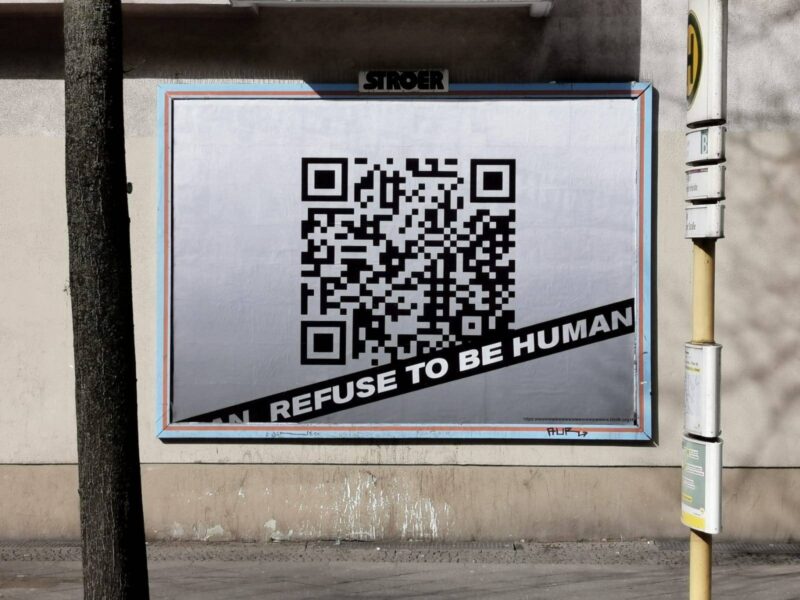 !Mediengruppe Bitnik, Refuse To Be Human, 2021 !Mediengruppe Bitnik, Courtesy of the artists / OPEN BerlinEver wanted to surf the web as a bot? Ever wondered what a bot gets to see online that you don’t? In their latest work, !Mediengruppe Bitnik allows you to become a Yandex bot to find out. The number one search engine in Russia, Yandex uses web crawlers that extensively scrape the web for content for their search engines. Only what the bots see is indexed, for discovery later by users searching on Yandex. Refuse to be Human allows you to install a web extension that changes your browser’s user agent to match that of the Yandex bot, giving you access to what is referred to as the ‘grey web’ – a layer of content only visible to bots, and access to websites and archives usually paywalled. Download the browser extension here Firefox Chrome Produced in collaboration with transmediale and Open.Berlin .!Mediengruppe Bitnik (read – the not Mediengruppe Bitnik) are contemporary artists working on, and with, the Internet. Their practice expands from the digital to physical space, often intentionally applying loss of control to challenge established structures and mechanisms. !Mediengruppe Bitnik’s works formulate fundamental questions concerning contemporary issues. In the past they have been known to subvert surveillance cameras, bug an opera house and broadcast its performances outside, send a parcel containing a camera to Julian Assange at the Ecuadorian embassy in London, and physically glitch a building. Their works have been shown internationally, most recently in exhibitions at CAC Shanghai, LOAF Kyoto, Annka Kultys Gallery London, House of Electronic Arts Basel, Aksioma Ljubljana, Kunsthaus Zurich, FACT Liverpool, Onassis Cultural Center Athens, Public Access Gallery Chicago, Nam June Paik Art Center South Korea, Shanghai Minsheng 21st Century Museum, The Pushkin Museum of Fine Arts Moscow, Beijing Contemporary Art Biennial and the Tehran Roaming Biennial.