Rob Canning, with whom I discussed the Deptford, Symphony of a City film idea, proposed to create an endless, streaming radio loop with the Deptford.TV raw material in the form of a symphonic orchestrated radio station, by re-modifying the code, see also the Appendix that he wrote for the Radio Kulturo project. “Radio Kulturo simultaneously plays the live stream of the national classical radio station of every member state of the European Union and diffuses the mix to a multichannel sound system. It is part of a series of works exploring notions of consensus, time and simultaneity utilising Internet streaming media.” One can listen to the radio stream of the Deptford.TV raw material on Deptford.FM
Author: admin
Symphony of Deptford (work commenced)
Rob Canning wrote: Started work on the audio side of Symphony of Deptford a collaboration with Adnan Hadzi of deptford.tv. I will be using the deptford.tv database (http://watch.deptford.tv/) as a source of audio material and using the meta information that is attached to these files to impose a structure on to a generative sound installation. At the moment it is early days but there is a basic stream being generated on the server now and being broadcast here: http://rob.goto10.org/symphonyofdeptford.ogg http://grub.spc.org:8008/symphonyofdeptford.ogg Deptford Symphony of a city is a homage to Walter Ruthman “Berlin: Symphony of a great City” and Adnan Hadzi’s professorThomas Schadt who produced the remake “Berlin Symphony of a City” from http://www.filmakademie.de

Lewisham 77 at Cafe Crema
Quoted from Lewisham, Peace, Justice and Solidarity:
Who shot the sheriff? – the history of Rock Against Racism and Love Music Hate Racism inspiring and mobilising young people to stop the fascists by bringing together music and politics-from the 1970’s to today.
[Details here. Read an interview with director Alan Miles here. We showed this on our Lewisham 77 commemorative day, and it went down well. If you like it, you may also like our short films about Rock Against Racism’s Red Saunders: 1, 2.]
Lewisham 1977 about the Battle of Lewisham filmed in New Cross by Deptford TV volunteers.
[Not sure which of our films they are showing, presumably this one, filmed on our commemorative walk. More details of the film in this article. Our films were made by volunteers, including Goldsmiths MA Screen Documentary students, in collaboration with Deptford TV, a project which uses open source technologies to generate new forms of collaborative film-making to document changes in SE London.]
The Battle of Cable Street and The Legacy of Cable Street with film maker Yoav Segal
[More info here. Note: Cable Street features in our film about anti-fascist footsoldier Martin Lux.]
With Q and A with film maker and Unite Against Fascism – important lessons as the fascist BNP stand in the forthcoming elections.
Presented by the Lewisham Anti-Racist Action Group and south-east London Unite Against Fascism in conjunction with Café Crema , New Cross larag@talktalk.net; www.naar.org.uk/larag www.uaf.org.uk/ also join face book ‘sel uaf see LARAG online exhibition with images and quotes about fighting fascism in London from 1930’s to 2010.
For all the films at Café Crema there is a charge of £6 which includes polenta meal or cake and drink ordered at 7.30 pm, film screening 8.15pm. Tickets available from the café in advance. To guarantee a place at this cosy venue. 306 New Cross Road. London SE14 6AF. 2 minutes from New Cross and New Cross Gate stations mob 07905 961 876/ 07905 552 571 http://www.cafecremaevents.co.uk/ for information. Pop in: book your seat!
Bonus link: Watch the Deptford.TV film about Cafe Crema.
what the fork?
TV-Hacking
Deptford.TV runs tv hacking workshop at MakeArt Festival 2009 in Poitiers, France.
comment sniffer les cctv signals (special pour tristant + maud 
une histoire des piratageTV
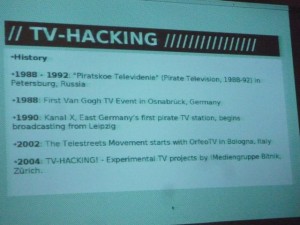
montre un clip de Max headroom
Regle : tout les receivers sont des broadcaster / c’est juste une question de technologie. =>une station de TV pour 50€…..
présente deptford.TV
Présentation de http://edit.deptford.tv/
images of ebb
The End of Something.. A collection of reflections on the Global Crisis
31 July – 30 August 2009
Volume: 114-116 Amersham Vale, Deptford Police Station, New Cross, London SE14 6LG
Opening hours: 12-5pm (Fri-Sun) / http://theendofsomething.wordpress.com
WORKSHOP 1
Images of Ebb workshop
w/ Adnan Hadzi (Deptford TV) + Rob Canning (GOTO10)
August 1st (Sat) @ Deskspace medialab, 1-5pm
The Images of Ebb workshop will introduce participants to Sousveillance and CCTV filmmaking where material and images from the Deptford.TV archive will be edited to submissions from Sounds of Ebb.
Footage taken from Deptford.TV was filmed during a previous TV hacking workshop where participants equipped with CCTV surveillance signal receivers were lead through the city by incoming surveillance camera signals. CCTV video signal receivers cached surveillance camera signals into public and private spaces and were made visible: surveillance became sousveillance.
By making images visible which normally remain hidden, we gain access to the “surveillance from above” enabling us to use these images to create personal narratives of the city. The Images of Ebb workshop will look at constructing a narrative to the Sounds of Ebb.
Sound of Ebb (a branch project of The End of Something) is an open source sound series that asks sound artists and artists working with sound to respond to the question: What is the sound of Recession? Contributions are collected internationally reflecting the affects of crisis and recession from various social contexts and geographic locations. Together the Sounds of Ebb and images from Sousveillance produce articulations of a local city in crisis with global resonances of recession.
Deptford.TV is a research project on collaborative film – initiated by Adnan Hadzi in collaboration with the Deckspace media lab, Bitnik media collective, Boundless project, Liquid Culture initiative, and Goldsmiths College.
It is an online media database documenting the urban change of Deptford, in Sout East London. Deptford TV functions as an open, collaborative platform that allows artists, filmmakers and people living and working around Deptford to store, share, re-edit and redistribute the documentation of Deptford. http://deptford.tv
GOTO10 is a collective of international artists and programmers, dedicated to Free/Libre/Open Source Software (FLOSS) and digital arts. GOTO10 aims to support and grow digital art projects and tools for artistic creation, located on the blurry line between software programming and art. http://goto10.org
To reserve a place, please RSVP with phone number to: a.hadzi(a)gold.ac.uk (limited space!)
—
The End of Something is a critical archival project that aims create a platform for reflection on the global crisis. During August 2009, LOUDSPKR in collaboration with Volume will embark on an on-going process of accumulation to build up an archive of personal, critical and creative reflections from a local and international community. Located in the former ‘Archive Room’ of a police station, Volume will become once again a bureau and repository for information. The archive exists both online in a ‘digital archive’ and in a physical archive at Volume. As a provisional space, the archive is perpetually incomplete and flawed. It, however, offers a space for dialogue and critical reflection on notions of crises that demand urgency as it increasingly seeps into our everyday. Through events, workshops and talks, the public will be engaged in processes of creating and imagining new narratives and understandings of a rather complex time.
Have something to contribute? Please get in touch: teos.project@gmail.com
Launch Event – July 31st (Fri) @ Volume, 7pm-11pm
Screening: Big Willow Eco Camp in Crystal Palace south London by Stefan Szczelkun and Thomas Zagrosek (8pm)
Stuff.Swap – on-going throughout the month @ Volume: Bring your stuff to swap! Bring objects, clothes, toys and things to exchange with another for Free!
Deptford.TV at Open Video Conference NY
Deptford.TV presented Cinelerra Server during the ‘Hack Day’ of the Open Video Conference 2009.
Today is Hack Day at the Open Video Conference. This is your chance to come out and organize a workshop, a discussion, a screening, or anything else. The building is yours!
To check out the awesome events that have already been scheduled, or to schedule your own, go to our Hack Day wiki. For example, we already have what looks to be a great Open Video in Education event with the folks at Columbia University’s Center for New Media Teaching and Learning at 12pm, and a screening of the beautiful film Sita Sings the Blues at 2pm.
Hope to see you there! Happy hacking.
– dtv method first prototype out & presented in NY
http://osvideo.constantvzw.org/
a trail of images of Deptford
During May (12th May till 1st June), Deptford.TV will host in collaboration with CUCR, http://dek.spc.org and http://www.bitnik.org a three weeks long hands on database filmmaking workshop, in which we will do some serious tv hacking, editing and uploading to Deptford.TV, a public database of documentary film and video to help annotate the urban change in Deptford and across SE London.
We invite you to take part in 4 workshop days over the period of three weeks plus to walk with the !Mediengruppe Bitnik artists through Deptford.
The workshops are free but places are limited, to book, please send an email to a.hadzi@gold.ac.uk and state workshop days you want to attend (it is first come first serve & priority is given to those able to attend all four days).
cheers,
adnan
Programme:
*Workshop Day #1: A hack a day*
Tuesday, 12th May, 11am till 5pm (take your cameras!)
After a short introduction to Sousveillance and CCTV film making, we will set out on a walk through Deptford. Equipped with CCTV video signal receivers we will let the incoming surveillance camera signals lead us through the city. The CCTV video signal receivers will catch surveillance camera signals in public and private spaces and make them visible: surveillance becomes sousveillance. By making images visible which normally remain hidden, we gain access to the “surveillance from above” enabling us to use these images for a personal narrative of the city.
Workshop with construction manual for later DIY! Attendance free Whoever has handycam, bring it! (plus cable and fully charged battery!)).
*Workshop Day #2: Collaborative Editing*
Monday, 18th May, 11am till 5pm (take your laptops!)
Introduction into Cinelerra & pure:dyne:
“Working with digital video is part of many artistic disciplines. Besides single screen narratives, video productions can range from animation, multiple screen installation to interactive work. Still, many aspects of digital video can be traced back to the history of film. The interface of a timeline editing software such as Cinelerra shows a multitrack timeline, a viewing monitor, a bin for clips; echoing the setup of a flatbed table for editing celluloid.” (digital artists handbook)
*Workshop Day #3: Deptford.TV database*
Monday, 25th May, 11am till 5pm (take your laptops!)
Introduction into the Deptford.TV database & how to use the alternative subversion control workflow:
“When you start working with free software as a videomaker, it is likely that you need to invest some time and energy in understanding certain basics of the video production process. Sometimes this might mean you have to look for alternative workflows, to dive ‘under the hood’ of a digital tool, or reconfigure an existing solution to suit your needs. Investigating the tools you use as a video maker is an important part of the job, it can help gain insights, it can be an inspiration to explore new ways of working and imagemaking.” (digital artists handbook)
*Workshop Day #4: pic nic*
Monday, 1st June, in the afternoon (take food & drinks!)
If the weather permits we will go to Greenwich Park and screen the films on portable screens while enjoying the spring/summer, tba!
The events are free, but places are limited. *to book please email* a.hadzi@gold.ac.uk
*supported by:*
Arts Council of England http://www.artscouncil.org.uk/
LCACE http://www.lcace.org.uk/
*Further infos:*
http://deptford.tv
Deptford.TV is a project focusing on collaborative film – initiated by Adnan Hadzi in collaboration with the Deckspace media lab, Bitnik media collective, Boundless project, Liquid Culture initiative, and Goldsmiths College.
It is an online media database documenting the urban change of Deptford, in South East London. Deptford TV functions as an open, collaborative platform that allows artists, filmmakers and people living and working around Deptford to store, share, re-edit and redistribute the documentation of the regeneration process.
The open and collaborative aspect of the project is of particular importance as it manifests in two ways: a) audiences can become producers by submitting their own footage, b) the interface that is being used enables the contributors to discuss and interact with each other through the database.
Deptford TV is a form of “television”, since audiences are able to choose edited “time lines” they would like to watch; at the same time they have the option to comment on or change the actual content. Deptford TV makes us of licenses such as the creative commons sa-by and gnu general public license to allow and enhance this politics of sharing.
!Mediengruppe Bitnik is a media collective that became notorious, amongst others, by bugging the Zurich opera with radio transmitters and offering free live telephone broadcasts of the opera performances to the neighborhood, aesthetic hacking of movie files, and a pirate TV station based on media illegally downloaded from the Internet. The group does not understand hacking as a cult of technology geeks, but as a social intervention and practice everyone can adopt. To this end, they have been touring with their workshop series ,,A Hack a Day“, inviting and working with local and international artists.
networkcultures09
Deptford.TV took part in the winter camp 2009 collaborating with Dyne.org & GOTO10.org
About Winter Camp
Winter Camp is an event, organized by the Institute of Network Cultures and will take place 3-7 March ‘09 in Amsterdam. Network Cultures Winter Camp will be a mix of presentations and work spaces with an emphasis on getting things done. It will be a four-day program of work spaces and plenary presentations, in which a dozen networks (each of which has 5-15 people) can work on their specific current topics.
March 3 a plenary opening in the evening
March 4 – 6 workshops & group sessions
March 7 plenary wrap up with presentations
Format
This specific format was inspired by the special cardboard box architecture with parallel workspaces, built by Paco Gonzalez for the 10th edition of the Zemos98 festival in Seville, Spain, in March 2008.
http://www.zemos98.org/spip.php?article891?rubrique=19.
Background info
When a network settles down, and is not so new anymore, it can be quite a challenge to keep it’s activity level. Should a network then transform into a so-called ‘organized network’? Organizing a network does not necessarily mean decreasing the level of spontaneity to make way for rules and hierarchy: it can provide a place for sustainable knowledge sharing and production. As Ned Rossiter argues in his book Organized Networks (2006), face-to-face meetings are crucial “if the network is to maintain momentum, revitalize energy, consolidate old friendships and discover new ones, recast ideas, undertake further planning activities, and so on.” Network Cultures Winter Camp is therefore meant for those networks and (potential) network members that need support to gather in real life, conspire, discuss and make the necessary steps forward. Winter Camp does not have an (academic) educational or training component, but there is a lot to learn.
hack a night #11 – Our Own Private Pirate TV Session
with contributions/ performances from Serhat Köksal – 2/5BZ (.tr),
Alexander Tuchacek (.at/.ch), Raffael Dörig (.ch), Adnan Hadzi (.uk) and
!Mediengruppe Bitnik (.ch)
Saturday, February 14th 2009, 19 p.m.
Stiftung Binz39 – Sihlquai 133, 8005 Zürich, Switzerland
http://www.binz39.ch – http://www.bitnik.org
An evening of vicious audio, fierce visuals, elated air waves and
flickering tv sets.
Found footage, online videos and sound samples blend together for an
audiovisual performance night in the name of the parasite: In his
performance project «No Pipeline NO Exotic», the istanbul artist Serhat
Köksal aka 2/5 BZ will illuminate the common cultural clichés between
Orient and Occident; With «Paradise Now – The End» Alexander Tuchacek
will reenact a moment in the history of Pop music in which the anarchic
determination to create thrilled the cybernetic controll room into
vibration; Raffael Dörig will intervene with video works; !Mediengruppe
Bitnik will explain the set-up and use of a micro pirate TV station.
The performances will take place simultaneously at the Binz39 and as a
broadcast through the micro TV station for viewers in the vicinity.
__Serhat Köksal aka 2/5 BZ: NO Pipeline NO Exotic_____________________
Serhat Köksal aka 2/5 BZ has continued to develop his multimedia project
2/5BZ, initiated in Istanbul in 1986, up until the present day,
expressing himself in a wide range of media forms. In his audiovisual
performances Serhat Köksal illuminates the common cultural clichés
between Orient and Occident in a critical and humorous way employing
collage and cut-up techniques, found film material, outdoor shots and
samples.
http://www.2-5bz.com
http://www.myspace.com/2serhat5bz
__Alexander Tuchacek: Paradise Now – The End__________________________
An attempt at a re-enactment
On the 1st of March 1969, the singer Jim Morrison called the audience to
participate through repetitive speech acts: Chaos broke loose, the stage
nearly collapsed and the concert was abandoned early.
With «Paradise Now – The End» Alexander Tuchacek sets out to trace
moments in time when effective rules and existing boundaries are
temporarily lifted; when the anarchic determination to create thrills
the cybernetic control room into vibration.
__Raffael Dörig: The Artist, the Tube (and You)_______________________
Raffael Dörig will show and comment films and videos about and by
artists who concern themselves with the televison media: Artists in
dialogue with and about television set within a performance for the
television audience at our studio and at home.
http://www.interdisco.net
http://www.shiftfestival.ch
http://www.iplugin.net
__!Mediengruppe Bitnik: Your Own Private Pirate TV Station____________
With various examples taken from the history of TV Hacking,
!Mediengruppe Bitnik will illustrate the virtues of possessing your own
private pirate TV station.
// «A Hack a Day / Night» is an ongoing series of workshops and
performances which !Mediengruppe Bitnik has been organising since 2007.
Introducing the Data Sphere
Why Openness Matters: the Deptford.TV Project
by Adnan Hadzi, Department of Media and Communication, Goldsmiths, University of London
We are in many ways living in times of slavery of the mind. Through Intellectual Property, our culture is owned by a few. As parts of this reader take up the fraught issue of how Deptford’s history is entangled in slavery I want to elaborate upon this idea of slavery, extending it to our ideas and our minds through referring to Rousseau’s Social Contract (1762/1968).
Thus, however we look at the question, the “right” of slavery is seen to be void; void, not only because it cannot be justified, but also because it is nonsensical, because it has no meaning. The words “slavery” and “right” are contradictory, they cancel each other out. Whether as between one man and another, or between one man and a whole people, it would always be absurd to say: “I hereby make a covenant with you which is wholly at your expense and wholly to my advantage; I will respect it so long as I please and you shall respect it so long as I wish.” (Rousseau 1762/1968)
The Debian Foundation, one of the biggest platforms for the Linux operating system, coined the ‘Debian Social Contract’ for the free and Open Source software community reflecting many of Rousseau’s thoughts:
Our priorities are our users and free software. We will be guided by the needs of our users and the free software community. We will place their interests first in our priorities. We will support the needs of our users for operation in many different kinds of computing environments. We will not object to non-free works that are intended to be used on Debian systems, or attempt to charge a fee to people who create or use such works. We will allow others to create distributions containing both the Debian system and other works, without any fee from us. In furtherance of these goals, we will provide an integrated system of high- quality materials with no legal restrictions that would prevent such uses of the system. (Debian, 2004)
In this paper I will extend the idea of the Debian Social Contract to media, suggesting similar principles that can be applied to free and open media and define these as a pre-condition for peer-to-peer database documentaries such as Deptford.TV. In the field of media, so-called Open Content licenses have been created over the last decade in response to how copyright laws have changed in favour of huge media conglomerates. A famous example is the copyright-term extension act of 1998 – often labeled the ‘Mickey Mouse Protection Act’, due to the extensive lobbying by the Walt Disney corporation that ensured that Mickey Mouse’s absence from the public domain.
Another, more recent example of the battle over social contracts and the sharing of rights – and its connected wealth – is the Writers Guild of America Strike which took place in Hollywood in 2007: more than 12,000 writers went on strike from November 2007 until February 2008. The strike was against the Alliance of Motion Picture and Television Producers which cares for the interests of the American film and television producers. The strike started because the two sides could not agree on how to handle the revenues from digital media sales such as DVDs and, more importantly, the increasing revenues from Internet-distributed media. The Alliance of Motion Picture and Television Producers refused to negotiate an increasing share for the digital media sales.
On the 8th of January 2008 the strikers had a symbolic victory with the shutting down of the Golden Globe TV gala and it looked likely that also the Oscar Award Ceremony would be cancelled for the first time in its history. The writers decided to compete with the studios by collaboratively producing and distributing their own shows online and The Independent went so far as to state that the strike could ‘potentially […] revolutionise the way television is made and consumed in the online area’ (Gumbel, 2008).
With social contracts such as the Debian Social Contract in place one can decide how to produce, distribute and share media. But these alternatives are quickly corrupted if the issues, especially in regards to author’s rights, are not looked at in a sincere way as once defined by Rousseau and rewritten by the Debian Software Foundation.
I ask: are FLOSS (Free / Libre / Open Source Software) and other, related open and free content licenses likely to develop further in the future providing a platform for alternative media practices? I argue that the development of computers and microchips with built-in copy control technology, and the current changes in the Intellectual Property legislation endanger the sustainability of such alternative practices and licensing schemes. Worryingly, the social contracts that relate to copyright and intellectual property tend to breach the current privacy protection of consumers: in order to enforce new copyright laws, control needs to be tightened by surveying the computers consumers use in their private sphere. Unfortunately these new control mechanisms can also be used to silence critical voices.
These are ultimately issues of legislation. I know that I am now digressing into the legal terrain, but I do so in an attempt to outline a possibility practiced with the Deptford.TV project. The concern was how to move from an abstract idea of social contracts to a concrete legislation which could enable a cultural production that is not deemed antithetical, or oppositional. This can be done through defining the independent terms and conditions, namely free and open content licenses. At this point I would like to offer the reader a link to the video clip Staking a Claim in Cyberspace from Paper Tiger TV, in order to involve you into the practice of media production. Unfortunately this is not legally possible within the academic context: one can only get hold of a copy or link to the file through the more nebulous file-sharing networks…
Social contracts
Yet in spite of this broad spectrum of possibilities, there is no place where one can prepare for a collective practice. At best, there are the rare examples where teams (usually partnerships of two) can apply as one for admission into institutions of higher learning. But once in the school, from administration to curriculum, students are forced to accept the ideological imperative that artistic practice is an individual practice. (Critical Arts Ensemble, 2000)
With the concept of social contracts, the assumption that all individuals are sovereign changes. With social contracts the people give up sovereignty to a system that will make sure that individual rights are protected. A portion of each individual’s sovereignty is given up for the common good (in anarchist terms one would speak of solidarity). Rousseau believes that the sovereignty stays with the people. If the people are not content with the governing force they rise up. Rousseau’s social contract was therefore one of the main references for the French Revolution.
In the 18th century Rousseau published The Social Contract (1762/ 1968). Rousseau thinks that there is a conflict between obedience and people’s freedom. He argues that our natural freedom is our own will. Rousseau defined Social Contract as a law “written” by everybody. His argument was that if everybody was involved in making the laws they would only have to obey to themselves and as such follow their free will. How could people then create a common will? For Rousseau this would only have been possible in smaller communities through the practice of caring for each other and managing conflicts for the common good – ultimately through love. He imagined a society of the size of the city of Geneva, where he came from, as an ideal ground for the implementation of the Social Contract theory. Ironically it was France through its revolutionaries (amongst whom Robespierre was a great admirer of Rousseau’s writing) which implemented the Social Contract theory. Nevertheless France read it differently, imposing Social Contracts to the people.
In this chapter I outline the concept of social contracts in terms of freedom and ownership through a form of coalition as defined by the Critical Arts Ensemble. I explain how one can have an ad-hoc coalition to implement a strategy in order to achieve a common aim. Therefore the coalition only needs to function until the strategy has been implemented. Then a standard is created which can be adapted by society.
In other words, for peer-to-peer film-making the extension of copyright legislation is an important social contract. As argued below, copyright laws are not in effect functioning anymore in regard to digital distribution. Consequently, artists, programmers and activists have been looking for alternatives and extensions of these laws. According to the Critical Arts Ensemble (CAE), collectives can configure themselves to address any issue or space, and they can use all types of media. The result is a practice that defies specialization.
Solidarity is based on similarity in terms of skills and political/aesthetic perceptions. Most of the now classic cellular collectives of the 70s and 80s, such as Ant Farm, General Idea, Group Material, Testing the Limits (before it splintered), and Gran Fury used such a method with admirable results. Certainly these collectives’ models for group activity are being emulated by a new generation (Critical Art Ensemble, 2000)
In the Deptford.TV project the groups doing a documentary film together often share a similar political and/or aesthetic approach to the film but different levels of technological know-how. I borrow the term ‘cell’, used by the CAE to describe the organism of their group, to refer to the Deptford.TV collective. In these cells, solidarity arrives through difference. Because the individuals bring in different knowledge into a cell, the possibilities of endless conflicts are reduced. Film teams are ideally built up with participants specialised in directing, editing, producing, operating the camera etc. When a cell decides how to produce the film/project those members with the most know-how in their special fields are becoming authoritative in the sense of deciding how to film, direct, edit etc. CAE argue that solidarity based on difference creates functional and more powerful groups. They compare this to the dominant approach of solidarity based on equality and consent democracy, which was adopted by many tactical media groups such as the Ant Farm collective. Such groups had a fear that hierarchy would lead to stronger members becoming dominant over the weaker members within the collective. The Critical Art Ensemble does not follow the democratic model.
Coalitions, not communities
The collective does recognize its merits; however, CAE follows Foucault’s principle that hierarchical power can be productive (it does not necessarily lead to domination), and hence uses a floating hierarchy to produce projects. […] Consequently, there has always been a drive toward finding a social principle that would allow like-minded people or cells to organize into larger groups. Currently, the dominant principle is “community.” CAE sees this development as very unfortunate. The idea of community is without doubt the liberal equivalent of the conservative notion of “family values.” […] Talking about a gay community is as silly as talking about a “straight community.” The word community is only meaningful in this case as a euphemism for “minority.” The closest social constellation to a community that does exist is friendship networks, but those too fall short of being communities in any sociological sense. (Critical Art Ensemble, 2000)
In Deptford.TV people are coming together from different backgrounds but share similar concerns. We deliberately try to group together participants with different skills. These participants choose to document specific topics that fall within their personal interests thus accepting that conflicts could occur, while approaching these as positive for the overall production of the documentation process. CAE explain that this kind of alliance, ‘created for purposes of large scale cultural production and/or for the visible consolidation of economic and political power, is known as a coalition’ (Critical Art Ensemble, 2000). Those who take responsibility within a Deptford.TV cell are also those who are most involved in decision-making in the spirit that, in order to keep the coalition together, what is important is tools, not rules.
Similarly, theorists of the online world like Howard Rheingold increasingly acknowledge that notions of ‘community’ with all its gemeinschaft-like connotations (close-knit, familial, based on mutual solidarity etc.) are often overstated. Steven Jones (1995) notes how ‘community’ is generally conceptualised as (1) solidarity institutions, (2) primary interaction or (3) institutionally distinct groups. Only really the third of these, Jones argues – community as institutionally distinct groups – makes sense in the context of computer-mediated-communications. While I would diverge from Jones’s argument in that this mode of communication is not only socially produced, but equally technically constituted, it is notable how it still challenges the idea of community as being based on geographic proximity to the extent that one could, like Jones, talk about computer-mediated communities as ‘pseudo-communities’.
Communities formed by CMC have been called “virtual communities” and defined as incontrovertibly social spaces in which people still meet face-to-face, but under new definitions of both “meet” and “face”. (Jones 1995: 19)
With the recognition borrowed from Miller & Slater (2000) and effectively repeated by andrea rota both in this reader and our previous one (2006) we must not assume an insurmountable gap between the alleged ‘online’ and ‘offline’ worlds: Deptford.TV is a local, situated practice as well as one which stretches into the online world. Nevetheless, it is one which should not be mistaken for a permanent, tight-knit community; rather, it is a temporary, tool-based (technological as much as social), if not occasional coalition.
Open Content Licenses
Open Content Licensing schemes, as outlined in Lawrence Liang’s book Guide to Open Content Licenses (2004), help to create an understanding of a shared culture – culture as a communication medium rather than a commodity. Culture and creativity very often build upon previous works, through re-using, remixing and reinterpreting works; often this is a fundamental part of any creative practice. Therefore the academic and journalistic concept of ‘fair use’ could be an import part of social contracts for creative practices. But fair use and even ‘public domain’ is under threat. New digital copyrights such as the Millennium Copyright Act (1998) where written in order to tackle file-sharing, illegalising this new technology in many countries without considering any of its the benefits.
This is a recurring discussion that tends to take place around any invention of new communication technologies. An example is the invention of VCR recorders: at the time it became clear that those trying to stop the distribution and production of VCRs, especially the big studios, made huge profits from rentals and sales in the new home-video market. The same could prove to be the case in regards to the file-sharing technologies.
The original intention behind copyright laws was to support a vibrant production of culture through the protection of producers and artists. As the current copyright legislation cannot be fully implemented when it comes to practices of online distribution and file-sharing, new copyright laws are proposed by the lobby of media giants which violate the private sphere of the consumer and threaten the existence of a democratic public sphere. The irony behind the attempt to create a more strict copyright through eliminating fair use is that this original intention to support cultural production might come to a stand-still, as the artists will not be able to access and use cultural materials they need in order for them to produce new work. As a result, stricter copyright laws disadvantage artists and small producers while they work for the benefit of the already powerful media conglomerates.
For the most part, copyrights are not held by individuals, but by corporate entities who are part of the content industry. The content industry would argue that strengthening their position allows them to provide greater incentives to individual creators, but many creators vociferously challenge that notion. Strengthening copyright laws does improve the position of the content industry by giving them a relatively untempered monopoly over content, but it does so at the expense of the public good. (Besser, 2001)
The public sphere has traditionally been determined by law. Here I coin the term data sphere as an extension of the public sphere following Fenton & Downey’s (2003) argumentation on ‘counter-public’ spheres, in order to describe a digi-tal and networked public sphere where practices such as peer-to-peer networking cannot possibly adhere to traditional copyright laws and cultural content is made available in complete disregard of current legislation. This happens largely through processes that are wholly machinic: automated, self-emergent, governed by protocol rather than direct human intent. Consequently, these copyright laws are, for the first time, being breached by a critical mass of technology; technologies which are mainly in the hands of consumers. When observable coalitions arise out of this mass, they resemble a ‘data sphere’ more than an intentional, human-centred ‘public sphere’ in the traditional sense, since the coming-together need not be by personal volition but by the ways the actual infrastructures are configured. If the ‘datascapes’ of Latour and others (which Jonas Andersson writes about in chapter 2.4 of this volume) make possible a tracing and documentation of how existing social structures come together and become constituated, ‘data spheres’ are the more particular instantiations that form through an actual mobilisation within these datascapes.
Social contracts and laws will eventually be defined for these data spheres, but until then the big ‘user-generated’ platforms such as YouTube, MySpace and Facebook try to get their hands on every uploaded piece of content in accord with the old, non-efficacious, copyright legislation. Reading the terms and conditions of those mega-platforms makes one wonder how it can be that so many artists and independent producers hand over the rights for their content to these platforms. This is an excerpt from Facebook’s own terms and conditions:
By posting User Content to any part of the Site, you automatically grant, and you represent and warrant that you have the right to grant, to the Company an irrevocable, perpetual, non- exclusive, transferable, fully paid, worldwide license (with the right to sublicense) to use, copy, publicly perform, publicly display, reformat, translate, excerpt (in whole or in part) and distribute such User Content for any purpose, commercial, advertising, or otherwise, on or in connection with the Site or the promotion thereof, to prepare derivative works of, or incorporate into other works, such User Content, and to grant and authorize sublicenses of the foregoing. (Facebook Terms & Conditions, 2008)
These platforms present themselves as open-content providers that host a democratic discourse by offering members of the public freedom of speech. In reality they hold the contributors as slaves to advertisement which is, at the moment, the only real means of income generation and profit-making for these ventures. Investments in this field can be on a grand scale: Google bought YouTube in 2007 for $1.65 billion. These companies need to see a quick return on their investment so they become a “wolf in sheep’s clothing,” marketing themselves as providers of free and open content while in fact implementing strict proprietary rules.
Consciousness of desire and the desire for consciousness together and indissolubly constitute that project which in its negative form has as its goal the abolition of classes and the direct possession by the workers of every aspect of their activity. The opposite of this project is the society of the spectacle, where the commodity contemplates itself in a world of its own making. (Debord, 1994)
I suggest that the only use of these platforms should be tactical – as when publishing content on YouTube one can benefit from higher visibility, but this comes with abandoning one’s rights. The use of file-sharing technologies on the other hand is strategic – as the participants do not need to abandon their rights and can bypass the draconian terms and conditions imposed by platforms such as YouTube and Facebook. Michel de Certeau defines ‘strategy’ in The Practice of Everyday Life:
I call a “strategy” the calculus of force-relationships which becomes possible when a subject of will and power (a proprietor, an enterprise, a city, a scientific institution) can be isolated from an “environment.” A strategy assumes a place that can be circumscribed as proper (propre) and thus serve as the basis for generating relations with an exterior distinct from it (competitors, adversaries, “clienteles,” “targets,” or “objects” of research). Political, economic, and scientific rationality has been constructed on this strategic model. (de Certeau 1984)
Often strategic models depend on the building of infrastructures and the production of laws, goods, literature, inventions, etc. Through this production process a strategy aspires to sustain itself. I argue that Internet is such an infrastructure and is, by its very ontology, a file-sharing technology. As such, use of the Internet through file-sharing is almost impossible to restrict by enforcing non-realistic copyright laws. This use is a strategical utilisation of an infrastructure that is already anti-hierarchical. This strategic utilisation generates data spheres, which have to be moderated through social contracts since the anti-hierarchy and openness of the datascapes does not lend itself to restriction in the traditional sense.
Adding Open Content licensing schemes to the file-sharing distribution technology enables audiences to become active not only in the process of viewing and criticising content but also, and more importantly, in its production process. Open, free content licenses are often referred to as ‘copyleft’.
In the online hacker lexicon jargon.net, copyleft is thus defined as:
copyleft /kop’ee-left/ /n./ [play on ‘copyright’] 1. The copyright notice (‘General Public License’) carried by GNU EMACS and other Free Software Foundation software, granting reuse and reproduction rights to all comers (but see also General Public Virus) 2. By extension, any copyright notice intended to achieve similar aims.
In 1983 Richard Stallman, a software programmer, started the GNU Project, creating software to be shared with the goal to develop a completely free operating system. For this, Stallman invented the General Public License (GPL) which allows for the freedom of reuse, modification and reproduction of works.
Copyright asserts ownership and attribution to the author. Copyright protects the attribution to the author in relation to his/her work. It also protects the work from being altered by others without the author’s consent and restricts the reproduction of the work. Copyleft is not, as many think, an anti-copyright. Copyleft is an extension of copyright: it includes copyright through its regulations for attribution and ownership reference to the author. But it also extends copyright by allowing for free re-distribution of the work and, more controversially, the right to change the work if the altered version attributes the original author and is re-distributed under the same terms.
For the “copy-paste generation,” copyleft is already the natural propagation of digital information in a society which provides the possibility of interacting through digital networks. In doing so one naturally uses content generated by others, remixing, altering or redistributing this.
Simple “public domain” publication will not work, because some will try to abuse this for profit by depriving others of freedom; as long as we live in a world with a legal system where legal abstractions such as copyright are necessary, as responsible artists or scientists we will need the formal legal abstractions of copyleft that ensure our freedom and the freedom of others. (Debian, 1997)
One of the main current Linux platforms is the Debian Project. Debian describes itself as ‘an association of individuals who have made common cause to create a free operating system’ (Debian, 1997). Debian, as a group of volunteers, created the Debian GNU Linux operating system. ‘The project and all developers working on the project adhere to the Debian Social Contract’ (Debian, 2004). In this social contract Debian defines the criteria for free software and, as such, which software can be distributed over their network.
The Deptford.TV project is strategically building up its own server system with the goal to distribute over file-sharing networks rather than relying on YouTube or MySpace, thus distributing the files over the Free Art License in the spirit of the GPL and the Creative Commons ‘Share-Alike’ attribution license. Nevertheless, Debian reviewed the Creative Commons licenses and concluded that none of the Creative Commons core licenses actually are free in accordance to the Debian Free Software Guidelines, recommending that works released under these licenses ‘should not be included in Debian’ (Debian, 2005).
Creative Commons (CC) was critically discussed in the first Deptford.TV reader by rota & Pozzi (2006), specifically criticising the ‘Non-Commercial’ clause of the CC license. This Non-Commercial (NC) license forbids for-profit uses of works. Despite that, it is often used by content creators who want their media to be distributed and find useful the exchange of information and critical opinions about their work. In this way, a common pool is created. For commercial use of material distributed under the the NC license, one would have to contact the original author for permission. Nevertheless, the definition of ‘Non-Commercial’ is, strictly speaking, very difficult. Many producers use CC licenses to distribute content cheaply via the Internet in order to raise attention to their works. It is interesting that through this attitude we see more artists relying on revenues coming from higher visibility rather than sales of their work. For musicians, for example, this can be live concerts; for photographers, ad-hoc commissions. According to rota, ‘the Non-Commercial clause would only limit diffusion of their works, as well as limit the availability of freely reusable work in the communal pool from which everyone can draw and contribute back’ (rota & Pozzi 2006).
Unfortunately these uncertainties in the Creative Commons system made it corruptible. This is the reason why YouTube, MySpace etc. are often referred to as “open” user-generated content platforms. They provide tools which merely make it seem as if there’s real sharing going on, whereas in reality these sites are about driving traffic to one single site and controlling this site.
Deptford.TV uses the General Public License (GPL), the Free Art License and the Creative Commons Share-Alike attribution license as a statement of copyleft attitude. The basic reference for the Deptford.TV project is the General Public License, a Free Software license, which grants to you the four following freedoms:
0. The freedom to run the program for any purpose.
1. The freedom to study how the program works and adapt it to your needs.
2. The freedom to redistribute copies so you can help your neighbour.
3. The freedom to improve the program and release your improvements to the public, so that the whole community benefits.
You may exercise the freedoms specified here provided that you comply with the express conditions of this license. The principal conditions are:
• You must conspicuously and appropriately publish on each copy distributed an appropriate copyright notice and disclaimer of warranty and keep intact all the notices that refer to this License and to the absence of any warranty; and give any other recipients of the Program a copy of the GNU General Public License along with the Program. Any translation of the GNU General Public License must be accompanied by the GNU General Public License.
• If you modify your copy or copies of the program or any portion of it, or develop a program based upon it, you may distribute the resulting work provided you do so under the GNU General Public License. Any translation of the GNU General Public License must be accompanied by the GNU General Public License.
• If you copy or distribute the program, you must accompany it with the complete corresponding machine-readable source code or with a written offer, valid for at least three years, to furnish the complete corresponding machine-readable source code.
Michael Stutz (1997) describes how the GPL can also be applied to non-software information. The GPL states that it ‘applies to any program or other work which contains a notice placed by the copyright holder saying it may be distributed under the terms of this General Public License,’ so according to Stutz this ‘program,’ then, may not necessarily be a computer software program – any work of any nature that can be copyrighted can be copylefted with the GNU GPL (Stutz, 1997).
The Free Art License as well as the CC Share-Alike attribution license follow the attitude of the GPL. As the Creative Commons ‘SA-BY’ license states, you are free to Share (to copy, distribute and transmit the work) and to Remix (to adapt the work).
In many ways, the GPL provides a de-militarized zone. Everyone agrees to leave the big guns at the door. Period. The non-commercial CC license, on the other hand, is a pledge not to use the guns, if you play nice. And, to be on the sure side, being nice means to consume, but not to build upon works in a serious way. […] essentially (and to daringly simplify) GPL comes from an ethical conflict/dilemma, while CC comes from economic/jurisdictional observation. (Princic, 2005)
These licenses are unfortunately not entirely compatible with each other, however they carry the same attitude. Like with the discussion between free and open-source licensing schemes and the resulting labeling of FLOSS (Free / Libre / Open Source Software) I argue that alternatively the same can be done with media to represent the same attitude. Therefore one could perhaps speak of “FLOMS” (as in Free / Libre / Open Media Systems), since the discussions and differences in the open media field between GPL and CC are like the ones in the software field between free software and open-source software. To use file-sharing as technology and to apply the attitude of copyleft is a possible strategy for alternative media practices with the aim of creating a social contract, a legal model in which the culture of sharing becomes valuable. Therefore concentrating on a copyleft attitude for media production might be a better way forward to bring social contracts into the data sphere and with it a new discussion around the meaning of the public sphere and the shared cultural heritage of the file-sharing generation.
Bibliography
- Atton, Chris. (2005) Alternative Internet. Edinburgh: University Press.
- Benjamin, Walter. (1970) Illuminations. London: Jonathan Cape Ltd
- Berry, David. (2004) The Contestation of Code. In Cristical Discourse Studies Vol. 1. No. 1. April, pp. 65-89.
- Besser, Howard. (2001) The attack on Public Space. Los Angeles: UCLA
- de Certeau, Michel. (2002). The Practice of Everyday Life. Los Angeles: University of California Press
- Cieply, Micheal. (2007). Writers Say Strike to Start Monday. The New York Times, 2nd November 2007.
- Confucius. (BC 450). Classic Rites.http://www.gutenberg.org/files/24055/24055-8.txt
- Copyleft.cc (2002) Byteart. Basel, Switzerland: Plugin.
- Couldry, Nick & Curran, James (ed.) 2003 Contesting Media Power: Alternative Media in a Networked World. London: Rowan & Littlefield.
- Cramer, Florian. (2006) Stallman no longer endorses cc. Nettime. 8th February.
- Cramer, Florian (2005) Critique on Creative Commons. Nettime. 1st July.
- Critical Arts Ensemble. (2000). Digital Resistance. New York: Autonomedia.
- Critical Arts Ensemble. (1996) The electronic disobedience. New York: Autonomedia.
- CUCR. (1998a) The Urban Regeneration Process in Creekside SRB Partnership. London: CUCR, Goldsmiths College.
- CUCR. (1998b) Community Involvement in Creekside SRB Partnership. London: CUCR, Goldsmiths College.
- CUCR. (1998c) Case Studies in Urban Regeneration in Creekside SRB Partnership. London: CUCR, Goldsmiths College.
- Debian. (1997). About Debian. http://www.us.debian.org/intro/about
- Debian. (2004). Debian Social Contract. http://www.debian.org/social_contract
- Debian. (2005). debian-legal summary of creative commons.http://people.debian.org/~evan/ccsummary.html
- Debord, Guy. (1994) The society of the spectacle. London: Zone Books.
- Documentary Filmmakers Statement. (2006) Best Practices in Fair Use. Washington: center for the social study of the Public Domain.
- Documentary Filmmakers Statement. (2007) The New Deal: Version 1.5. Washington: center for the social study of the Public Domain.
- Dovey, John. (1986) Copyright as Censorship In Merck, Mandy, ed. Screen Vol 27 Number 2 March-April.
- Dowmunt, Tony (ed) (1993) Channels of Resistance: Global Television and Local Empowerment London: Goldsmiths, University of London
- Dowmunt, Tony. Dunford, Mark. Van Hemert, Nicole (ed) (2007) Inclusion through Media London: BFI
- Effrat, Marcia Pelly. (ed) (1974). The Community: Approaches and Applications. New York: The Free Press
- Fenton Natalie. (1997) Alternative Media and Social Change Loughborough: University
- Fenton Natalie & John Downey. (2003) counter public spheres and global modernity. the public vol. 10 (2003), 1, 15-32.
- Foucault, Michel. (2002). Power. London: Penguin
- Gumbel, Andrew. (2008). Striking writers pull plug on Golden Globes TV gala. London: The Independent, 8th January 2008
- Hadzi, Adnan (ed) (2006) Deptford.TV diaries. London: OpenMute
- Hadzi, Adnan (ed) (2007) Convege: Online Video. London: OpenMute
- Harbord, Janet (2002) Film Cultures. London: Sage Publications.
- Hoem, Jon. (2004) Videoblogs as “Collective Documentary”. Vienna: Blog Talk conference.
- King, JJ. (2004) Reflections on Dan Hunter’s Culture War. Nettime. 7th October.
- King, JJ. (2005) signing away subversion. London: Mute February 2005.
- kingdom of piracy (2003) Dive [software] Liverpool: Fact.
- Liang, Lawrence. (2004) guide to open content licenses. Rotterdam: Piet Zwart Institute
- Littman, Jessica. (2001) Digital Copyright. New York: Prometheus Books.
- Lovink, Geert. (2005) Abandoning Copyright – A Blessing for Artists, Art and Society. Nettime. 19th December.
- Ludlow, Peter. (2001) Crypto anarchy, cyberstates, and pirate utopias, Massachusetts: MIT Press.
- Medosch, Armin. (2003) Piratology. In Kingdom of Piracy (ed). electrohippie. Liverpool: Fact. pp. 8-19.
- Moody, Glyn. (2006) A lawyer who is also idealist – how refreshing. The Guardian. 30th March.
- Negativland. (1995) Fair Use: The Story of the Letter U and the Numeral 2. El Cerrito, California: Seeland
- Next 5 Minutes. (2003) Reader: Next 5 Minutes. Amsterdam: Next 5 Minutes.
- Node.London. (2006) Seasons of Media Art. London: Node.London.
- Nori, Franziska (ed.). (2002) I love you. Frankfurt: Museum fuer angewandte Kunst.
- Not Bored. (2003) Surveillance Camera Theater – in 10 easy-to-follow steps. New York: Panix.
- Notes from Nowhere. (2003) We are everywhere. London: Verso.
- Oconnor, Jillian. (2006). YouTube and You.http://nothingness.org situationist mailinglist
- Paper Tiger TV. (1993). Staking a Claim in Cyberspace. Video: mini-DV. New York: Paper Tiger TV
- Post, Robert C. (ed) (1998). Censorship and Silencing. Los Angeles: Getty Research Institute
- Princic, Luca. (2005). GPL vs. CC. https://lists.skylined.org/pipermail/ossa/2005-February/000648.html
- Rheingold, Howard. (2000). Rethinking Virtual Communities. http://www.rheingold.com/VirtualCommunity.html
- Rheingold, Howard. (1999). The Virtual Community. MIT Press.
- Rota, Andrea. (2006). The discreet charme of the commons. in Deptford.TV diaries. London: OpenMute
- Rousseau, Jean Jacques. (1762). The Social Contract. London: Penguin Classics
- Silberman, Marc. (2001) Brecht on Film. London: methuen
- Sjoeberg, Patrik. (2001). The World in Pieces. Stockholm, Sweden: Penguin Classics
- Smiers,(1996) Copyrights: a choice of no choice for artists and third world countries: the public domain is loosing anyway. Utrecht: School of the Arts.
- Vaidhyanathan, Siva. (2004) The Anarchist in the Library. New York: Basic Books