Author: admin
End Meeting for All
Forced Entertainment nailed it with the ZOOM performance End Meeting for All. Kristy Stott, theatre editor writes: We’ve all become more familiar with Zoom during the lockdown…and whether you love or hate the video conferencing platform, End Meeting For All is probably the most entertaining Zoom call you will have during the pandemic. The grid of screens lends itself perfectly to this perceptive and comically unsettling performance. Brilliantly reflective of current times, the performers are plagued by technical difficulties and artistic misunderstandings.
Excavating comic chaos from complete isolation despair – Claire Marshall, Cathy Naden, Terry O’Connor, Robin Arthur, Richard Lowdon and Tim Etchells – are stuck in a world where the lockdown appears to have been going on for a very very very very long time. Cue bad wigs, skeletons, fake tears, frozen screens, smeared make-up, interruptions by dogs…and lots of gin.
Forced Entertainment have been at the forefront of new developments in theatre and performance for 35 years, and are renowned internationally for pushing the boundaries of contemporary theatre, this project sees the company turn their eye for collage, fragmented narrative and innovation towards video. Multi-layered improvisation, gradual repetitions and breakdowns all provide a reflection on the strange state of lockdown, and the wider anxieties that have surfaced during the pandemic.
Bringing absurd wit and brilliant humour, despite each performers’ infinite state of isolation, End Meeting For All is compelling viewing. If only all Zoom meetings were this entertaining…
MoneyLab#8
Critical thinkers, artists, researchers, activists, and geeks in search of other economies and financial discourses for a fair society.
All along, these have been dark times for the economy, as offshore finance wreaks havoc in the very fabric of cities and communities, and crypto-companies navigate the world in search of their own tax havens. Information leaks from financial paradises have made it clear that the wealthy, influential, and well-connected will still escape taxation. These are the same people turning places like Malta and the Bahamas into luxury apartment zones. At the same time, well-documented Dutch fiscal loopholes cost the world approximately 22 billion euros in lost taxes each year. Corporations like Shell tempt governments with scraps of their ill-gained revenues in exchange for legal residence in anonymous letterboxes. Global business and crypto-speculation have debased national regulations to the competitive logics of an international tax marketplace, and local economies and communities struggle to hold up against privatisation and the mass transformation of jobs to a precarious freelance existence in the gig economy.
Weeks into the corona crisis, it is too early to say which aspects of the global financial system have been thrown into the dustbin of history. Pivotal nation-states are now exploring digital currencies as one tool for post-pandemic stimulus (or austerity). How do the earlier proposals for Universal Basic Income relate to the sudden appearance of helicopter money in some countries? Are the Keynesian money proposals to prop up the Western economies an indication of the end of the neoliberal hegemony? Is the ban on cash during the corona crisis an indication of the arrival of the cashless society?
It is a grim scenario, but perhaps not all is lost. The economy is not – and never was – merely in the hands of faceless corporations and cryptocurrency speculators. MoneyLab explores the imaginaries of artists, researchers, activists, and geeks in search of other possible economies and urgently interrogates a different financial discourse. It has always asked: can we use technology critically to support alternative values of cooperation and “commoning” in a world that is dominated by individualism and competition?
MoneyLab #8, the first-ever in a post-socialist country and the first-ever virtual edition, features examples far from the mainstream media spotlight. It zooms in on the effects of offshore finance and explores counter-experiments in the realms of housing, care work, and blockchain technology. In the fringes, something interesting is happening: blockchain is no longer just another tool for capitalist growth obsessions, and people are realising radical visions for fairly-waged care work, redistributed wealth, equitable social relations, and strong grassroots communities. In our world of vanishing cash, corner-cutting multinationals, and weakened social support structures, can community currencies or self-organised care networks strengthen neighbourhoods? What would fair and social housing look like if it was turned into the cornerstone of the economy? Who is building local systems that can stand up against the financialisation of housing in the global platform economy?
MoneyLab #8 sheds light on radical and alternative strategies for self-organisation and pushes on towards new and collective futures situated in resilient local communities.
Museum lives in post-pandemia
The coronavirus pandemic has brought unprecedented challenges to the museum landscape. As expected, most institutions turned to social media but should museums think differently when trying to bridge a physical and virtual reality?
This webinar shall explore the ways and means how institutions can sustain relevance over time even when circumstances dictate closure. It shall also provide practical suggestions as to how museums can keep keep sight of their communities’ needs and ambitions as these evolve and change over time.
Sandro Debono (b. 1970) is a museum thinker and culture strategist. He is the brains behind MUŻA – The Malta National Community Art Museum which he spearheaded and for which he developed the origional guiding vision. He is culture advisor to the President of the Republic of Malta, the national representative at the European Museum Academy and sits on the advisory board of We Are Museums, the international platform of museum innovators and change-makers. He is also visiting lecturer at the Department of Arts, Open Communities and Adult Education (University of Malta), international fora and institutions.
Interactive map with museum re-opening plans
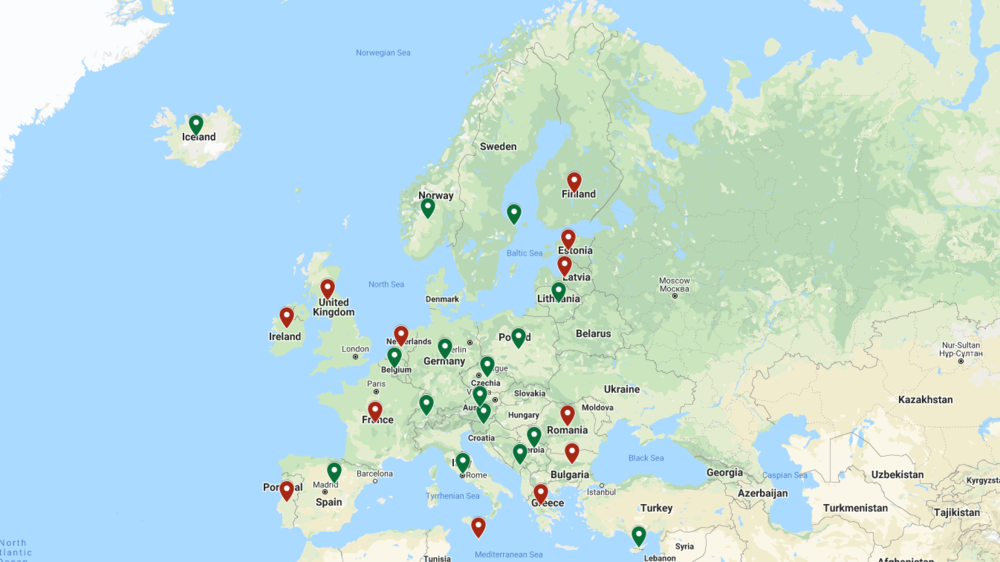
After getting an overview of the impact that COVID-19 has had on museums and how they are reacting to and coping with the pandemic, we are looking more closely at the re-opening of museums in Europe. With the help of our members, we hve created a map that gives a quick overview of European countries’ plans to re-open museums to the public. If managed well and if appropriate security and safety measures are adopted, there is no reason to keep museums closed.
Screen Walk with Roc Herms
Roc Herms will lead a tour of his favorite virtual worlds and share his practice of screenshot-based photo reportages. Viewers are given the opportunity to engage with the artist, learn about screenshotting techniques and discover alternative online spaces for social exchange and interaction.
webcare: From local solidarity networks to international ones?
All over Europe new working tools, ideas and support mechanisms of and for cultural initiatives have popped up during the past weeks. Some of them might be temporary, some might be here to stay. Some of them are developed by you, a lot of them by others. All of them try addressing our ‘new normal’. But how normal is this new situation?
We invite you to join our webcare sessions: Speaking in a community of care and with peers from all over Europe to exchange on new realities, share fears and dreams, listen to and support one another.
In this third webcare session we will together discuss if and how the newly formed grassroots solidarity movements might find an international equivalent?
Hosts Shelagh Wright and Peter Jenkinson are cultural change agents working locally andinternationally with activists in culture, development and progressive politics, including with Reshape, Laboratories of Care and Compass UK.
Zoomed In
Zoomed In is a new virtual festival celebrating photography and architecture.
The festival will take part from 21st-24th April 2020, and is one of the official partners of the Dezeen Virtual Design Festival.
Zoomed In is organised by London-based architectural photographer Luke O’Donovan, kindly supported by an incredibly generous network of guest curators and event participants. Please direct any enquiries to Luke at contact@lukeodonovan.co.uk
For updates on the festival, please check our Instagram, Twitter, and Youtube. You can also subscribe to Luke’s email newsletter below for updates on Zoomed In and other architectural photography projects.
Art and artificial intelligence
On April 23 New York-based artist Ellen Pearlman will give a public artist talk about the practices of working with artificial intelligence and its use in contemporary art. The event is organized in frames of the American Arts Incubator program.
Is there a place in human consciousness where surveillance cannot go? Can artificial intelligence be fascist? These are just some of the complex questions raised by the work of Dr. Ellen Pearlman in her brainwave and AI operas Noor and AIBO. In this artists presentation Ellen will show excerpts from both operas and highlight their technological breakthroughs. She will also present her work as Director of ThoughtWorks Arts – a global research and innovation lab at the forefront of new developments in emerging technologies that embraces the unique perspective artists can help foster to understand the implications and impacts technological developments have on society.
Dr. Ellen Pearlman is a New York based new media artist, critic, curator and educator. As a Zero1 American Arts Incubator/U.S. State Department artist she will be leading workshops in the Ukraine on artificial intelligence and art. A Fulbright World Learning Specialist in Art, New Media and Technology, she is a Senior Research Assistant Professor at RISEBA University in Riga, Latvia, and on faculty at Parsons/New School University in New York. Ellen received her PhD at the School of Creative Media, Hong Kong City University where her PhD thesis was awarded highest global honors by Leonardo LABS Abstracts.
The talk will be held online on IZOLYATSIA facebook page and ZOOM in English with simultaneous translation to Ukrainian.
ELIA Platform for Internationalisation (PIE)
As the majority of the universities and academies are closed, leaders and lecturers find themselves having to convert their courses to digital formats with immediate effect. During this one-hour conversation, we invite ELIA members to share their thoughts and experiences with their international colleagues. Guest speaker Dimitrios Vlachopoulos will explore the various implications of a speedy transition to teaching and learning online and look at practical ways arts educators can improve their practice for the future. We will also touch upon the social changes and societal challenges that COVID-19 has created for higher education in the arts, staff and students.
Dimitrios Vlachopoulos has a PhD in distance education and instructional technology. His research focuses on new and emerging pedagogies, instructional design, digital transformation, teachers’ training and quality assurance. He is a Senior Fellow of the Higher Education Academy (SFHEA) and Fellow of the Royal Society of Arts (FRSA) with over 80 publications in books and peer-reviewed journals. He is currently Program Manager with “EdTech for Social Change” at Amsterdam University of Applied Sciences.
During Virtual PIE, we encourage you to join us online and share your experiences and concerns regarding the impact of the coronavirus on your institution.Aparajita Dutta (Head of International Affairs at The Royal Academy of Art in The Hague and PIE Coordinator) outlines for us what are the main challenges that institutions are facing during this coronavirus crisis, particularly from the perspective of international offices.We will be looking at what is the impact that this situation has and will have on internationalisation.Maria Jaber (International Partnerships Head at NABA, Nuova Accademia di Belle Arti, Italy) presents the approach and the solutions that her institution has implemented to face the current situation, specifically looking at international students inquiries and showcasing the NABA Open Day Online.
These and many other questions are raising up these days:
* How should we deal with the current crisis?
* How should we ensure the wellbeing of students and staff?
* How can we run exams online?
* How can the PIE community help each other in this situation?
Our sector and members are under intense pressure at this point in time. Teaching has moved online, students and freelancers have lost part-time jobs, events, projects, performances, exams have been postponed or cancelled.
*Recent developments in response to COVID-19* *EU Emergency Measures* The EU is adopting various new measures to ensure the immediate release of funds to help member states deal with the effects of the current pandemic. Although the measures are general, we recognise that it is vital the cultural sector remains a priority within that framework. *Joint Letter initiated by Culture Action Europe* Earlier this month ELIA Executive Director Maria Hansen signed on behalf of the ELIA network, a joint letter initiated by Culture Action Europe. Sent to Commissioner Gabriel and Members of the Directorate General for Education, Youth, Sport and Culture (DG EAC), the letter contains a list of proposed ways to deal with the consequences of COVID-19 on Creative Europe and the European Cultural and Creative Sectors. Proposed support measures include: – Extension of eligibility period of Creative Europe projects that had to cancel or postpone events and other activities due to the crisis. – Eligibility for compensation of costs already made for planned events and projects that had to be cancelled. – Allowing physical events to be replaced with other formats and activities more suited to the current situation. – “Provide the possibility to apply for additional funding to mitigate losses and support the rescheduling of events where appropriate”.
*Response from Commissioner Mariya Gabriel* CAE received a swift response from Commissioner Gabriel. In her letter she outlines the following core points: – She agrees that there is a need to ‘urgently implement measures to mitigate the impact of COVID-19 amongst Creative Europe beneficiaries and beyond’ – The Commission and Croatian presidency of the Council are organising a summit of European Ministers of Culture to discuss these issues and how to move forward together. – DG EAC and EACEA are exploring extra flexibility measures regarding ongoing Creative Europe projects. These are good signs however ELIA will continue to campaign alongside others to ensure these good intentions are turned into practical measures. *Letter and Open Petition initiated by Green CULT MEPs signed by ELIA* Supported also by Culture Action Europe this letter demands immediate and unbureaucratic initiatives such as the following: – Offer financial aid to the Cultural and Creative Sectors and the whole cultural ecosystem, including through the Corona Response Investment Initiative, proportionally to the size of the CCS in our economy. – Ensure access to unemployment and other social benefits for all cultural professionals, with particular attention to freelancers, self-employed and others in atypical forms of work, including creators coming from cultural minorities, and grant them compensation for the discontinuation of income. – Provide emergency aid to cultural professionals, especially the independent ones, as well as to small and medium-sized cultural companies, for example in the form of tax relief, loans, (micro-)credits, compensation for losses and non-recoverable costs.
WATCH: Screen Walk with Alan Butler
Alan Butler led a tour of the game environment of Grand Theft Auto V, focusing on topics of representation and simulation as well as the role of the in-game photographer. Viewers were able to follow the artist in his critical analysis of the game logics, and their social, political, and economic implications.